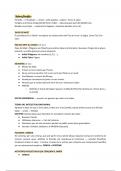
Wall Street Prep: Accounting Crash Course Study Guide 2023
What is Accounting? Accounting is the language of business; it is a standard set of rules for measuring a company's financial performance. Assessing a company's financial performance is important for: The firm's officers (managers and employees) Investors Lenders General public Standard financial statements serve as a "yardstick" of communicating financial performance to the general public. Why is Accounting Important? Enables managers to make corporate decisions Enables the general public to make investment decisions Who Uses Accounting? Used by a variety of organizations - from the federal government to non-profit organizations to small businesses to corporations We will discuss accounting rules as they pertain to publicly-traded companies Accounting Regulations Accounting attempts to standardize financial information and follows rules and regulations These rules are called Generally Accepted Accounting Principles (GAAP) In the US, the Securities and Exchange Commision (SEC) authorizes the Financial Accounting Standards Board (FASB) to determine accounting rules GAAP comes from the Statements of Financial Accounting Standards (SFAS) issued by the FASB An Overview of the SEC A US federal agency established by the US Congress in 1934 Primary mission is "to protect investors and maintain the integrity of the securities markets" Division of Corporate Finance oversees FASB An Overview of FASB Established in 1973 as an independent body to carry out the function of codifying accounting standards on the behalf of the SEC Composed of seven full-time members appointed for five years by the Financial Account Foundation (FAF) Decisions are influenced by: International Financial Reporting Standards (IFRS) Over 100 countries, including the EU, UK, Canada, Australia, and Russia, have adopted a unified set of international accounting standards (IFRS) Although we have seen unprecedented convergence over the last few years between US GAAP and IFRS, some differences remain Assumption 1: Accounting Entity A company is considered a separate "living" enterprise, apart from its owners In other words, a corporation is a "fictional" being Assumption 2: Going Concern A company is considered a "going concern" for the foreseeable future; it is assumed to remain in existence indefinitely Assumption 3: Measurement Financial statements can only show measurable activities of a corporation such as its quantifiable resources, its liability, amount of taxes it is facing, etc. Assumption 4: Periodicity Companies are required to file annual and interim reports In the US, quarterly and annual financial reports are required An accounting year (fiscal year) is frequently aligned with the calendar year Four Underlying Assumptions of Accounting (1) Accounting Entity (2) Going Concern (3) Measurement (4) Periodicity
Written for
- Institution
- Wall Street Prep
- Module
- Wall Street Prep
Document information
- Uploaded on
- July 25, 2023
- Number of pages
- 36
- Written in
- 2022/2023
- Type
- Exam (elaborations)
- Contains
- Questions & answers
Subjects
-
wall street prep accounting crash course study
-
wall street prep