
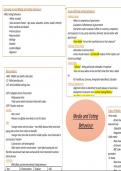
Concepts around Media and voting behaviour: Issues affecting voting behaviour:
-Affect voting behaviour: -Valence Issues
- Media- scandals
-Refers to competency of government
- Socio-economic factors – age, status, education, income, wealth, ethnicity
-Evaluation of effectiveness of government
-Party manifesto and leaders
-Key factors used to evaluate is effect on: economy, competency
-Pressure groups
and responses to crisis, party unanimity, dominant, decisive leader with
-Representation
good record
-Ideology
-Peter Kebler “not on their manifesto but on their character”
-Weather
-Rational choice theory
-Location/Region
-Alternative to valence theory
-Alignment
-Voters should conduct a cost-benefit analysis of their options and
choose accordingly
-Issue voting
- “Salience”- being particularly noticeable or important
Data analysis: - Place one issue above all else and that’s what their vote is based
-ABC1- Middle class (white collar jobs) on
-C2- Skilled working class -EG- healthcare, Economy, Immigration laws/Brexit, Education
-D/E- Semi/unskilled working class -Partisan Dealignment
-Alignment refers to attachment to party because of social class
1979- Callaghan winter of discontent -Dealignment is become more common (Swing/floaters)
-Widespread strike -Blair “We are all middle class”
-Trade unions which have been linked with Labour
1979- Thatcher took over
-Gender Types of Media I
-Not a trend
-Women are slightly more likely to vote for labour Media and Voting -Print media
-Broad shee
-Age
-Younger voters vote for Labour – most likely because they have lower Behaviour measured way
-Tabloid Me
paying jobs and are more reliant on benefits -Magazines
-Younger voter more like to vote for smaller parties- more interested in -Radio media
social justice, freedom -News head
-Cultural wars- anti-woke agenda -Commercia
-Older voters vote for conservatives – have higher paying jobs and -BBC radio-
therefore would want lower taxes and would be more interested in policies perception
about pension -TV media
-Ethnicity -News broa
-BME (Black and minority ethnic) Voting behaviour -Party politi
Year % Conservatives %Labour %LD
-Affect voting behaviour: -Valence Issues
- Media- scandals
-Refers to competency of government
- Socio-economic factors – age, status, education, income, wealth, ethnicity
-Evaluation of effectiveness of government
-Party manifesto and leaders
-Key factors used to evaluate is effect on: economy, competency
-Pressure groups
and responses to crisis, party unanimity, dominant, decisive leader with
-Representation
good record
-Ideology
-Peter Kebler “not on their manifesto but on their character”
-Weather
-Rational choice theory
-Location/Region
-Alternative to valence theory
-Alignment
-Voters should conduct a cost-benefit analysis of their options and
choose accordingly
-Issue voting
- “Salience”- being particularly noticeable or important
Data analysis: - Place one issue above all else and that’s what their vote is based
-ABC1- Middle class (white collar jobs) on
-C2- Skilled working class -EG- healthcare, Economy, Immigration laws/Brexit, Education
-D/E- Semi/unskilled working class -Partisan Dealignment
-Alignment refers to attachment to party because of social class
1979- Callaghan winter of discontent -Dealignment is become more common (Swing/floaters)
-Widespread strike -Blair “We are all middle class”
-Trade unions which have been linked with Labour
1979- Thatcher took over
-Gender Types of Media I
-Not a trend
-Women are slightly more likely to vote for labour Media and Voting -Print media
-Broad shee
-Age
-Younger voters vote for Labour – most likely because they have lower Behaviour measured way
-Tabloid Me
paying jobs and are more reliant on benefits -Magazines
-Younger voter more like to vote for smaller parties- more interested in -Radio media
social justice, freedom -News head
-Cultural wars- anti-woke agenda -Commercia
-Older voters vote for conservatives – have higher paying jobs and -BBC radio-
therefore would want lower taxes and would be more interested in policies perception
about pension -TV media
-Ethnicity -News broa
-BME (Black and minority ethnic) Voting behaviour -Party politi
Year % Conservatives %Labour %LD


