

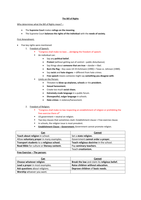
The Bill of Rights
Who determines what the Bill of Rights mean? –
The Supreme Court makes rulings on the meaning.
The Supreme Court balances the rights of the individual with the needs of society.
First Amendment:
Five key rights were mentioned:
1. Freedom of Speech:
“Congress shall make no laws … abridging the freedom of speech.
An individual can:
Say any political belief.
Protest (without getting out of control – public disturbance).
Say things about someone that are true – slander + libel.
Burn the flag – Key cases US VS Eichmann (1990) + Texas vs. Johnson (1989).
Say racist and hate slogans -> different from hate crimes.
Free speech means someone might say something you disagree with.
Limits on the Person:
Threaten to blow up airplanes, schools or the president.
Sexual harassment.
Create too much social chaos.
Extremely crude language in a public forum.
Disrespectful, vulgar language in schools.
Hate crimes -> violence/harassment.
2. Freedom of Religion:
“Congress shall make no law respecting an establishment of religion or prohibiting the
free exercise there of”
US government = neutral on religion.
Two key clauses that sometimes clash: Establishment clause + Free exercise clause.
In schools, the religion issue is most prevalent.
Establishment Clause – Government: Government cannot promote religion.
Can Cannot
Teach about religion in school. Set a state religion.
Allow voluntary prayer in many examples. Government cannot order a prayer.
Transport students to a religious school. Teach religious doctrine in the school.
Read Bible for culture or literacy content. Pay seminary teachers.
Teach creationism.
Free Exercise – The person:
Can Cannot
Choose whatever religion. Break the law and claim its religious belief.
Lead a prayer in most examples. Raise children without education.
Ask questions about religions. Deprave children of basic needs.
Worship whoever you want.
Who determines what the Bill of Rights mean? –
The Supreme Court makes rulings on the meaning.
The Supreme Court balances the rights of the individual with the needs of society.
First Amendment:
Five key rights were mentioned:
1. Freedom of Speech:
“Congress shall make no laws … abridging the freedom of speech.
An individual can:
Say any political belief.
Protest (without getting out of control – public disturbance).
Say things about someone that are true – slander + libel.
Burn the flag – Key cases US VS Eichmann (1990) + Texas vs. Johnson (1989).
Say racist and hate slogans -> different from hate crimes.
Free speech means someone might say something you disagree with.
Limits on the Person:
Threaten to blow up airplanes, schools or the president.
Sexual harassment.
Create too much social chaos.
Extremely crude language in a public forum.
Disrespectful, vulgar language in schools.
Hate crimes -> violence/harassment.
2. Freedom of Religion:
“Congress shall make no law respecting an establishment of religion or prohibiting the
free exercise there of”
US government = neutral on religion.
Two key clauses that sometimes clash: Establishment clause + Free exercise clause.
In schools, the religion issue is most prevalent.
Establishment Clause – Government: Government cannot promote religion.
Can Cannot
Teach about religion in school. Set a state religion.
Allow voluntary prayer in many examples. Government cannot order a prayer.
Transport students to a religious school. Teach religious doctrine in the school.
Read Bible for culture or literacy content. Pay seminary teachers.
Teach creationism.
Free Exercise – The person:
Can Cannot
Choose whatever religion. Break the law and claim its religious belief.
Lead a prayer in most examples. Raise children without education.
Ask questions about religions. Deprave children of basic needs.
Worship whoever you want.


