
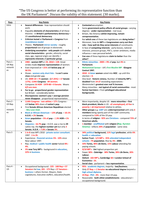
"The US Congress is better at performing its representative function than
the UK Parliament". Discuss the validity of this statement. (30 marks).
Para Key Points Key Points
Intro Several differences - how representation should Contested assumption.
work. Some government policy effects all social groups - varying
Arguably elements of characteristics of all these degrees - under representation - real issue.
theories - in Britain's parliamentary democracy + Britain, like America whilst improving, remain
US constitutional democracy. unrepresentative.
Criticism levied at Parliament + Congress from But which one of these two legislatures are doing better?
resemblance model. Moreover, how do MP's + Congressmen carry out their
Theory - Parliament mirror society - roughly role + how well do they serve interests of constituents.
proportional size of groups in electorate. In face of competing interests - party bosses, national
Underlying assumption - only people with similar interests, pressure groups, PAC's, career ambitions, media
social characteristics - gender, ethnicity, social influence + own personal beliefs.
class, age, regional origin can identify + Can one of these legislatures claim to better than the
represents interests of particular group. other?
Para 1 - 1983 - women MP's = 23. 2010 = 139. Great Ethnic minorities - 2005 = 9% of pop. but 4% in
UK Rep. strides made improve representation of women. Parliament.
minoriti Even improved at = 21% still below pop. of Mohammad Sarwar - UK's first Muslim MP - Glasgow
es 50.5%. Central 1997.
Shows - women only short lists - haven't came 2010 - 6 Asian women voted into HOC - up until this
close end gender gap. election = 0.
US: 2009-10 = 75 women - (17.25%) + 17 Senate One level - historic victory. Number of minority MP's -
(17%). 114th Congress - 84 women. doubled from 14-27 exceeding expectations -
Compares 16 HOR - 1979-80 + 0 Senate. Means Westminster's greatest ever real % increase.
4/5 are men. Many minorities - not typical of racial communities - most
Far to go - proportional gender representation former barristers + from privileged educational
but Britain - considerably better. backgrounds.
Discrepancies: women's pay + average pension
never disappear - proportional representation.
Para 2 - 114th Congress - non whites = 17% Congress - More importantly, despite US - more minorities + first
US Rep. still below 38% share of nation's pop. black president, blacks in US - x2 unemployed, x3 live in
- First female African American Republican elected poverty + x6 imprisoned relative to whites.
minoriti - Mia Love Utah. Other groups e.g. LGBT are underrepresented with only 6
es Black or African-American – 13% of pop. – 10.1% members being openly part of the LGBT community
H.O.R. + 2% Senate. compared to 3.8% of the US pop.
Asian population – 5% of pop – 2.3% HOR + 1% In terms of religion - 92% are Christians - compared 73% of
Senate. American adults.
Hispanics - 16.7% pop – H.O.R. saw a rise to 29 1 member - unaffiliated with religion (Rep. Kyrsten
Latino rep. the highest number yet but only 3 Sinema)- reflects 20% of population - same view.
Senate. H.O.R. – 7.8% + Senate 3%.
Para 3 1 in 8 new MP's 2010 - private sector consultant. 34% political background, 11% legal profession, while 6%
1997 - 1 in 25. health or education.
Experience - financial services 5% - 10% since Sutton Trust - 1/3 MP's - 35% attended independent
New Labour 1997. schools - 7% population. Rise by 3% - 2005.
Rep. medical + public health sector halved 8% - 54% Tories, 40% Lib Dems, 15% Labour attending fee
4%. paying schools.
3% new Tory MP's - background in education, 9/10 MP's - Uni highest proportion yet.
22% in business. Fewer 30% - Oxbridge - 38% Tories, 28% Lib Dems, 20%
Labour.
Oxford - 102 MP's, Cambridge 58 + London School of
Economics - 25.
Social class - parliament = less representative.
Para 4 - Occupational background - 225 - 168 Rep + 57 95% - academic degrees, majority - law/business.
US Senators list law, 201 - 175 Rep + 27 Senators - Only 27 Rep. + 1 Senator no educational degree beyond a
business + others former, Mayors, State high school diploma.
Legislatures, Executive staffers, education/health. 23 Rep - PhD - 4% - more than US pop.
Reasonable - both elitist establishments - educational +
occupational background.
the UK Parliament". Discuss the validity of this statement. (30 marks).
Para Key Points Key Points
Intro Several differences - how representation should Contested assumption.
work. Some government policy effects all social groups - varying
Arguably elements of characteristics of all these degrees - under representation - real issue.
theories - in Britain's parliamentary democracy + Britain, like America whilst improving, remain
US constitutional democracy. unrepresentative.
Criticism levied at Parliament + Congress from But which one of these two legislatures are doing better?
resemblance model. Moreover, how do MP's + Congressmen carry out their
Theory - Parliament mirror society - roughly role + how well do they serve interests of constituents.
proportional size of groups in electorate. In face of competing interests - party bosses, national
Underlying assumption - only people with similar interests, pressure groups, PAC's, career ambitions, media
social characteristics - gender, ethnicity, social influence + own personal beliefs.
class, age, regional origin can identify + Can one of these legislatures claim to better than the
represents interests of particular group. other?
Para 1 - 1983 - women MP's = 23. 2010 = 139. Great Ethnic minorities - 2005 = 9% of pop. but 4% in
UK Rep. strides made improve representation of women. Parliament.
minoriti Even improved at = 21% still below pop. of Mohammad Sarwar - UK's first Muslim MP - Glasgow
es 50.5%. Central 1997.
Shows - women only short lists - haven't came 2010 - 6 Asian women voted into HOC - up until this
close end gender gap. election = 0.
US: 2009-10 = 75 women - (17.25%) + 17 Senate One level - historic victory. Number of minority MP's -
(17%). 114th Congress - 84 women. doubled from 14-27 exceeding expectations -
Compares 16 HOR - 1979-80 + 0 Senate. Means Westminster's greatest ever real % increase.
4/5 are men. Many minorities - not typical of racial communities - most
Far to go - proportional gender representation former barristers + from privileged educational
but Britain - considerably better. backgrounds.
Discrepancies: women's pay + average pension
never disappear - proportional representation.
Para 2 - 114th Congress - non whites = 17% Congress - More importantly, despite US - more minorities + first
US Rep. still below 38% share of nation's pop. black president, blacks in US - x2 unemployed, x3 live in
- First female African American Republican elected poverty + x6 imprisoned relative to whites.
minoriti - Mia Love Utah. Other groups e.g. LGBT are underrepresented with only 6
es Black or African-American – 13% of pop. – 10.1% members being openly part of the LGBT community
H.O.R. + 2% Senate. compared to 3.8% of the US pop.
Asian population – 5% of pop – 2.3% HOR + 1% In terms of religion - 92% are Christians - compared 73% of
Senate. American adults.
Hispanics - 16.7% pop – H.O.R. saw a rise to 29 1 member - unaffiliated with religion (Rep. Kyrsten
Latino rep. the highest number yet but only 3 Sinema)- reflects 20% of population - same view.
Senate. H.O.R. – 7.8% + Senate 3%.
Para 3 1 in 8 new MP's 2010 - private sector consultant. 34% political background, 11% legal profession, while 6%
1997 - 1 in 25. health or education.
Experience - financial services 5% - 10% since Sutton Trust - 1/3 MP's - 35% attended independent
New Labour 1997. schools - 7% population. Rise by 3% - 2005.
Rep. medical + public health sector halved 8% - 54% Tories, 40% Lib Dems, 15% Labour attending fee
4%. paying schools.
3% new Tory MP's - background in education, 9/10 MP's - Uni highest proportion yet.
22% in business. Fewer 30% - Oxbridge - 38% Tories, 28% Lib Dems, 20%
Labour.
Oxford - 102 MP's, Cambridge 58 + London School of
Economics - 25.
Social class - parliament = less representative.
Para 4 - Occupational background - 225 - 168 Rep + 57 95% - academic degrees, majority - law/business.
US Senators list law, 201 - 175 Rep + 27 Senators - Only 27 Rep. + 1 Senator no educational degree beyond a
business + others former, Mayors, State high school diploma.
Legislatures, Executive staffers, education/health. 23 Rep - PhD - 4% - more than US pop.
Reasonable - both elitist establishments - educational +
occupational background.


