WGU C779 WEB DEVELOPMENT FOUNDATIONS|UPDATED&VERIFIED|100% SOLVED|GUARANTEED SUCCESS
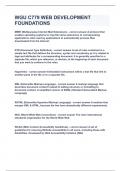
MIME (Multipurpose Internet Mail Extensions) A protocol that enables operating systems to map file name extensions to corresponding applications. Also used by applications to automatically process files downloaded from the internet. DTD (Document Type Definition) A set of rules contained in a simple text file that defines the structure, syntax and vocabulary as it is related to tags and attributes for a corresponding document. It is generally specified in a separate file, which you reference, or declare, at the beginning of each document that you want to conform to the rules. Hyperlinks Embedded instructions within a text file that link to another point in the file or to a separate file. XML (Extensible Markup Language) A markup language that describes document content instead of adding structure or formatting to document content. A simplified version of SGML (Standard Generalized Markup Language) XHTML (Extensible Hypertext Markup Language) A medium that merges XML & HTML, because the two have dramatically different requirements. W3C (World Wide Web Consortium) The main international standards organization for the World Wide Web WCAG (Web Content Accessibility Guidelines) A set of guidelines for ensuring Website accessibility to all users, including those with disabilities. Developed by Web Accessibility Initiative (WAI) HTML The traditional authoring language used to develop Webpages for many applications CSS (Cascading Style Sheets) A technology that allows greater style definition and formatting control of HTML elements. Formatting can be placed within the HTML or called remotely from an external style sheet. JavaScript Scripting language that provides dynamic, interactive capabilities to Webpages. user agent Any application, such as a Web browser, mobile phone, smartphone or help engine, that renders HTML for display to users. Section 508 of the Rehabilitation Act Requires Federal agencies to provide accommodation for users with disabilities. Wireframing The process of developing an outline for a Web presence Trade Secret Intellectual property that must remain private for a company to retain viability. Examples include proprietary code, business plans and sales contacts. Copyright The legal ownership of expression by an author. According to most developed countries, copyrighted intellectual property becomes the property of the author for a certain number of years. Copyright protection ensures that the person or group who owns the copyright has the right to publish or otherwise distribute material, and control how it is redistributed. In most countries, a copyright can be sold by its owner. Trademark A unique word, phrase or symbol that is claimed or officially registered by an organization with the government. Trademarks can include logos, phrases, company names and so forth. If a logo, word or phrase is trademarked, then only the organization that registered it can use it. Licensing The legal authorized use of another person's or entity's copyrighted intellectual property. The terms of the license are generally dictated by the copyright holder. Licenses require contracts and usually an exchange of money, service, or both. Infringement Any violation of a copyright or trademark. Copyright and trademark infringement are punishable crimes. Plagiarism A specific instance of infringement in which an individual or entity claims to have created content (e.g., images, writing or other exact expression) that was in fact created by other developers. Proven plagiarism can result in severe reprimands, loss of employment, corporate lawsuits and financial penalties. Cloud Computing Software, infrastructure and platform services that are hosted by a remote data center and provided to an organization or individuals over the internet. GUI (Graphical User Interface) A program that provides visual navigation with menus and screen icons, and performs automated functions when users click command buttons. Markup language A series of commands used to format, organize and describe information on a Webpage Metalanguage A language used for defining other languages On the fly Dynamically created Webpage content, as opposed to pre-defined, static content. SaaS (Software as a Service) Software that is hosted centrally on the internet and accessed by users with a Web Browser SGML (Standard Generalized Markup Language) A metalanguage used to create other languages, including HTML and XHTML Trouble ticket A record of a problem related to a service provider by an ISP or cloud service provider. Used to record receipt of a complaint and track resolution of the problem. Storyboard A document that describes the purpose and intended audience for a Website, and provides a rough outline of the pages needed. Co-location hosting solution Service provider that allocates space for your equipment but does not provide the server hardware. HTML 4.01 Transitional allowed developers to insert formatting using either CSS or traditional layout instructions HTML 4.01 Strict required the exclusive use of CSS when defining layout instructions HTML 4.01 Frameset Required for pages that used HTML frames, which placed Web pages inside each other to create separate panes in the browser window. ADA (Americans with Disabilities Act) Enacted to protect the civil rights of people with disabilities. Includes mandates that electronic information be accessible to all people. The HTML Web Development "Trifecta" HTML5, CSS, Javascript GUI HTML Editor Have not kept pace with the evolution of HTML, and do not provide options for more recent markup standards. However, many of these allow you to modify your HTML code manually. If you know HTML, you can maximize the benefit of these programs by adding code. Dedicated hosting (or co-hosting) The service provider gives you access to a dedicated server that it owns virtual server One Web server contains your site and several other sites ERP (Enterprise Resource Planning) Is the ability to automate the planning and operations of an entire organization. This automation might include hiring, termination, manufacturing and marketing. It is a server typically provided by a cloud service provider. Container tags tags that come in pairs. Container tags use starting and ending tags. For example, when you want emphasis (italic) text, you will contain the text between starting and ending em /em tags. These tags are also called the opening and closing tags.
Written for
- Institution
- WGU C779 WEB DEVELOPMENT FOUNDATIONS
- Course
- WGU C779 WEB DEVELOPMENT FOUNDATIONS
Document information
- Uploaded on
- July 22, 2023
- Number of pages
- 16
- Written in
- 2022/2023
- Type
- Exam (elaborations)
- Contains
- Questions & answers
Subjects
-
wgu c779 web development foundations|updatedampverif

Also available in package deal