

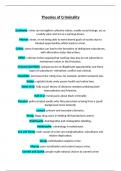
Theories of Criminality
Durkheim: crime can strengthen collective values, enable social change, act as
a safety valve and act as a warning device.
Merton: strain, or not being able to meet shared goals of society due to
blocked opportunities which leads to crime.
Cohen: status frustration can lead to the formation of delinquent subcultures,
with alternative status hierarchies.
Miller: criticises Cohen arguing that working class boy do not subscribe to
mainstream values in the first place.
Cloward and Ohlin: unequal access to illegitimate opportunities and three
types of subcultures- retreatism, conflict and criminal.
Chambliss: law favours the ruling class, for example, protects property law.
Snider: capitalist state rarely passes health and safety laws.
Taylor et al: ‘fully social’ theory of deviance needed combining both
interactionism and Marxism.
Hall et al: moral panic about black criminality
Cicourel: police treated youths who they perceived as being from a ‘good’
background more leniently.
Lemert: primary and secondary deviance.
Young: hippy drug users in Notting Hill had deviant careers.
Braithwaite: disintegrative and reintegrative labelling.
Heidensohn: criminology is malestream.
Lea and Young: main causes of crime are marginalisation, subcultures and
relative deprivation.
Young: individualism explains crime.
Murray: poor socialisation and control causes crime.
Cornish and Clarke: people make rational choices to commit crime
Durkheim: crime can strengthen collective values, enable social change, act as
a safety valve and act as a warning device.
Merton: strain, or not being able to meet shared goals of society due to
blocked opportunities which leads to crime.
Cohen: status frustration can lead to the formation of delinquent subcultures,
with alternative status hierarchies.
Miller: criticises Cohen arguing that working class boy do not subscribe to
mainstream values in the first place.
Cloward and Ohlin: unequal access to illegitimate opportunities and three
types of subcultures- retreatism, conflict and criminal.
Chambliss: law favours the ruling class, for example, protects property law.
Snider: capitalist state rarely passes health and safety laws.
Taylor et al: ‘fully social’ theory of deviance needed combining both
interactionism and Marxism.
Hall et al: moral panic about black criminality
Cicourel: police treated youths who they perceived as being from a ‘good’
background more leniently.
Lemert: primary and secondary deviance.
Young: hippy drug users in Notting Hill had deviant careers.
Braithwaite: disintegrative and reintegrative labelling.
Heidensohn: criminology is malestream.
Lea and Young: main causes of crime are marginalisation, subcultures and
relative deprivation.
Young: individualism explains crime.
Murray: poor socialisation and control causes crime.
Cornish and Clarke: people make rational choices to commit crime


