
WGU Educational Psychology Exam Question With 100% Verified AnswersWGU Educational Psychology Exam Question With 100% Verified Answers
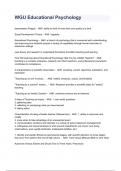
WGU Educational Psychology Exam Question With 100% Verified Answers decentration (Piaget) - ANS ability to think of more than one quality at a time Social Development Theory - ANS Vygotsky Educational Psychology - ANS a branch of psychology that is concerned with understanding and improving how students acquire a variety of capabilities through formal instruction in classroom settings. uses theory and research to understand the factors that affect teaching and learning How Will Learning about Educational Psychology Help You be a Better Teacher? - ANS teaching is a complex enterprise, research can inform teachers, and professional coursework contributes to competence 5 characteristics of scientific observation - ANS sampling, control, objectivity, publication, and replication "Teaching as an art" involves... - ANS beliefs, emotions, values, and flexibility "Teaching as a science" means... - ANS Research provides a scientific basis for "artistic" teaching "Teaching as an Artistic Scholar" - ANS combines science and art theories 4 steps of Teaching as Inquiry - ANS 1: ask useful questions 2: gathering data 3: reflecting on (analyzing) what you have learned 4: taking action Characteristics of being a flexible teacher (Wasserman) - ANS 1. ability to improvise and modify 2. know when to take advantage of an unexpected event 3. communication emotions and interests in a variety of ways (classroom management) 4. willingness and resourcefulness to work around impediments not of your own doing (interruptions, poor-quality textbooks, inadequate facilities, etc.) 1. Identify and explain Erikson's psychosocial stages, with specific attention on those stages that occur from preK to the end of high school. - ANS Trust Versus Mistrust (Birth to One Year) Autonomy Versus Shame and Doubt (Two to Three Years; Preschool) Initiative Versus Guilt (Four to Five Years; Preschool to Kindergarten) Industry Versus Inferiority (Six to Eleven Years; Elementary to Middle School) Identity Versus Role Confusion (Twelve to Eighteen Years; Middle Through High School) Intimacy Versus Isolation (Young Adulthood) Generativity Versus Stagnation (Middle Age) Integrity Versus Despair (Old Age) 2. Identify at least 3 strategies to help students develop a sense of industry (you may also refer to chapter 13, and don't forget to read the "Suggestions for Teaching!"). - ANS Set them up to be successful! *base grades on realistic and attainable standards that are worked out ahead of time and communicated to the students *providing clear expectations as to what students should be able to do after a unit of instruction *designing lessons that are logical and meaningful *using teaching methods that support effective learning processes 3. Explain Marcia's 4 identity statuses. - ANS 1. identity diffusion crisis: not yet commitment: weak Not self-directed; disorganized, impulsive, low self-esteem, alienated from parents; avoids getting involved in schoolwork and interpersonal relationships.
Document information
- Uploaded on
- July 21, 2023
- Number of pages
- 22
- Written in
- 2022/2023
- Type
- Exam (elaborations)
- Contains
- Questions & answers


