
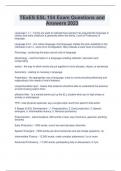
TExES ESL 154 Exam Questions and Answers 2023
Language 1 L1 - Terms are used to indicate that a person has acquired the language in infancy and early childhooh & generally within the family. Level of Proficiency in language. Language 2 L2 - non-native language, 2nd language) implies the prior aailability to the individual of an L1, some form of biligualism. May indicate a lower level of proficiency. Phonology - producing the basic sound units of language Morphology - word formation in a language including inflection, derivation and compunding syntax - the way in which words are put together to form phrases, clause, or sentences Semantics - relating to menaing in language Pragmatics - the appropriate use of language; rules for communicating effectively and responding to the needs of one's listeners. comprehensible input - means that students should be able to understand the essence of what is being said to them affective filter - Is a mental barrier put up the ELL student when put in high stress or anxiety or embrassess TPR - total physical repsonse; say a single action word then perform that action 5 Stages of ESL Development - 1. Preproduction, 2. Early production, 3. Speech emergent, 4. Intermediate fluency, 5. Advance proficiency Preproduction - silent/receptive, 500 words or less; use of pictures, gestures, pointing; 6months Early Production - 1000 words, one & two word phrases; 6months Speech Emergent - 7000 words,use short sentences and ask simple questions, 1yr Intermediate Fluency - 12,000 words, make complex statements, 1yr or more Advanced Proficiency - 17,000 words, participating fully in discussions, 5-7yrs Cognitive Processes - memorization, categorization, generalization, & metacognition Bloom's Taxonomy - Knowledge Comprehension Application Analysis Synthesis Evaluation cognates - word that have a common etymological origion Idioms - Don't use them; "start from scratch" "when the cat is away, the mouse will play" ESL Fundatmental Language Concepts - 1. Increase compreshensibility, 2. Encourage Interations, 3. Thinking & Study Skills, 4. Use of Native language to increase comprehension ESL Teaching methods - Lingusitic Instruction, Sheltered English, Reciprocal Teaching Lingusitic Instruction - must include initiating frequent interaction with English-specaking peers and materials for L1 & L2 Sheltered English - is an instruction in English understandable to ESL students. Use physical activities, visual aids Reciprocal Teaching - refers to an instructional activity that takes place in the form of a dialogue between teachers and students regarding the segment of the text. Structure by 4 strategies: summarizing, question generating, clarifying, and predicting Content based ESL Instruction - applies knowledge of effective practices, resources, and materials for providing engaging students in critical thinking ESL Interrelatedness - Listening, Speaking, Reading, & Writing is learn concurrently BICS - Basic Interpersonal Communicatin Skills; language skills needed in social situations, day to day lang., playground, lunchroom, school bus, parties, etc; not very cognitively demanding CALP - Cognitive Academic Language Proficiency; refers to formal academic learning; reading, listening, speaking, writing about subject area content; cognitively demanding SIOP - Sheltered Instruction Observation Protocol LPAC - Language Proficience Assessment Committe Bloom - Higher order thinking, engaging students in critical thinking Cummins - CALP, cognitive academic language proficiency
Document information
- Uploaded on
- July 20, 2023
- Number of pages
- 5
- Written in
- 2022/2023
- Type
- Exam (elaborations)
- Contains
- Questions & answers


