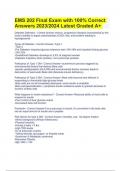
EMS 202 Final Exam Questions With Correct Answers 2023/2024 Latest Graded A+
EMS 202 Final Exam Questions With Correct Answers 2023/2024 Latest Graded A+. Preventing Type 2 DM - Correct Answer--periodic screening (FBS, TRG) -committed screening if you have a family hx -exercise -avoid concentrated glucose sources in mass quantities Diagnosing DM - Correct Answer-1. FBS or equal to 126 on at least two different occasions 2. Random or casual glucose 200 3. Oral Glucose Tolerance Test (results outlined below) Oral Glucose Tolerance Test Results - Correct Answer-2 hr post prandial BG 140 = normal 2 hr post prandial BG 140-199 = prediabetes 2 hr post prandial BG 200 or greater = Diabetes S&S of Hypoglycemia ( 70) - Correct Answer-nervousness/anxiousness sweating shaking/tremors irritability tachycardia headache confusion/drowsiness slurred speech blurred vision coma seizure death S&S of Hyperglycemia (250) - Correct Answer-Elevated BG Increased appetite followed by lack of appetite N/V Dry/Flushed Skin Kussmaul's Respirations Frequent urination Increased thirst Blurred vision Fatigue Headache Fruity-smelling breath Nausea and vomiting Shortness of breath Dry mouth Weakness Confusion Coma Abdominal pain The Liver and Hyperglycemia - Correct Answer--The liver plays a role in CHO metabolism. This includes storing and releasing glycogen as the body needs it -Glycogen turns into glucose (glycogenolysis) -If liver glucose is not available, fats and proteins will be broken down and used for fuel Ketones - Correct Answer--substance that is produced when fat is used instead of glucose for cellular energy -They collect in the blood and can decrease the pH, leading to metabolic acidosis (Diabetic Ketoacidosis) What happens when insulin is deficient? - Correct Answer--When insulin is deficient, fats break down releasing fatty acids. These acids convert to ketone bodies and provide a backup energy source Protein as Fuel in DM - Correct Answer--Protein from muscle can also be used as fuel -Increased glucose levels lead to protein wasting as the body turns to muscle for energy. Kidney excretion of protein is called, proteinuria How the kidneys respond to high BG - Correct Answer--high blood glucose levels will be excreted via the kidneys in the urine (glycosuria) -kidneys will also excrete ketones in the urine when the BG level reaches about 300. This is called ketonuria Insulin for Type 1 and Type 2 Diabetes - Correct Answer-Type 1-The pt MUST take insulin Type 2-involves lifestyle adjustment (initially), oral meds, and may involve eventual use of insulin or all three at some point in the disease process (DO NOT necessarily need insulin) Insulin - Correct Answer--chemically made by recombinant DNA technology (Human insulin) -various durations of action (rapid, short, intermediate, long acting) Insulin--Rapid Acting - Correct Answer-Humalog (lispro), Novolog (aspart) O: 5 minutes P: 1 hour D: 2-4 hours *Administer immediately before eating 3 P's (Hyperglycemia) - Correct Answer--Polyphagia -Polydipsia -Polyuria Insulin--Short Acting - Correct Answer-Humulin R, Novolin R O: 30 mins to 2 hours P: 4-10 hours D: 10-16 hours *Administer 30 minutes before eating Insulin--Intermediate - Correct Answer-Humulin (NPH), Humulin L (Lente) O: 2-4 hours P: 4-10 hours D: 10-16 hours *2/3 in the morning, 1/3 in the afternoon. Start at 1/2 a unit/kg/day Insulin--Intermediate Mixed - Correct Answer-Humulin 70/30 (70% intermediate, 30% regular) O: 1/2-1 hour P: Dual D: 10-16 *Administer 30 mins before breakfast and dinner Negative Feedback System in DM - Correct Answer--Low glucose tells pancreas to release glucagon from Alpha cells, which stimulates the liver to release glucose High glucose tells beta cells to release insulin, which lowers BG Insulin--Long Acting (Basal) - Correct Answer-Levemir (Detemir), Lantus (Glargine) O: 3-4 hours P: 3-14 hours (Detemir) No peak (Lantus) D: 24 hours *Administer usually once daily at same time, never mix with other insulins! Administration of Insulin - Correct Answer--When mixing insulins, put air in intermediate insulin vial first, then push air into rapid/regular insulin and withdraw rapid/regular first (fast first) *never mix any insulin with Lantus/Levemir *regular insulin can also be given intravenously Oral Meds: Sulfonylureas --1st generation - Correct Answer-Orinase (tolbutamide) Diabenese (chlorpropamide) Dymelor (acetohexamide) Tolinase (tolazamide) Action: these increase insulin secretion Avoid Alcohol--may create disulfram-like reaction. Symptoms are flushing, headache, sweating, slurred speech, and possible death Oral Meds: Sulfonylureas --2nd generation - Correct Answer-Glucotrol (Glipizide) Micronase (Glyburide) Amaryl (Glimiperide) Action: these increase insulin secretion *Give 30 minutes before meals, 1-3 times/day. Look for S&S of hypoglycemia Oral Meds: Biguanides - Correct Answer-Example: Metformin (Glucophage) Action: decrease hepatic production of glucose, increase sensitivity to insulin *Take with food 1-2 times/day Not used in patients with CHF Look for signs of lactic acidosis GI symptoms can occur (n/v/d) *Only used in Type 2 Diabetes, also in PCOD *Generally held if NPO, held for scans involving contrast dye until kidney function is normal again Oral Meds: Meglitinide Analogues - Correct Answer-Prandin (Repaglimide) Starlix (Nataglimide) Action: increase insulin secretion, prevent increase in post meal blood glucose *Administer 1-30 minutes prior to meal Oral Meds: Alpha Glucosidase Inhibitors - Correct Answer-Precose (Acarbose) Glyset (Migitol) Action: prevent post meal increase in BG *Administer with first bite of each main meal Monitor LFTs, renal function Oral Meds: Thiazolidinediones (TZDs) - Correct Answer-Actos (Pioglitizone) *Action: Improve tissue sensitivity to insulin Monitor LFTs, may reduce effectiveness of oral contraceptives Sub Q: Amylin Analogues - Correct Answer-Symlin (Pramlintide) (Type 1 or 2) Action: decreases gastric emptying, decreases post meal BG, triggers satiety in the brain, which leads to weightloss and decreased calorie consumption *Administer SubQ before a meal S/Es: n/v/anorexia Risk of hypoglycemia Pen Injection: Increntin Mimetics - Correct Answer-Byetta (Exenitide), Victoza (Liraglutide) -This drug is similar to the natural gut hormone, GLP-1 (Glucoagon-like peptide) that responds to food intake Action: lower glycogen secreion from the pancreas. Stimulates release of insulin S/Es: nausea Pen injector: take within 60 minutes of morning or afternoon meal DPP-IV Inhibitors--Januvia (Sitagliptin) - Correct Answer-Action: increase increntin hormone levels (released by the intestine, regulate glucose homeostasis) DPP-IV Inhibitor--Onglyza (Saxagliptin) - Correct Answer-Adjunctive use with metormin, glyburide, or a TZD Action: lowers A1C by reducing fasting and post prandial glucose with Type 2 Diabetes Can be given PO, taken once daily Exercise Benefits - Correct Answer--emphasize importance -consult MD before staring Benefits: -increase insulin sensitivity-reducing BG levels -decreases risk of CV disease -decreases blood lipid levels -decreases BP -decreases body weight Precautions for Exercise - Correct Answer--If BG 100, eat 15-30 grams of CHO -Stay adequately hydrated -Carry a carb snack (simple sugar) -Wear ID bracelet -If BG 250, wait to exercise. Vigorous exercise can increase BG levels by releasing stored glycogen Unplanned Exercise - Correct Answer--can lead to dangerously low BG levels -potential for hypoglycemia exists due to increased muscle uptake of glucose -can occur up to 24 hours after exercising U-500 Insulin - Correct Answer-**Must have another nurse verify dosing and administration **5x the concentration of regular insulin Safety Considerations During Exercise, Type 1/2 - Correct Answer--avoid if BG 80 or 250 -avoid if ketones in urine, ketones indicate that current insulin levels aren't adequate, exercise will then increase BG -no exercise for 1 hour after taking insulin or at insulin peak -risk for hypoglycemia -patient may need to reduce dosage of insulin, will need to check with MD When to Self-Test (Types 1 and 2) - Correct Answer--usually before breakfast -may do 2-4 times per day until BG levels are controlled -when ill -when having symptoms of hypoglycemia -before and after exercise -when new meds are started -when pregnant Traditional BG Monitoring - Correct Answer--often referred to as CBS, gluc checks, fingersticks or accuchecks, BGMs Purpose: to monitor BG levels and track effectiveness of therapy (meds, diet, exercise) Insulin Pumps - Correct Answer--newer pumps have a skin sensor that monitors BG and transmits the result via an external pump and then injects the appropriate number of units of insulin -pump holds approx. 3 days supply of insulin -also known as CSII (Continuous subcutaneous insulin infusion) Evaluating Insulin Control - Correct Answer-A1C 6.5 (ADA recommended) BG level should be: -no higher than 180, 1-2 hours after meals -at bedtime between 100-140
Document information
- Uploaded on
- July 17, 2023
- Number of pages
- 32
- Written in
- 2022/2023
- Type
- Exam (elaborations)
- Contains
- Questions & answers