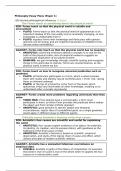
Philosophy Essay Plans (Paper 1)
(1A) Ancient philosophical influences (4 plans)
The Forms teach us something about the physical world
FOR- Forms teach us that the physical world is volatile and
inconsistent
PLATO: Forms teach us that the physical world of appearances is an
imperfect shadow of the true reality and is constantly changing, so true
knowledge is unattainable from it
PLATO: equates Forms with knowledge and Particulars with opinion:
opinions can be wrong, and are imperfect facsimiles of infallible Forms
(proves sense unreliability)
AGAINST- Forms only teach us that the physical world has no meaning
ARISTOTLE: examining irrelevant abstract concepts is no use for the
truth of the physical realm; lack of empirical evidence suggests an
unnecessary duplication of our physical world
DAWKINS: we gain knowledge through scientific testing and recognise
things in this world due to memes; Forms are counterintuitive, as the
physical world is where we live
FOR- Forms teach us how to recognise universal predicates such as
goodness
PLATO: all Particulars participate in a Form, which is what provides
them with reality and identity (eg all red Particulars = Form ‘red,’ giving
them an inherent redness)
PLATO: at the top of a hierarchy is the Form of the Good, which
epitomises virtue and illuminates all other knowledge, enabling us to
understand other concepts (eg beauty)
AGAINST- Forms create more problems regarding universals than they
solve
THIRD MAN: if two objects have a commonality, a form must
participate in them, so which Form provides the predicate which makes
the object and Form similar (infinite regress)?
ARISTOTLE: good pertains to specific spatial and temporal
circumstances; rejects idea of a predefined good, as a single goodness
would apply in different ways to different agents
Critically assess Aristotle’s doctrine of the four causes
FOR- Aristotle’s four causes are scientific and useful for explaining
the world
ARISTOTLE: four causes explain existence of an object: its materials,
its identity, its creation, and its purpose (telos), with goodness as the
fulfilment of the final cause or telos
ARISTOTLE: Aristotle’s doctrine is based on scientific, empirical
observation, and study of the logical chain of cause and effect, which
utilises principles of modern scientific method
AGAINST- Aristotle has a somewhat fallacious overreliance on
empirical data
RUSSELL: Aristotle is guilty of the fallacy of composition; he assumes
that what is true of a part is true of the whole when he applies the four
causes on a macrocosmic scale
, KIERKEGAARD: Aristotle limits himself by excluding the possibility of
spiritual or intuitive knowledge in favour of scientific demonstration:
some things require a ‘leap of faith’
FOR- Aristotle’s Prime Mover and universal telos is a compelling view
of creation
ARISTOTLE: all matter exists in a state of perpetual flux, with one
efficient cause and one final cause, which he thought to be the Prime
Mover, a being which actualizes all potential
ARISTOTLE: all things desire to be in the image of God’s perfection, so
they are attracted towards it: love and desire for the Prime Mover is
therefore the telos of all movement
AGAINST- Aristotle’s doctrine of the Prime Mover is flawed
UNCLEAR: does not explain what catalysed the beginning of the
universe or where the constituent matter in the universe came from if
the Prime Mover is necessarily ignorant
CAMUS: the universe requires no explanation, cause and effect may be
an eternal chain or simply result from blind chance: a Prime Mover is an
unnecessary variable (Occam’s razor)
Critically compare Plato’s Form of the Good and Aristotle’s Prime
Mover
FOR- the PM and Form are similar as they both heavily influenced
Christian thought
EXISTENCE: both produce existence: Form of Good is at the apex of a
hierarchy that illuminates all other Forms and the Prime Mover is the
original uncaused cause
JUDEO-CHRISTIAN: both influenced Christian view of God as an
omnipotent, transcendent, permanent, unchanging, moral paradigm and
uncaused cause; unlike the physical world
AGAINST- the Form cannot contemplate and both have differing
abilities
MENTAL: the Form of Good is not a being and lacks a mind and the
capacity for conscious thought, but the Prime Mover contemplates itself
so is somewhat more of an entity
PHYSICAL: the Form of Good is entirely passive: exemplifies quality
without activity but the Prime Mover actively draws things towards it by
forces of attraction, creating movement
FOR- the PM and Form invoke similar ideas of necessary yet
impersonal beings
NECESSARY: both have an independent, necessary, perfect existence;
neither depends on anything else (PM could not as this would
compromise its state of pure actuality)
IMPERSONAL: both are uninterested in moral affairs of humanity
(transcendent) as Form of Good has no mind and Prime Mover is pure
actuality so cannot interact with the world
AGAINST- the PM and Form have different relationships with
knowledge and morality
MORALITY: the Form of Good is pure, sole goodness and source of
morality, but the Prime Mover is occupied with motion, cause, and
, change, and is not related to morality
KNOWLEDGE: the Form of Good can be encountered by the soul after
death and learnt about spiritually, but the Prime Mover cannot be learnt
about after death as not dualistic
Aristotle’s understanding of the world is more convincing than
that of Plato
FOR- Plato’s theory of Forms is a convincing understanding of reality
PLATO: all Particulars participate in a Form, which is what provides
them with reality and identity despite the changeability of the physical
world (eg all red Particulars = Form ‘red’)
RATIONAL: Plato’s argument from innate knowledge (uneducated Slave
boy in Meno performing arithmetic) is logically cogent and compelling,
senses can be deceitful
AGAINST- Plato’s theory has significant flaws which threaten its
cohesiveness
ARISTOTLE: Forms could exist, but within the material world, as ideal
Forms make no sense without corresponding Particulars (eg what is
beauty without a beautiful object?)
DAWKINS: Forms are counterintuitive, as the physical world is where
we live; lack of empirical evidence suggests they are an unnecessary
duplication of our physical world
FOR- Aristotle’s four causes framework is a convincing understanding
of reality
ARISTOTLE: Aristotle’s doctrine is based on scientific, empirical
observation, and study of the logical chain of cause and effect, allowing
him to construct universal predicates
EMPIRICAL: plausible because it does not veer into the abstract and
intangible, using modern principles of scientific method to offer
evidence-centric philosophical answers
AGAINST- Aristotle’s empiricism has some problems in application
HUME: inductive empirical reason can never be 100% certain: Aristotle
affirms the consequent when he assumes that cause and effect are a
constant, not coincidental link
CAMUS: life has no objective purpose; it makes no sense to talk about
the telos of the universe: it just exists, without any reason or goal, as a
by-product of a chance encounter
(1B) Soul, mind, and body (4 plans)
Materialism is a convincing approach to matters of body and soul
FOR- materialism is a rational and scientific view of the soul
ARISTOTLE: soul is an inherent part of the matter and structure of all
living things that cannot be separated from them (eg if an axe had a
soul, it would be its capacity to chop)
DAWKINS: consciousness cannot be separated from the brain, as it is
only neurochemical processes that cannot survive bodily death; the soul
is simply a myth (survival machines)
AGAINST- materialism seems much less plausible than dualism in a
religious context
PLATO: soul is the immortal life-giving essence of a person, which
(1A) Ancient philosophical influences (4 plans)
The Forms teach us something about the physical world
FOR- Forms teach us that the physical world is volatile and
inconsistent
PLATO: Forms teach us that the physical world of appearances is an
imperfect shadow of the true reality and is constantly changing, so true
knowledge is unattainable from it
PLATO: equates Forms with knowledge and Particulars with opinion:
opinions can be wrong, and are imperfect facsimiles of infallible Forms
(proves sense unreliability)
AGAINST- Forms only teach us that the physical world has no meaning
ARISTOTLE: examining irrelevant abstract concepts is no use for the
truth of the physical realm; lack of empirical evidence suggests an
unnecessary duplication of our physical world
DAWKINS: we gain knowledge through scientific testing and recognise
things in this world due to memes; Forms are counterintuitive, as the
physical world is where we live
FOR- Forms teach us how to recognise universal predicates such as
goodness
PLATO: all Particulars participate in a Form, which is what provides
them with reality and identity (eg all red Particulars = Form ‘red,’ giving
them an inherent redness)
PLATO: at the top of a hierarchy is the Form of the Good, which
epitomises virtue and illuminates all other knowledge, enabling us to
understand other concepts (eg beauty)
AGAINST- Forms create more problems regarding universals than they
solve
THIRD MAN: if two objects have a commonality, a form must
participate in them, so which Form provides the predicate which makes
the object and Form similar (infinite regress)?
ARISTOTLE: good pertains to specific spatial and temporal
circumstances; rejects idea of a predefined good, as a single goodness
would apply in different ways to different agents
Critically assess Aristotle’s doctrine of the four causes
FOR- Aristotle’s four causes are scientific and useful for explaining
the world
ARISTOTLE: four causes explain existence of an object: its materials,
its identity, its creation, and its purpose (telos), with goodness as the
fulfilment of the final cause or telos
ARISTOTLE: Aristotle’s doctrine is based on scientific, empirical
observation, and study of the logical chain of cause and effect, which
utilises principles of modern scientific method
AGAINST- Aristotle has a somewhat fallacious overreliance on
empirical data
RUSSELL: Aristotle is guilty of the fallacy of composition; he assumes
that what is true of a part is true of the whole when he applies the four
causes on a macrocosmic scale
, KIERKEGAARD: Aristotle limits himself by excluding the possibility of
spiritual or intuitive knowledge in favour of scientific demonstration:
some things require a ‘leap of faith’
FOR- Aristotle’s Prime Mover and universal telos is a compelling view
of creation
ARISTOTLE: all matter exists in a state of perpetual flux, with one
efficient cause and one final cause, which he thought to be the Prime
Mover, a being which actualizes all potential
ARISTOTLE: all things desire to be in the image of God’s perfection, so
they are attracted towards it: love and desire for the Prime Mover is
therefore the telos of all movement
AGAINST- Aristotle’s doctrine of the Prime Mover is flawed
UNCLEAR: does not explain what catalysed the beginning of the
universe or where the constituent matter in the universe came from if
the Prime Mover is necessarily ignorant
CAMUS: the universe requires no explanation, cause and effect may be
an eternal chain or simply result from blind chance: a Prime Mover is an
unnecessary variable (Occam’s razor)
Critically compare Plato’s Form of the Good and Aristotle’s Prime
Mover
FOR- the PM and Form are similar as they both heavily influenced
Christian thought
EXISTENCE: both produce existence: Form of Good is at the apex of a
hierarchy that illuminates all other Forms and the Prime Mover is the
original uncaused cause
JUDEO-CHRISTIAN: both influenced Christian view of God as an
omnipotent, transcendent, permanent, unchanging, moral paradigm and
uncaused cause; unlike the physical world
AGAINST- the Form cannot contemplate and both have differing
abilities
MENTAL: the Form of Good is not a being and lacks a mind and the
capacity for conscious thought, but the Prime Mover contemplates itself
so is somewhat more of an entity
PHYSICAL: the Form of Good is entirely passive: exemplifies quality
without activity but the Prime Mover actively draws things towards it by
forces of attraction, creating movement
FOR- the PM and Form invoke similar ideas of necessary yet
impersonal beings
NECESSARY: both have an independent, necessary, perfect existence;
neither depends on anything else (PM could not as this would
compromise its state of pure actuality)
IMPERSONAL: both are uninterested in moral affairs of humanity
(transcendent) as Form of Good has no mind and Prime Mover is pure
actuality so cannot interact with the world
AGAINST- the PM and Form have different relationships with
knowledge and morality
MORALITY: the Form of Good is pure, sole goodness and source of
morality, but the Prime Mover is occupied with motion, cause, and
, change, and is not related to morality
KNOWLEDGE: the Form of Good can be encountered by the soul after
death and learnt about spiritually, but the Prime Mover cannot be learnt
about after death as not dualistic
Aristotle’s understanding of the world is more convincing than
that of Plato
FOR- Plato’s theory of Forms is a convincing understanding of reality
PLATO: all Particulars participate in a Form, which is what provides
them with reality and identity despite the changeability of the physical
world (eg all red Particulars = Form ‘red’)
RATIONAL: Plato’s argument from innate knowledge (uneducated Slave
boy in Meno performing arithmetic) is logically cogent and compelling,
senses can be deceitful
AGAINST- Plato’s theory has significant flaws which threaten its
cohesiveness
ARISTOTLE: Forms could exist, but within the material world, as ideal
Forms make no sense without corresponding Particulars (eg what is
beauty without a beautiful object?)
DAWKINS: Forms are counterintuitive, as the physical world is where
we live; lack of empirical evidence suggests they are an unnecessary
duplication of our physical world
FOR- Aristotle’s four causes framework is a convincing understanding
of reality
ARISTOTLE: Aristotle’s doctrine is based on scientific, empirical
observation, and study of the logical chain of cause and effect, allowing
him to construct universal predicates
EMPIRICAL: plausible because it does not veer into the abstract and
intangible, using modern principles of scientific method to offer
evidence-centric philosophical answers
AGAINST- Aristotle’s empiricism has some problems in application
HUME: inductive empirical reason can never be 100% certain: Aristotle
affirms the consequent when he assumes that cause and effect are a
constant, not coincidental link
CAMUS: life has no objective purpose; it makes no sense to talk about
the telos of the universe: it just exists, without any reason or goal, as a
by-product of a chance encounter
(1B) Soul, mind, and body (4 plans)
Materialism is a convincing approach to matters of body and soul
FOR- materialism is a rational and scientific view of the soul
ARISTOTLE: soul is an inherent part of the matter and structure of all
living things that cannot be separated from them (eg if an axe had a
soul, it would be its capacity to chop)
DAWKINS: consciousness cannot be separated from the brain, as it is
only neurochemical processes that cannot survive bodily death; the soul
is simply a myth (survival machines)
AGAINST- materialism seems much less plausible than dualism in a
religious context
PLATO: soul is the immortal life-giving essence of a person, which