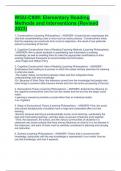
WGU-C909: Elementary Reading Methods and Interventions (Revised 2023)
1. Constructivism (Learning Philosophies): - ANSWER--Constructivism emphasizes the idea that comprehending a text is very much an active process. -Constructivism holds that the meaning one constructs from a text is subjective—the result of one particular person's processing of the text. 2. Cognitive-Constructivist View of Reading-Teaching Methods (Learning Philosophies): - ANSWER--Aim to assist students in assimilating new information to existing knowledge, as well as enabling them to make the appropriate modifications to their existing intellectual framework to accommodate that information. -Jean Piaget and William Perry 3. Cognitive-Constructivist View of Reading (Learning Philosophies): - ANSWER--Emphasizes that reading is a process in which the reader actively searches for meaning in what she reads. -The reader makes connections between ideas and then integrates these understandings with prior knowledge -Ex: Because of Winn-Dixie,-the inference comes from her knowledge that people who have things in common often become friends and from her active processing of the text. 4. Sociocultural Theory (Learning Philosophies): - ANSWER--Extends the influence on the cognitive-constructivist view out from the reader and the text into the larger social realm. -Learning is viewed as primarily a social rather than an individual matter. -Lev Vygotsky 5. Steps of Sociocultural Theory (Learning Philosophies): - ANSWER--First, the social and cultural backgrounds of students have a huge and undeniable effect on their learning. -Second, because learning is quintessentially social, much learning—particularly the best and most lasting learning—will take place as groups of learners work together. -Third, the classroom, the school, and the various communities of students in a classroom are social contexts that have strong influences on what is or is not learned in the classroom, and each of them must be carefully considered in planning and carrying out instruction. 6. Schema (Learning Philosophies): - ANSWER--Theory that is concerned with knowledge, particularly with the way knowledge is represented in our minds, how we use that knowledge, and how it expands. 7. Reader Response Theory (Learning Philosophies): - ANSWER--Puts a good deal of emphasis on the reader, stressing that the meaning one gains from text is the result of a transaction between the reader and the text and that readers will have a range of responses to literary works. -Many literary texts simply do not have a single correct interpretation, and readers should be allowed and encouraged to construct a variety of interpretations—if they can support them. -Louise Rosenblatt 8. The three phases of the construction-integration process (Learning Philosophies): - ANSWER-(1.) Construction (2.) Integration (3.) Metacognition 9. Construction (Construction-Integration Process-Learning Philosophies): Phase 1: - ANSWER--In the construction phase, a reader uses knowledge of vocabulary and syntax to make meaning. 10. Integration (Construction-Integration Process-Learning Philosophies): Phase 2: - ANSWER--Integrates words and sentences by linking previous information using cohesive ties to create a textbase. 11. Metacognition (Construction-Integration Process-Learning Philosophies): Phase 3: - ANSWER--A reader employs metacognition to monitor his processes to ensure the meaning makes sense. If it doesn't, the reader employs strategies to fix comprehension. 12. Define Metacognition as it Applies to Reading (Learning Philosophies): - ANSWER--Metacognition is the process of reflecting on one's reading strategies while reading to monitor comprehension. -A metacognitive reader is able to articulate the strategies he uses to comprehend. He is also able to recognize when meaning breaks down and employ strategies to fix comprehension. 13. Oral Language Development (Stages of Development): - ANSWER--The complex system that relates sounds to meanings, is made up of three components: the phonological, semantic, and syntactic. 14. How Oral Language Supports Vocabulary Development (Stages of Development): - ANSWER--Reading and talking with children plays an important role in developing their vocabulary. -The more you read to children, the larger vocabulary they will develop. 15. Phonological Component (Oral Language Dev.-Stages of Development): - ANSWER--Involves the rules for combining sounds. -We are not aware of our knowledge of these rules, but our ability to understand and pronounce English words demonstrates that we do know a vast number of rules.
Geschreven voor
- Instelling
- WGU-C909
- Vak
- WGU-C909
Documentinformatie
- Geüpload op
- 8 juli 2023
- Aantal pagina's
- 22
- Geschreven in
- 2022/2023
- Type
- Tentamen (uitwerkingen)
- Bevat
- Vragen en antwoorden
Onderwerpen
- wgu c909
-
wgu c909 elementary reading methods
-
1 constructivism learning philosophies
-
2 cognitive constructivist view of reading teachi

Ook beschikbaar in voordeelbundel