

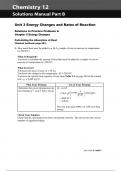
Unit 3 Energy Changes and Rates of Reaction
Solutions to Practice Problems in
Chapter 5 Energy Changes
Calculating the Absorption of Heat
(Student textbook page 281)
1. How much heat must be added to a 36.2 g sample of iron to increase its temperature
by 250.0ºC?
What Is Required?
You have to calculate the amount of heat that must be added to a sample of iron to
increase its temperature by 250.0ºC.
What Is Given?
You know the mass of iron: m = 36.2 g
You know the change in the temperature: ∆T = 250.0°C
You have the specific heat capacity of iron from Table 5.1 on page 280 of the student
text: cFe = 0.449 J/g•°C
Plan Your Strategy Act on Your Strategy
Substitute the given information into Q mcT
the formula Q = mc∆T. Solve for Q. J
(36.2 g ) 0.449 (250.0 C )
g • C
4063.45 J
4.06 kJ
The iron must gain 4060 J or 4.06 kJ of heat
energy.
Check Your Solution
Check that the information has been substituted correctly. The answer has the correct
number of significant digits.
Unit 3 Part B ● MHR 1
,2. How much heat must be added to 128.62 g of steam at 126.0ºC to increase its
temperature to 189.5ºC?
What Is Required?
You must determine the amount of heat that must be added to a sample of steam to
increase its temperature from 126.0ºC to 189.5ºC.
What Is Given?
You know the mass of steam: m = 128.62 g
You know the initial temperature: Tinitial = 126.0°C
You know the final temperature: Tfinal = 189.5°C
You have the specific heat capacity of steam from Table 5.1 on page 280 of the
student textbook: cH O(g) = 2.02 J/g•°C
2
Plan Your Strategy Act on Your Strategy
Determine the temperature change of T Tfinal Tinitial
the steam. 189.5C 126.0C
63.5C
Use the formula Q = mc∆T to Q mcT
calculate the quantity of heat. J
(128.6 g ) 2.02 (63.5 C )
g • C
16 495.5 J
16.5 kJ
The steam must gain 16500 J or 16.5 kJ of
heat energy.
Check Your Solution
Check that the information has been substituted correctly. The answer has the correct
number of significant digits.
2 MHR ● Chemistry 12 Solutions Manual 978-0-07-106042-4
,3. A 1.00 × 10² g sample of ethanol at 25.0°C is heated until it reaches 50.0°C. How
much thermal energy does the ethanol gain?
What Is Required?
You must calculate the thermal energy gained by a sample of ethanol.
What Is Given?
You know the mass of ethanol: m = 1.00 × 10² g
You know the initial temperature: Tinitial = 25.0°C
You know the final temperature: Tfinal = 50.0°C
You have the specific heat capacity of ethanol from Table 5.1 on page 280 of the
student textbook: cethanol = 2.44 J/g•°C
Plan Your Strategy Act on Your Strategy
Determine the temperature change of T Tfinal Tinitial
the ethanol. 50.0C 25.0C
25.0C
Use the formula Q = mc∆T to calculate Q mcT
the quantity of heat gained. J
(1102 g ) 2.44 (25.0 C )
g • C
6.10 103 J
6.10 kJ
The ethanol gains 6.10 × 10³ J or 6.10 kJ
of heat energy.
Check Your Solution
Check that the information has been substituted correctly. The answer has the correct
number of significant digits.
Unit 3 Part B ● MHR 3
, 4. Beaker A contains 50 g of liquid at room temperature. The beaker is heated until the
liquid increases in temperature by 10°C. Beaker B contains 100 g of the same liquid at
room temperature. The beaker is also heated until the liquid increases in temperature
by 10°C. In which beaker does the liquid absorb more heat? Explain your answer.
What Is Required?
You must compare the heat absorbed by two samples of the same liquid.
What Is Given?
You know the mass of sample A is 50 g and that the mass of sample B is 100 g. Both
liquids increase in temperature by 10°C.
Plan Your Strategy Act on Your Strategy
Use the formula Q = mc∆T to compare The liquid in beaker B absorbs twice as
the quantities of heat gained. much heat because it has twice the mass.
QA mA cT
(50 g)cT
QB mBcT
(100 g)cT
2 50 g cT
2 QA
Therefore, QB = 2QA.
Check Your Solution
The answer is reasonable since Q and m are directly related in the equation Q = mc∆T.
4 MHR ● Chemistry 12 Solutions Manual 978-0-07-106042-4
Solutions to Practice Problems in
Chapter 5 Energy Changes
Calculating the Absorption of Heat
(Student textbook page 281)
1. How much heat must be added to a 36.2 g sample of iron to increase its temperature
by 250.0ºC?
What Is Required?
You have to calculate the amount of heat that must be added to a sample of iron to
increase its temperature by 250.0ºC.
What Is Given?
You know the mass of iron: m = 36.2 g
You know the change in the temperature: ∆T = 250.0°C
You have the specific heat capacity of iron from Table 5.1 on page 280 of the student
text: cFe = 0.449 J/g•°C
Plan Your Strategy Act on Your Strategy
Substitute the given information into Q mcT
the formula Q = mc∆T. Solve for Q. J
(36.2 g ) 0.449 (250.0 C )
g • C
4063.45 J
4.06 kJ
The iron must gain 4060 J or 4.06 kJ of heat
energy.
Check Your Solution
Check that the information has been substituted correctly. The answer has the correct
number of significant digits.
Unit 3 Part B ● MHR 1
,2. How much heat must be added to 128.62 g of steam at 126.0ºC to increase its
temperature to 189.5ºC?
What Is Required?
You must determine the amount of heat that must be added to a sample of steam to
increase its temperature from 126.0ºC to 189.5ºC.
What Is Given?
You know the mass of steam: m = 128.62 g
You know the initial temperature: Tinitial = 126.0°C
You know the final temperature: Tfinal = 189.5°C
You have the specific heat capacity of steam from Table 5.1 on page 280 of the
student textbook: cH O(g) = 2.02 J/g•°C
2
Plan Your Strategy Act on Your Strategy
Determine the temperature change of T Tfinal Tinitial
the steam. 189.5C 126.0C
63.5C
Use the formula Q = mc∆T to Q mcT
calculate the quantity of heat. J
(128.6 g ) 2.02 (63.5 C )
g • C
16 495.5 J
16.5 kJ
The steam must gain 16500 J or 16.5 kJ of
heat energy.
Check Your Solution
Check that the information has been substituted correctly. The answer has the correct
number of significant digits.
2 MHR ● Chemistry 12 Solutions Manual 978-0-07-106042-4
,3. A 1.00 × 10² g sample of ethanol at 25.0°C is heated until it reaches 50.0°C. How
much thermal energy does the ethanol gain?
What Is Required?
You must calculate the thermal energy gained by a sample of ethanol.
What Is Given?
You know the mass of ethanol: m = 1.00 × 10² g
You know the initial temperature: Tinitial = 25.0°C
You know the final temperature: Tfinal = 50.0°C
You have the specific heat capacity of ethanol from Table 5.1 on page 280 of the
student textbook: cethanol = 2.44 J/g•°C
Plan Your Strategy Act on Your Strategy
Determine the temperature change of T Tfinal Tinitial
the ethanol. 50.0C 25.0C
25.0C
Use the formula Q = mc∆T to calculate Q mcT
the quantity of heat gained. J
(1102 g ) 2.44 (25.0 C )
g • C
6.10 103 J
6.10 kJ
The ethanol gains 6.10 × 10³ J or 6.10 kJ
of heat energy.
Check Your Solution
Check that the information has been substituted correctly. The answer has the correct
number of significant digits.
Unit 3 Part B ● MHR 3
, 4. Beaker A contains 50 g of liquid at room temperature. The beaker is heated until the
liquid increases in temperature by 10°C. Beaker B contains 100 g of the same liquid at
room temperature. The beaker is also heated until the liquid increases in temperature
by 10°C. In which beaker does the liquid absorb more heat? Explain your answer.
What Is Required?
You must compare the heat absorbed by two samples of the same liquid.
What Is Given?
You know the mass of sample A is 50 g and that the mass of sample B is 100 g. Both
liquids increase in temperature by 10°C.
Plan Your Strategy Act on Your Strategy
Use the formula Q = mc∆T to compare The liquid in beaker B absorbs twice as
the quantities of heat gained. much heat because it has twice the mass.
QA mA cT
(50 g)cT
QB mBcT
(100 g)cT
2 50 g cT
2 QA
Therefore, QB = 2QA.
Check Your Solution
The answer is reasonable since Q and m are directly related in the equation Q = mc∆T.
4 MHR ● Chemistry 12 Solutions Manual 978-0-07-106042-4



