

100% tevredenheidsgarantie Direct beschikbaar na je betaling Lees online óf als PDF Geen vaste maandelijkse kosten 4.2 TrustPilot
logo-home
Tentamen (uitwerkingen)

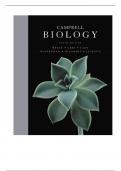
Test bank Campbell Biology (11th Revised Edition) Textbook

Beoordeling
4.0
(1)
Verkocht
5
Pagina's
1244
Cijfer
A+
Geüpload op
06-07-2023
Geschreven in
2022/2023

Campbell Biology, 11e (Urry) Chapter 1 Evolution, the Themes of Biology, and Scientific Inquiry 1.1 Multiple-Choice Questions 1) Cells are . A) only found in pairs, because single cells cannot exist independently B) limited in size to 200 and 500 micrometers in diameter C) characteristic of eukaryotic but not prokaryotic organisms D) characteristic of prokaryotic and eukaryotic organisms Answer: D Bloom's Taxonomy: Knowledge/Comprehension Section: 1.1 2) In comparison to eukaryotes, prokaryotes . A) are more structurally complex B) are larger C) are smaller D) do not have membranes Answer: C Bloom's Taxonomy: Knowledge/Comprehension Section: 1.1 3) Which of the following types of cells utilize deoxyribonucleic acid (DNA) as their genetic material but do not have their DNA encased within a nuclear envelope? A) animal B) plant C) archaean D) fungi Answer: C Bloom's Taxonomy: Application/Analysis Section: 1.1 4) To understand the chemical basis of inheritance, we must understand the molecular structure of DNA. This is an example of the application of which concept to the study of biology? A) evolution B) emergent properties C) reductionism D) feedback regulation Answer: C Bloom's Taxonomy: Application/Analysis Section: 1.1 5) A localized group of organisms that belong to the same species is called a . A) community B) population C) ecosystem D) family Answer: B Bloom's Taxonomy: Knowledge/Comprehension Section: 1.1 6) Which of the following statements is true regarding the complexity of biological systems? A) An understanding of the interactions between different components within a living system is an approach towards understanding reductionism. B) Knowing the function of a component of a living system can provide insights into the structure and organization of the living system. C) Understanding the chemical structure of DNA reveals how it directs the functioning of a living cell. D) An ecosystem displays complex properties of the biotic component only. Answer: B Bloom's Taxonomy: Application/Analysis Section: 1.1 7) Which of the following order is correct in terms of the hierarchy of the organization? A) Ecosystem → Biosphere → Population → Community → Organism B) Biosphere → Ecosystem → Population → Community → Organism C) Ecosystem → Community → Biosphere → Population → Organism D) Biosphere → Ecosystem →Community → Population → Organism Answer: D Bloom's Taxonomy: Application/Analysis Section: 1.1 8) When your body temperature rises on a hot day, the neural and hormonal mechanisms activate sweating. Evaporation of sweat leads to cooling of the body surface. This is an example of . A) positive feedback regulation B) negative feedback regulation C) chemical cycling D) emergent properties Answer: B Bloom's Taxonomy: Application/Analysis Section: 1.1 9) Characters are transmitted from parents to offspring. are the units of inheritance. A) Genes B) Proteins C) RNA D) DNA Answer: A Bloom's Taxonomy: Knowledge/Comprehension Section: 1.1 10) As letters are to English language, is/are to genetic information. A) proteins B) nucleotides C) DNA double helix D) A and B Answer: B Bloom's Taxonomy: Knowledge/Comprehension Section: 1.1 11) The process by which the information in a gene directs the synthesis of a protein is called . A) gene expression B) replication C) post translation modification D) cloning Answer: A Bloom's Taxonomy: Application/Analysis Section: 1.2 12) Which of the following statements is true? A) mRNA is the only type of RNA found in the living system B) All forms of life employ the same genetic code C) A typical human liver cell has one set of chromosomes D) Organisms interact but do not affect their environment Answer: B Bloom's Taxonomy: Knowledge/Comprehension Section: 1.2 13) Plants convert . A) chemical energy to mechanical energy. B) sunlight to mechanical energy. C) sunlight to chemical energy. D) mechanical energy to chemical energy. Answer: C Bloom's Taxonomy: Knowledge/Comprehension Section: 1.2 14) Which of these provides evidence of the common ancestry of all life? A) near universality of the genetic code B) structure of the nucleus C) structure of cilia D) structure of chloroplasts Answer: A Bloom's Taxonomy: Application/Analysis Section: 1.2 15) Which branch of biology is concerned with the naming and classifying of organisms? A) informatics B) taxonomy C) genomics D) evolution Answer: B Bloom's Taxonomy: Knowledge/Comprehension Section: 1.2 16) Use the following figure to answer the question. The phylogenetic tree . A) depicts that Archaea is closer to Bacteria than Eukarya B) depicts that Eukarya is closer to Bacteria than Archaea C) includes unicellular and some forms of multicellular life, but not complex animals and plants D) includes every single life form on this earth Answer: D Bloom's Taxonomy: Application/Analysis Section: 1.2 17) Use the following figure to answer the question. "A" is ; "B" is . A) the most recent species to evolve on Earth; an ancestor of group "A" B) the most recent species to evolve on Earth; the last common ancestor of Archaea and Eukarya C) the common ancestor of all life; the common ancestor of Bacteria and Archaea D) the common ancestor of all life; the last common ancestor of Archaea and Eukarya Answer: D Bloom's Taxonomy: Application/Analysis Section: 1.2 18) You are suffering from Streptococcus throat infection. You share the following with the bacteria that is responsible for your condition. A) You both belong to the same domain. B) You both are made up of cells. C) You both have genetic material in your nucleus. D) You and Streptococcus have nothing in common. Answer: B Bloom's Taxonomy: Application/Analysis Section: 1.2 19) Which of the following is true of natural selection? A) It requires genetic variation. B) It results in descent with modification. C) It involves differential reproductive success. D) It requires genetic variation, results in descent with modification, and involves differential reproductive success. Answer: D Bloom's Taxonomy: Knowledge/Comprehension Section: 1.2 20) Which of the following is not one of Charles Darwin's observations? A) Individuals in a population vary in their traits. B) Many of the traits in an individual are heritable. C) A population avoids competition by producing only as many offspring as can successfully reproduce on their own. D) Species generally are adapted to their environments. Answer: C Bloom's Taxonomy: Knowledge/Comprehension Section: 1.2 21) The evolution of one species into two or more species as a result of different populations becoming reproductively isolated from each other is best termed as . A) adaptive radiation B) creationism C) natural selection D) prototype Answer: A Bloom's Taxonomy: Knowledge/Comprehension Section: 1.2

Meer zien Lees minder


Oeps! We kunnen je document nu niet laden. Probeer het nog eens of neem contact op met support.

Documentinformatie

Geüpload op
6 juli 2023
Aantal pagina's
1244
Geschreven in
2022/2023
Type
Tentamen (uitwerkingen)
Bevat
Vragen en antwoorden

Onderwerpen

Voorbeeld van de inhoud

,Test Bank

,Campbell Biology, 11e (Urry)
Chapter 1 Evolution, the Themes of Biology, and Scientific Inquiry

1.1 Multiple-Choice Questions

1) Cells are .
A) only found in pairs, because single cells cannot exist independently
B) limited in size to 200 and 500 micrometers in diameter
C) characteristic of eukaryotic but not prokaryotic organisms
D) characteristic of prokaryotic and eukaryotic organisms
Answer: D
Bloom's Taxonomy: Knowledge/Comprehension
Section: 1.1

2) In comparison to eukaryotes, prokaryotes .
A) are more structurally complex
B) are larger
C) are smaller
D) do not have membranes
Answer: C
Bloom's Taxonomy: Knowledge/Comprehension
Section: 1.1

3) Which of the following types of cells utilize deoxyribonucleic acid (DNA) as their genetic
material but do not have their DNA encased within a nuclear envelope?
A) animal
B) plant
C) archaean
D) fungi
Answer: C
Bloom's Taxonomy: Application/Analysis
Section: 1.1

4) To understand the chemical basis of inheritance, we must understand the molecular structure
of DNA. This is an example of the application of which concept to the study of biology?
A) evolution
B) emergent properties
C) reductionism
D) feedback regulation
Answer: C
Bloom's Taxonomy: Application/Analysis
Section: 1.1


1
Copyright © 2017 Pearson Education, Inc.

, 5) A localized group of organisms that belong to the same species is called a .
A) community
B) population
C) ecosystem
D) family
Answer: B
Bloom's Taxonomy: Knowledge/Comprehension
Section: 1.1

6) Which of the following statements is true regarding the complexity of biological systems?
A) An understanding of the interactions between different components within a living system is
an approach towards understanding reductionism.
B) Knowing the function of a component of a living system can provide insights into the
structure and organization of the living system.
C) Understanding the chemical structure of DNA reveals how it directs the functioning of a
living cell.
D) An ecosystem displays complex properties of the biotic component only.
Answer: B
Bloom's Taxonomy: Application/Analysis
Section: 1.1

7) Which of the following order is correct in terms of the hierarchy of the organization?
A) Ecosystem → Biosphere → Population → Community → Organism
B) Biosphere → Ecosystem → Population → Community → Organism
C) Ecosystem → Community → Biosphere → Population → Organism
D) Biosphere → Ecosystem →Community → Population → Organism
Answer: D
Bloom's Taxonomy: Application/Analysis
Section: 1.1

8) When your body temperature rises on a hot day, the neural and hormonal mechanisms activate
sweating. Evaporation of sweat leads to cooling of the body surface. This is an example of
.
A) positive feedback regulation
B) negative feedback regulation
C) chemical cycling
D) emergent properties
Answer: B
Bloom's Taxonomy: Application/Analysis
Section: 1.1


2
Copyright © 2017 Pearson Education, Inc.

Beoordelingen van geverifieerde kopers

Alle reviews worden weergegeven
2 jaar geleden

4.0

1 beoordelingen

5
0
4
1
3
0
2
0
1
0
Betrouwbare reviews op Stuvia

Alle beoordelingen zijn geschreven door echte Stuvia-gebruikers na geverifieerde aankopen.

Maak kennis met de verkoper

Seller avatar
De reputatie van een verkoper is gebaseerd op het aantal documenten dat iemand tegen betaling verkocht heeft en de beoordelingen die voor die items ontvangen zijn. Er zijn drie niveau’s te onderscheiden: brons, zilver en goud. Hoe beter de reputatie, hoe meer de kwaliteit van zijn of haar werk te vertrouwen is.
Studyprime Eduprime Limited
Bekijk profiel
Volgen Je moet ingelogd zijn om studenten of vakken te kunnen volgen
Verkocht
41
Lid sinds
4 jaar
Aantal volgers
29
Documenten
73
Laatst verkocht
4 maanden geleden

4.7

3 beoordelingen

5
2
4
1
3
0
2
0
1
0

Recent door jou bekeken

Waarom studenten kiezen voor Stuvia

Gemaakt door medestudenten, geverifieerd door reviews

Kwaliteit die je kunt vertrouwen: geschreven door studenten die slaagden en beoordeeld door anderen die dit document gebruikten.

Niet tevreden? Kies een ander document

Geen zorgen! Je kunt voor hetzelfde geld direct een ander document kiezen dat beter past bij wat je zoekt.

Betaal zoals je wilt, start meteen met leren

Geen abonnement, geen verplichtingen. Betaal zoals je gewend bent via iDeal of creditcard en download je PDF-document meteen.

Student with book image

“Gekocht, gedownload en geslaagd. Zo makkelijk kan het dus zijn.”

Alisha Student

Veelgestelde vragen


