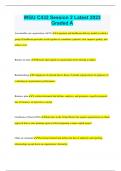
WGU C432 Session 2 Latest 2023 Graded A
WGU C432 Session 2 Latest 2023 Graded A Accountable care organization (ACO) A payment and healthcare delivery model in which a group of healthcare providers work together to coordinate a patient's care, improve quality, and reduce costs. Barriers to entry Obstacles that impede an organization from entering a market. Benchmarking Comparison of internal data to those of outside organizations for purposes of evaluating an organization's performance. Business plan A written document that defines, analyzes, and promotes a specific proposal, line of business, or innovative concept Certificate of Need (CON) State laws in the United States that require organizations to obtain approval from a state planning agency before beginning a major capital project Chain of command The formal channel that defines the line of authority and reporting relationships up and down an organization's hierarchy. Coalition An alliance of individuals and groups that support a cause or an effort. Core competencies The internal activities and functions central to fulfilling an organization's mission. Core competencies are strategically valuable and the essence of what makes an organization unique in providing value to its customers Corporate structure An overarching management configuration that controls and supervises divisions or SBUs. A corporation is a legal structure that can be instituted to limit owners' personal liability and centralize management under a governing board. Differentiation Dividing and separating activities, functions, and products to make them distinct from others Division of labor Specialization of work that breaks down tasks within a production process so that personnel become highly proficient in components of the process. Economies of scale Reductions in unit cost granted to purchasers of large volumes of products or services. Exit barriers The costs an organization will incur if it exits a market. Five Forces model A framework devised by Michael Porter that identifies five factors affecting the degree of competition in a market and the ability of established organizations to influence prices: (1) the potential for new entrants, (2) the threat of substitute products, (3) the power of suppliers, (4) the power of buyers, and (5) rivalry among competing sellers Force field analysis A technique used to evaluate whether environmental influences support or undermine an organization's decisions/plans. Four Ps - - Four attributes that have traditionally been used to establish an organization's market position: (1) product, (2) price, (3) promotion, and (4) place. Gap analysis A method of identifying the distance between the organization's current position and its desired position with regard to its mission, vision, and values Goals and objectives Goals are broad results that an organization seeks to achieve. Objectives are narrower "stepping stones" that quantifiably support and elaborate on goals. Group purchasing organizations (GPOs) Alliances formed to give member organizations greater negotiating power and concessions on price, delivery times, and quality when purchasing products/services. Intangible resources An organization's non-physical assets, including reputation, brand names, employees' skills, and industry knowledge. Integration Combining, coordinating, and collaborating duties and tasks to facilitate communication and efficiency. Internal environmental analysis Evaluation of an organization's products, assets, operations, and other factors to determine whether the organization is carrying out its mission effectively and efficiently. Isomorphic - The tendency of organizations in a market to become similar in form and structure, offer similar products, and adopt similar practices over time. Marketing - The activities involved in promoting products and services, including creating, communicating, and delivering offerings that customer's value. Market analysis A study that examines competitors and relevant markets, including the market position in which an organization is/will be placed, relative to other industry competitors. Marketing plan A written document that details an organization's marketing strategies. Marketing and sales management An organization's approach to promoting and selling its products/services, including the type of marketing to be used (e.g., salespersons, direct mail, media advertising), the distribution channels to be used, and any related advantages (e.g., Internet, distributors, retailers). Mission A statement of an organization's purpose, aims, and values. Mobility barriers - Intra-industry obstacles that impede organizations in a strategic group from joining and competing in another group. Examples of mobility barriers include advertising, expenditures on research and development, distribution channels, breadth of product lines, and patents. Networks - Joint ventures and alliances between established organizations for growth purposes. By forming networks, organizations can enter a market more quickly and with minimal risk. Network outsource alliance - An arrangement in which a core organization outsources functions to contract organizations. For example, some pharmaceutical companies use this type of alliance for drug discovery and clinical trials. Organizational capabilities Internal resources, such as physical assets, human resources, reputation, culture, and processes and routines that enable an organization to accomplish its mission. Organization and management The structure, management team, ownership, and governance of an organization. PEST analysis An analytical method of deriving forces that are driving change in an industry. Categories of forces explored include political, economic, social/ cultural, and technological. Physician-hospital organization (PHO) A strategic alliance between a hospital and its medical staff, established to develop new services and compete effectively for managed care business. Planning structure The person(s) or unit that has responsibility for strategic planning. Pooled interdependence An arrangement in which organizational subunits group their resources but mostly have their own separate processes and require little coordination. Pooled service alliance - An arrangement in which the resources of a large number of organizations are grouped to produce value for member organizations. Group purchasing organizations (GPOs) are an example of this type of alliance. Positioning Designing and promoting an organization's products and services so that they occupy a distinctive place in the market. Reciprocal interdependence An arrangement in which organizational subunits have multiple interactions and make multiple exchanges of outputs/products among organizational subunits prior to producing a final outcome. Complex products that necessitate constant learning and communication are developed through reciprocal interdependence. Resource interdependence The relationships, dependencies, and interactions among organizational resources. Scenario analysis A technique of proposing alternative futures that could come to pass if a specified environmental change occurs. This type of analysis is used by leaders to better understand and plan for future contingencies. Sequential interdependence An arrangement in which resources/tasks are handed off from one organizational subunit to another. Information, materials, products, and resources must be highly coordinated among organizational subunits because these exchanges occur in a particular order. Segmentation The division of a market into subsets of consumers with similar needs and wants; enables marketers to focus their marketing efforts on consumers most likely to buy a product or use a service. Service or product line The particular kind or type of services or products offered by an organization. Span of control The number of subordinates reporting to a supervisor. Stakeholders Persons who have a claim to or obtain some benefit from an organization. Strategic action cycle The four stages of the strategic management cycle: (1) strategic planning, (2) budgeting, (3) implementing strategy, and (4) controlling problems/monitoring progress. Strategic alliance A mutually beneficial, long-term, formal relationship formed between two or more parties to pursue a set of common goals or to meet a critical business need while remaining independent organizations. Also called quasi-firm and hybrid arrangement. Strategic business units (SBUs) Profit centers in an organization that focus on a product line or market segment. Strategic groups Clusters of organizations that use the same or similar strategies in an industry. By classifying organizations into strategic groups, leaders can better analyze the structure of an industry. Strategic intent Statements, including mission, vision, and values that describe an organization's perception of its purpose, its direction, and acceptable conduct. Strategic management Overseeing and directing daily activities in an organization to ensure they support achievement of the organization's mission and vision. Responsibilities may include designing organizational structures, policies, and procedures; evaluating budgets and progress toward goals; and coordinating staff training. Strategic plan A formal, written document that guides an organization's actions and informs stakeholders about the organization's direction and future activities. Strategic planning committee A standing or an ad hoc committee that is responsible for organizing and leading an organization's strategic planning process. Strategic priorities The most important areas addressed by a strategic plan. Strategic thinking Collecting, collating, and assembling disparate pieces of information to make decisions. Switching costs The costs associated with changing a product, brand, marketplace, or supplier. SWOT analysis An analytical tool used to develop an overview of an organization's strategic situation and better understand its environment. This type of analysis examines four important aspects of an organization: its strengths and weaknesses (i.e., the internal environment) and its opportunities and threats (i.e., the external environment). Tangible resources An organization's physical assets, including land, buildings/plant, equipment, cash, and personnel. TOWS analysis A variant of SWOT analysis that helps leaders make better strategic decisions. Leaders compare external opportunities and threats to internal strengths and weaknesses to determine whether their organization's strengths can leverage its opportunities, minimize its threats, and so forth. Trend data Data that portray changes over time (generally from one year to the next). Values Statements expressing the ethics that guide an organization's actions and processes and the organization's standards for behavior among its staff. Valuable resources Resources that lack substitutes and are critical, rare, and difficult to imitate. Value chain The key internal processes or activities that an organization performs to create value for its stakeholders. The value chain provides a framework for analyzing an organization's strengths and weaknesses across the flow of product or service development and delivery. Vision A statement of the desired future state of an organization.
Document information
- Uploaded on
- July 4, 2023
- Number of pages
- 12
- Written in
- 2022/2023
- Type
- Exam (elaborations)
- Contains
- Questions & answers