
The question of whether UK society has become more child-centred is a topic of ongoing
debate among sociologists. Some argue that UK society has become more child-centred as
various laws and policies are now in place to protect them and there is a greater emphasis
on children’s rights. However, other sociologists argue that the extent to which the UK
society has become more child-centred is exaggerated and that childhood can still be a
negative experience for some children. The answer to the question of whether UK society
has become more child-centred is that yes, there have been significant advances in the
promotion of children’s rights and well-being; ultimately, there are large facets of UK society
where said society could do better to ensure that all children can receive a positive
childhood.
One way in which UK society has become more child-centred is laws and policies which
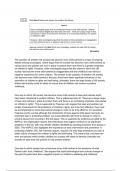
have been introduced to protect children. This is referenced Item D: “there are a large range
of laws and policies in place to protect them and there is an increasing emphasis now placed
on children’s rights”. This is supported by Freeman who argues that laws and policies can
create a framework for the protection of children’s rights, but to be truly effective, they must
be accompanied by social and cultural change in order to be truly effective. For example,
Freeman points out that although the introduction of laws against child abuse has been an
important step in protecting children, but social attitudes still need to change in order to
prevent abuse from occuring in the first place. This is supported by evidence provided by the
NSPCC; the organisation reports that child abuse and neglect continue to be significant
problems in the UK, with over 58,000 children identified as needing protection from abuse in
2020. This NSPCC also highlights the importance of early intervention and prevention in
protecting children; this, like Freeman argues, requires not only legal protections but also a
wider culture of respect for children’s rights and well-being. This means that, yes there are
laws and policies which protect children but society still needs to develop culturally and
socially for said laws and policies to fully protect children.
One way in which society has not become more child-centred is the existence of what
Palmer calls ‘toxic childhood’. She argues that rapid technological and cultural changes in
the past 25 years have had a negative impact on children’s wellbeing and childhood


