

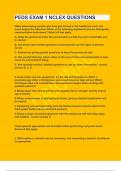
PEDS EXAM 1 NCLEX QUESTIONS|UPDATED&VERIFIED|GUARANTEED SUCCESS
While interviewing parents who have just arrived in the healthcare clinic, the nurse begins the interview. Which of the following statements involve therapeutic communication techniques? Select all that apply. A. Allow the parents to direct the conversation so that they feel comfortable and in control B. use broad, open-ended questions so that parents can feel open to discuss issues C. Redirect by asking guided questions to keep the parents on task D. Use careful listening, which relies on the use of clues and verbal leads to help move the conversation along E. Ask carefully worded, detailed questions to get accurate information B, C, D A nurse looks over her assignment for the day that includes an infant, a preschool-age child, a third-grader, and a sophomore in high school. Which techniques take into consideration developmental stages when working with pediatric patients? A Being aware that infants will become agitated due to stranger anxiety around age 4 months B When a preschooler is getting blood drawn, giving a detailed explanation will be helpful C Explaining and demonstrating what the blood pressure machine does to the third-grader before taking her blood pressure D Using a single consistent approach with the adolescent will help allay anger and hostility C These general approaches can be helpful when performing a physical exam. Select all that apply. a. With toddlers, restraint may be necessary, and requesting a parent's assistance is appropriate. b. When examining a preschooler, giving a choice of which parts to examine may be helpful in gaining the child's cooperation. c. With a school-age child, it is always best to have the parents present when examining. d. Giving explanations about body systems can make adolescents nervous due to their egocentricities. e. An infant physical exam is done head to toe, similarly to the adult. A, B When assessing blood pressure in a child: A. Knowledge of normal mean is important: newborn, 65/41. 1 month-2 years, 95/58. 2-5years, 101/57. B. Cuff size is the most important variable and should be measured using limb lengths C. The child is considered normotensive if the BP is below the 95th percentile D. Check upper and lower extremity BP to look for abnormalities such as aortic stenosis, which causes lower-extremity BP to be higher than upper-extremity BP A Growth measurement is a key element in children of their health status. One measurement for height is linear growth measurement. What should the nurse do to perfect this technique? Select all that apply. A Understand the difference in measurement for children who can stand alone and for those who must lie recumbent. B Use a length board and footboard or a standiometer, which is the best technique, or use a tape measure. C Two measurers are usually required for a recumbent child, although one measurer may be sufficient for a cooperative child. D Reposition the child and repeat the procedure. Measure at least twice (ideally three times). Average the measurements for the final value. E Demonstrate competency when measuring the growth of infants, children, and adolescents. Refresher sessions should be taken when a lack of standardization occurs. A, D, E When caring for their infant, a parents asks you, "Is Emily in a lot of pain? How would you know since she can't really tell you?" The best answer to this question is: A. "Infants don't feel pain as we do because their pain receptors are not fully developed yet" B. "The nurses give pain medication before she really feels the pain." C. "We assess her pain using an infant pain assessment tool and give the medicine as needed." D. "Although we try to give her medicine before she feels pain, we watch her very closely and use different techniques to help relieve the pain." D Pain scales for infants and their uses include but are not limited to; A. CRIES: Crying, Requiring increased oxygen, Inability to console, Expression, and Sleeplessness B. FLACC: child's face, legs, activity, cry, and consolability C. NCCPC: parents and health caregiver questionnaire assessing acute and chronic pain D. NPASS: neonatal pain, agitation, and sedation scale for infants from 3-6 months B As the nurse is getting Nathan ready for surgery, his doctor asked you to explain preemptive analgesic to Nathan's mother. Which response leads you to believe his mother needs more teaching? a. "I understand that preemptive analgesia is giving Nathan pain medication before he has pain and could be given before surgery." b. "This medication will control Nathan's pain so he doesn't feel anything." c. "Giving this medicine early may help prevent complications after surgery." d. "By controlling Nathan's pain, he will be more comfortable and may be able to go home sooner." B When teaching a 6-year-old child with sickle cell disease and his family about pain management, which of the following should the nurse discuss? Select all that apply. a. When pain medications are used, all pain will be eliminated. b. Nonpharmacologic methods of pain relief, including heat, massage, physical therapy, humor, and distraction. c. It is helpful to use a "passport card" that includes information about the diagnosis, any previous complications, and the pain regimen. d. Only the physician can decide the best course of treatment, and the other health care providers follow that plan. e. Long-term medication use considers many factors. B, C, D
Document information
- Uploaded on
- July 3, 2023
- Number of pages
- 13
- Written in
- 2022/2023
- Type
- Exam (elaborations)
- Contains
- Questions & answers


