

Positive statement: Statements that are based on facts, and can be proved or
disproved.
Normative statement: Subjective statements that are based on Judgement
and cannot be proved or disproved.
Basic economic problem: Wants are unlimited but resources are finite.
- Economic goods = resources limited in supply which are scarce
- Free goods = Resources which are unlimited in supply. Therefore, its
opportunity cost is 0.
Opportunity cost: Next best alternative foregone.
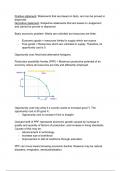
Production possibility frontier (PPF) = Maximum productive potential of an
economy where all resources are fully and efficiently employed.
Opportunity cost may arise if a country wants to increase good Y. The
opportunity cost is 50 good X.
- Opportunity cost is constant if line is straight
Outward shift of PPF represents economic growth caused by increase in
quality and quantity of factors of production, and increase in living standards.
Causes of this may be:
- Advancement in technology
- Increase size of workforce
- Improvement in skill of workforce through education
PPF can move inward showing economic decline. Reasons may be natural
disasters, emigration, deindustrialisation.
,Specialisation and division of labour = When each worker completes a specific
task in a production process.
~ Adam smith - economic growth achieved by division of labour, and can
increase labour productivity and efficiency.
+ Skills develop as job is done repeatedly, so there’s more labour
productivity and efficiency. If productivity increases, the cost per unit
decreases. This means prices would be lower so higher living
standards.
+ Higher output and quality
+ Workers only have to be trained for 1 task, so there’s less training costs.
Less time wasted switching between tasks, saving labour costs.
- Work is repetitive so lowers motivation of workers so lower quality and
productivity.
- Creates interdependence in production. If one group of workers goes on
strike or is missing, then it could halt production across the whole
industry, so whole chain collapses.
Function of Money
1) A medium of exchange: Can be used to buy and sell
2) A measure of value: compare value of goods
3) A store of Value: enables people to save money
4) A method of deferred payment: Debt = pay for things later
, Free-Market economies: Prices are determined by market mechanisms with
no government intervention, and all resources are privately owned.
+ Competition in markets leads to lower prices which benefits consumers.
+ Competition means firms are more efficient and improve quality to gain
advantage over rivals.
+ Employment opportunities higher
- Monopolies may take over small firms due to less government
intervention, causing prices to increase, and quality to decrease.
- Inequality - Those who own resources would benefit the most, whilst
poorer people would likely be exploited due to no government
intervention so no minimum wage.
- Lack of regulation on demerit goods like alcohol is a negative
externality.
- No government intervention means there’s higher external cost of
pollution and damage to environment.
Command economies: Resources allocated by the state, and state owns
everything.
+ More equality and no exploitation of workers = society maximises
welfare.
+ Government limits external costs like pollution and places taxes on
demerit goods like alcohol.
+ Funds provisions of public goods like public healthcare and education,
which often have high external benefit = quality of life higher.
- Lack of competition leads to inefficiency so productivity and quality is
low.
- Economic growth and quality of life is at a lower rate
- Price mechanism unable to operate which can lead to excess demand
and excess supply
- Labour has little incentives to work hard as wages are fixed.
Government's role in mixed economy
- Create framework of rules and regulations, such as minimum wage and
prevent abuse of monopolies. They can protect consumers through
protection laws
- Taxes to decrease inequality such as welfare
- Stabilises economy through policies like monetary and fiscal policies.
disproved.
Normative statement: Subjective statements that are based on Judgement
and cannot be proved or disproved.
Basic economic problem: Wants are unlimited but resources are finite.
- Economic goods = resources limited in supply which are scarce
- Free goods = Resources which are unlimited in supply. Therefore, its
opportunity cost is 0.
Opportunity cost: Next best alternative foregone.
Production possibility frontier (PPF) = Maximum productive potential of an
economy where all resources are fully and efficiently employed.
Opportunity cost may arise if a country wants to increase good Y. The
opportunity cost is 50 good X.
- Opportunity cost is constant if line is straight
Outward shift of PPF represents economic growth caused by increase in
quality and quantity of factors of production, and increase in living standards.
Causes of this may be:
- Advancement in technology
- Increase size of workforce
- Improvement in skill of workforce through education
PPF can move inward showing economic decline. Reasons may be natural
disasters, emigration, deindustrialisation.
,Specialisation and division of labour = When each worker completes a specific
task in a production process.
~ Adam smith - economic growth achieved by division of labour, and can
increase labour productivity and efficiency.
+ Skills develop as job is done repeatedly, so there’s more labour
productivity and efficiency. If productivity increases, the cost per unit
decreases. This means prices would be lower so higher living
standards.
+ Higher output and quality
+ Workers only have to be trained for 1 task, so there’s less training costs.
Less time wasted switching between tasks, saving labour costs.
- Work is repetitive so lowers motivation of workers so lower quality and
productivity.
- Creates interdependence in production. If one group of workers goes on
strike or is missing, then it could halt production across the whole
industry, so whole chain collapses.
Function of Money
1) A medium of exchange: Can be used to buy and sell
2) A measure of value: compare value of goods
3) A store of Value: enables people to save money
4) A method of deferred payment: Debt = pay for things later
, Free-Market economies: Prices are determined by market mechanisms with
no government intervention, and all resources are privately owned.
+ Competition in markets leads to lower prices which benefits consumers.
+ Competition means firms are more efficient and improve quality to gain
advantage over rivals.
+ Employment opportunities higher
- Monopolies may take over small firms due to less government
intervention, causing prices to increase, and quality to decrease.
- Inequality - Those who own resources would benefit the most, whilst
poorer people would likely be exploited due to no government
intervention so no minimum wage.
- Lack of regulation on demerit goods like alcohol is a negative
externality.
- No government intervention means there’s higher external cost of
pollution and damage to environment.
Command economies: Resources allocated by the state, and state owns
everything.
+ More equality and no exploitation of workers = society maximises
welfare.
+ Government limits external costs like pollution and places taxes on
demerit goods like alcohol.
+ Funds provisions of public goods like public healthcare and education,
which often have high external benefit = quality of life higher.
- Lack of competition leads to inefficiency so productivity and quality is
low.
- Economic growth and quality of life is at a lower rate
- Price mechanism unable to operate which can lead to excess demand
and excess supply
- Labour has little incentives to work hard as wages are fixed.
Government's role in mixed economy
- Create framework of rules and regulations, such as minimum wage and
prevent abuse of monopolies. They can protect consumers through
protection laws
- Taxes to decrease inequality such as welfare
- Stabilises economy through policies like monetary and fiscal policies.


