Pressure groups - 15 markers
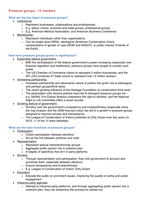
What are the two types of pressure groups?
• Institutional:
o Represent businesses, organisations and professionals
o E.g. labour unions, business and trade groups, professional groups
o E.g. American Medical Association, and American Business Conference
• Membership:
o Represent individuals rather than organisations
o Can be single issue (NRA), ideological (American Conservative Union),
representative of gender or race (NOW and NAACP), or public interest (Friends of
the Earth)
How have pressure groups grown in significance?
• Expanding federal government:
o With the centralisation of the federal government’s power increasing (especially over
financial regulation and healthcare), pressure groups have sought to counter such
power
o The US Chamber of Commerce claims to represent 3 million businesses, and the
AFL-CIO combines 57 trade unions to represent over 12 million workers
• Increasing partisanship:
o Increased partisanship and adversarial nature of politics has given rise to ideological
and partisan groups/think tanks
o The recent growing influence of the Heritage Foundation (a conservative think tank)
o The polarisation over divisive policies have led to divergent pressure groups too –
e.g. NARAL Pro-Choice America champions the right to abortion, and the National
Right to Life Committee offers a direct counter
• Growing distrust of government:
o Scrutiny over the government’s competency and trustworthiness (especially since
the Iraq invasion and the 2008 financial crisis) has led to a growth in pressure groups
designed to improve scrutiny and transparency
o The League of Conservation of Voters publishes its Dirty Dozen ever two years (in
2012, 11 of the 12 were defeated)
What are the main functions of pressure groups?
• Participation
o Citizen participation between elections
o Act as the link between politician and voter
• Representation
o Represent special interests/minority groups
o Aggregate public opinion into a coherent plan
o A degree of specificity that isn’t in party platforms
• Scrutiny
o Through representation and participation, they hold government to account and
scrutinise them, especially between elections
o Ensure transparency and trustworthiness
o E.g. League of Conservation of Voters’ Dirty Dozen
• Education
o Educate the public on prominent issues, improving the quality of voting and public
engagement
• Influence party agendas
o Attempt to influence party platforms, and through aggregating public opinion into a
coherent plan, they can streamline the process for parties too