
Chapter 10
Concept 10.1 Catabolic pathways yield energy by oxidizing organic fuels
How is chemical energy stored in the ecosystem
Energy flows into an ecosystem as sunlight and leaves as heat
Photosynthesis generates O and organic molecules (specifically carbohydrates = chemical energy),
2
which are used in cellular respiration
Cells use chemical energy stored in organic molecules (e.g. protein and carbohydrates) to regenerate
ATP, which powers work
Catabolic pathways and production of ATP
The breakdown of organic molecules is exergonic
Fermentation is a partial degradation of sugars that occurs without O 2
Aerobic respiration consumes organic molecules and O and yield ATP 2
Anaerobic respiration is similar to aerobic respiration but consumes other compounds than O 2
Cellular respiration includes both aerobic and anaerobic respiration but is often used to refer to
aerobic respiration
Redox reactions: oxidation and reduction
The transfer of electrons during chemical reactions releases energy stored in organic molecules. This
released energy is ultimately used to synthesize ATP
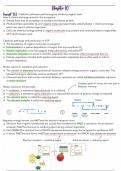
Chemical reactions that transfer electrons between reactants are called oxidation-reduction reactions
or redox reactions
Oxidatie: geeft d’r eentje, kijk daar gaat ie
Redox reactions: the principle Reductie: ontvangt
In oxidation, a substance loses electrons or is oxidized
In reduction, a substance gains electrons or is reduced (the amount of positive charge is reduced)
The electron donor is called the reducing agent
The electron receptor is called the oxidizing agent Products
Reactants
becomes oxidized
CHy + 202 CO2 Energy
+
2 H20
+
becomes oxidized becomes reduce
Y
1 Xe- X Ye
+ I
becomes reduced
2 Carbon dioxide Water
Methane Oxygen
Creducing loxidizing
agent) agent)
Stepwise energy harvest via NAD and the electron transport chain
I
Elections from organic compounds are usually first transferred to NAD, a coenzyme. As an electron
I
acceptor, NAD functions as an oxidizing agent during cellular respiration
I
Each NADH (the reduced form of NAD ) represents stored energy that is tapped to synthesize ATP
I
In short, NAD has two forms: NAD (can accept/store an electron) and NADH (can donate an electron)
I I
Electron receptor = oxidizing agent Electron donor = reducing agent
,Stepwise energy harvest via NAD and the electron transport chain
f
NADH passes the electrons to the electron transport chain
The electron transport chain passes electrons in a series of steps instead of one explosive reaction
O pulls electrons down the chain in an energy-yielding tumble. The energy yielded is used to
Z
regenerate ATP
Concept 10.2 Glycolysis harvests chemical energy by oxidizing glucose to pyruvate
The stages of cellular respiration an overview - I
Harvesting of energy from glucose has three stages:
Glycolysis: breaks down one glucose molecule into two molecules of pyruvate
The citric acid cycle (TCA) completes the breakdown of glucose
Oxidative phosphorylation (OXPHOS) accounts for most of the ATP synthesis through the election
transfer chain and chemiosmosis
The process that generates most of the ATP is called oxidative phosphorylation because it is powered
by redox reactions
The stages of cellular respiration an overview - II
OXPHOS accounts for almost 90% of the ATP generated by cellular respiration
A smaller amount of ATP is formed in glycolysis and the citric acid cycle
âçyŞvğiî
by substrate-level phosphorylation
Substrate-level phosphorylation occurs when an enzyme transfers a
phosphate group directly from a substrate to ADP J
For each molecule of glucose degraded to CO and water by
2
respiration, the cell can create up to 32 molecules of ATP
Glycolysis
Meaning: sugar splitting. Glucose (six-carbon sugar) splits into two
nçg
three-carbon sugars. These smaller sugars are then oxidized and their
remaining atoms rearranged to form two molecules of pyruvate. There
are 2 ATP's used and there are 4 ATP's and 2 NADH formed.
The net energy yield from glycolysis per glucose molecule is 2 ATP + 2
NADH
Substrate-level phosphorylation and oxidation of glucose
After pyruvate is oxidized, the citric acid cycle completes the energy-yielding oxidation of
Concept 10.3
organic molecules
Most of the energy in glucose remains stored in the pyruvate molecules produced by glycolysis
In the presence of O , pyruvate enters the mitochondrion (in eukaryotic cells) where the oxidation of
2
glucose is completed
This occurs in the cytosol for aerobic prokaryotes
Oxidation of pyruvate to acetyl-CoA
Pyruvate must be converted to acetyl-CoA which links glycolysis to the citric acid cycle.
This step is carried out by a multi-enzyme complex called pyruvate dehydrogenase. This complex
catalyzes three reactions:
Oxidation of pyruvate's carboxyl group, releasing the first CO of cellular respiration
Z
Reduction of NAD to NADH
f
Combination of the remaining two-carbon fragment with coenzyme A to form acetyl-CoA
, Pyruvate oxidation
5
Meaning: when O2 is present, the pyruvate in eukaryotic cells enters a
mitochondrion where the oxidation of glucose is completed. Pyruvate
binds to the transport protein pyruvates carboxyl and releases CO2.
Next it is oxidized and the electrons are transferred to NAD, storing
t
energy in the form of NADH. Coenzyme A binds to the carbon
intermediate and forms acetyl CoA
NAD NADH + H
I
t
The citric acid cycle or Krebs cycle
This cycle oxidizes organic fuel derived from pyruvate, generating 1 ATP, 3 NADH and 1 FADH per turn.
x
Because 2 pyrvuate are produced per glucose, the cycle runs twice per glucose molecule consumed
The acetyl group of acetyl-CoA joins the cycle by combining with oxaloacetate, forming citrate
The next 7 steps decompose the citrate back to oxaloacetate, making the process a cycle
The NADH and FADH produced by the cycle relay electrons extracted from food to the electron
transport chain
Citric acid cycle 1
Acetyl CoA adds it’s two-
merk Scot
C0
=
carbon acetyl group to
oxaloacetate, producing
↓JuseS
citrate
Acetyl CoA
CoA-SH 2
By removal of one water
200
molecule and addition of
0 c
=
situin:viain
-
'He
C COO another, citrate is converted to
C 4He isocitrate
HO-C-C00
het
8
The substrate Citrate
is oxidized, 3
reducing NAD Isocitrate is
to NADH and oxidized, reducing
regenerating NAD to NADH.
oxaloactetate
Citric acid cycle
Explained step by step NADA The resulting
compound loses
CO2
7
CO2
Addition of a
water molecule
COO
4
rearranges HC
CHe Another CO2 is lost
CoA-SH and the resulting
bonds in the doo CH2
substrate c 0
=
compound is
fumarate
oxidized, reducing
CoA-SH
a-ketoglutarate NAD to NADH. The
+
COO-
FADHz
coo
I
FAD CH2
CO2 remaining molecule is
CHe then attached to
6
e
I
Two hydrogens are transferred Pi
C 0
=
NADH coenzyme A
S-CoA +
GTP
to FAD, forming FADH2 and GBP
Saccinate Succinyl CoA
oxidizing succinate ADP
5
CoA is displaced by a phosphate
ATP
group, which is transferred to
GDP forming GTP. This can also
be used to generate ATP
Concept 10.1 Catabolic pathways yield energy by oxidizing organic fuels
How is chemical energy stored in the ecosystem
Energy flows into an ecosystem as sunlight and leaves as heat
Photosynthesis generates O and organic molecules (specifically carbohydrates = chemical energy),
2
which are used in cellular respiration
Cells use chemical energy stored in organic molecules (e.g. protein and carbohydrates) to regenerate
ATP, which powers work
Catabolic pathways and production of ATP
The breakdown of organic molecules is exergonic
Fermentation is a partial degradation of sugars that occurs without O 2
Aerobic respiration consumes organic molecules and O and yield ATP 2
Anaerobic respiration is similar to aerobic respiration but consumes other compounds than O 2
Cellular respiration includes both aerobic and anaerobic respiration but is often used to refer to
aerobic respiration
Redox reactions: oxidation and reduction
The transfer of electrons during chemical reactions releases energy stored in organic molecules. This
released energy is ultimately used to synthesize ATP
Chemical reactions that transfer electrons between reactants are called oxidation-reduction reactions
or redox reactions
Oxidatie: geeft d’r eentje, kijk daar gaat ie
Redox reactions: the principle Reductie: ontvangt
In oxidation, a substance loses electrons or is oxidized
In reduction, a substance gains electrons or is reduced (the amount of positive charge is reduced)
The electron donor is called the reducing agent
The electron receptor is called the oxidizing agent Products
Reactants
becomes oxidized
CHy + 202 CO2 Energy
+
2 H20
+
becomes oxidized becomes reduce
Y
1 Xe- X Ye
+ I
becomes reduced
2 Carbon dioxide Water
Methane Oxygen
Creducing loxidizing
agent) agent)
Stepwise energy harvest via NAD and the electron transport chain
I
Elections from organic compounds are usually first transferred to NAD, a coenzyme. As an electron
I
acceptor, NAD functions as an oxidizing agent during cellular respiration
I
Each NADH (the reduced form of NAD ) represents stored energy that is tapped to synthesize ATP
I
In short, NAD has two forms: NAD (can accept/store an electron) and NADH (can donate an electron)
I I
Electron receptor = oxidizing agent Electron donor = reducing agent
,Stepwise energy harvest via NAD and the electron transport chain
f
NADH passes the electrons to the electron transport chain
The electron transport chain passes electrons in a series of steps instead of one explosive reaction
O pulls electrons down the chain in an energy-yielding tumble. The energy yielded is used to
Z
regenerate ATP
Concept 10.2 Glycolysis harvests chemical energy by oxidizing glucose to pyruvate
The stages of cellular respiration an overview - I
Harvesting of energy from glucose has three stages:
Glycolysis: breaks down one glucose molecule into two molecules of pyruvate
The citric acid cycle (TCA) completes the breakdown of glucose
Oxidative phosphorylation (OXPHOS) accounts for most of the ATP synthesis through the election
transfer chain and chemiosmosis
The process that generates most of the ATP is called oxidative phosphorylation because it is powered
by redox reactions
The stages of cellular respiration an overview - II
OXPHOS accounts for almost 90% of the ATP generated by cellular respiration
A smaller amount of ATP is formed in glycolysis and the citric acid cycle
âçyŞvğiî
by substrate-level phosphorylation
Substrate-level phosphorylation occurs when an enzyme transfers a
phosphate group directly from a substrate to ADP J
For each molecule of glucose degraded to CO and water by
2
respiration, the cell can create up to 32 molecules of ATP
Glycolysis
Meaning: sugar splitting. Glucose (six-carbon sugar) splits into two
nçg
three-carbon sugars. These smaller sugars are then oxidized and their
remaining atoms rearranged to form two molecules of pyruvate. There
are 2 ATP's used and there are 4 ATP's and 2 NADH formed.
The net energy yield from glycolysis per glucose molecule is 2 ATP + 2
NADH
Substrate-level phosphorylation and oxidation of glucose
After pyruvate is oxidized, the citric acid cycle completes the energy-yielding oxidation of
Concept 10.3
organic molecules
Most of the energy in glucose remains stored in the pyruvate molecules produced by glycolysis
In the presence of O , pyruvate enters the mitochondrion (in eukaryotic cells) where the oxidation of
2
glucose is completed
This occurs in the cytosol for aerobic prokaryotes
Oxidation of pyruvate to acetyl-CoA
Pyruvate must be converted to acetyl-CoA which links glycolysis to the citric acid cycle.
This step is carried out by a multi-enzyme complex called pyruvate dehydrogenase. This complex
catalyzes three reactions:
Oxidation of pyruvate's carboxyl group, releasing the first CO of cellular respiration
Z
Reduction of NAD to NADH
f
Combination of the remaining two-carbon fragment with coenzyme A to form acetyl-CoA
, Pyruvate oxidation
5
Meaning: when O2 is present, the pyruvate in eukaryotic cells enters a
mitochondrion where the oxidation of glucose is completed. Pyruvate
binds to the transport protein pyruvates carboxyl and releases CO2.
Next it is oxidized and the electrons are transferred to NAD, storing
t
energy in the form of NADH. Coenzyme A binds to the carbon
intermediate and forms acetyl CoA
NAD NADH + H
I
t
The citric acid cycle or Krebs cycle
This cycle oxidizes organic fuel derived from pyruvate, generating 1 ATP, 3 NADH and 1 FADH per turn.
x
Because 2 pyrvuate are produced per glucose, the cycle runs twice per glucose molecule consumed
The acetyl group of acetyl-CoA joins the cycle by combining with oxaloacetate, forming citrate
The next 7 steps decompose the citrate back to oxaloacetate, making the process a cycle
The NADH and FADH produced by the cycle relay electrons extracted from food to the electron
transport chain
Citric acid cycle 1
Acetyl CoA adds it’s two-
merk Scot
C0
=
carbon acetyl group to
oxaloacetate, producing
↓JuseS
citrate
Acetyl CoA
CoA-SH 2
By removal of one water
200
molecule and addition of
0 c
=
situin:viain
-
'He
C COO another, citrate is converted to
C 4He isocitrate
HO-C-C00
het
8
The substrate Citrate
is oxidized, 3
reducing NAD Isocitrate is
to NADH and oxidized, reducing
regenerating NAD to NADH.
oxaloactetate
Citric acid cycle
Explained step by step NADA The resulting
compound loses
CO2
7
CO2
Addition of a
water molecule
COO
4
rearranges HC
CHe Another CO2 is lost
CoA-SH and the resulting
bonds in the doo CH2
substrate c 0
=
compound is
fumarate
oxidized, reducing
CoA-SH
a-ketoglutarate NAD to NADH. The
+
COO-
FADHz
coo
I
FAD CH2
CO2 remaining molecule is
CHe then attached to
6
e
I
Two hydrogens are transferred Pi
C 0
=
NADH coenzyme A
S-CoA +
GTP
to FAD, forming FADH2 and GBP
Saccinate Succinyl CoA
oxidizing succinate ADP
5
CoA is displaced by a phosphate
ATP
group, which is transferred to
GDP forming GTP. This can also
be used to generate ATP


