
Cases|Updated&Verified|Guaranteed Success
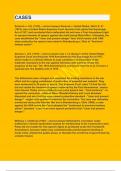
Schenck v. U.S. (1919) Schenck v. United States, 249 U.S. 47 (1919), was a United States Supreme Court decision that upheld the Espionage Act of 1917 and concluded that a defendant did not have a First Amendment right to express freedom of speech against the draft during World War I. Ultimately, the case established the "clear and present danger" test, which lasted until 1969 when protection for speech was raised in Brandenburg v. Ohio to "Imminent lawless action". Abrams v. U.S. (1919) was a 7-2 decision of the United States Supreme Court involving the 1918 Amendment to the Espionage Act of 1917, which made it a criminal offense to urge curtailment of production of the materials necessary to the war against Germany with intent to hinder the progress of the war. The 1918 Amendment is commonly referred to as if it were a separate Act, the Sedition Act of 1918. The defendants were charged and convicted for inciting resistance to the war effort and for urging curtailment of production of essential war material. They were sentenced to 20 years in prison. The Supreme Court ruled 7-2 that the Act did not violate the freedom of speech protected by the First Amendment. Justice John Hessin Clarke used a relatively restrictive speech test - "bad tendency" - to uphold the conviction. Justices Oliver Wendell Holmes and Louis Brandeis dissented and said that the more speech protective standard - "clear and present danger" - ought to be applied to overturn the conviction. The case was ultimately overturned during the Vietnam War era in Brandenburg v. Ohio (1968), a case against the KKK where the Court adopted the "incitement to imminent lawless action" standard - a test even more speech protective than "clear and present danger." Whitney v. California (1927) Defendant's conviction under California's criminal syndicalism statute for membership in the Communist Labor Party did not violate her free speech rights as protected under the Fourteenth Amendment, because states may constitutionally prohibit speech tending to incite crime, disturb the public peace, or threaten the overthrow of government by unlawful means Brandenburg v. Ohio (1969) Brandenburg v. Ohio, 395 U.S. 444 (1969), was a landmark United States Supreme Court case based on the First Amendment to the U.S. Constitution. The Court held that government cannot punish inflammatory speech unless that speech is directed to inciting, and is likely to incite, imminent lawless action. Specifically, it struck down Ohio's criminal syndicalism statute, because that statute broadly prohibited the mere advocacy of violence. In the process, Whitney v. California, 274 U.S. 357 (1927) was explicitly overruled, and doubt was cast on Schenck v. United States, 249 U.S. 47 (1919), Abrams v. United States, 250 U.S. 616 (1919), and Dennis v. United States, 341 U.S. 494 (1951). ● Near v. Minnesota (1931) Near v. Minnesota, 283 U.S. 697 (1931), was a United States Supreme Court decision that recognized the freedom of the press by roundly rejecting prior restraints on publication, a principle that was applied to free speech generally in subsequent jurisprudence. The Court ruled that a Minnesota law that targeted publishers of "malicious" or "scandalous" newspapers violated the First Amendment to the United States Constitution (as applied through the Fourteenth Amendment). Legal scholar and columnist Anthony Lewis called Near the Court's "first great press case".[1] It was later a key precedent in New York Times Co. v. United States (1971), in which the Court ruled against the Nixon administration's attempt to enjoin publication of the Pentagon Papers. New York Times v. U.S. (Pentagon Papers Case) (1971) New York Times Co. v. United States, 403 U.S. 713 (1971), was a landmark decision by the United States Supreme Court on the First Amendment. The ruling made it possible for the New York Times and Washington Post newspapers to publish the then-classified Pentagon Papers without risk of government censorship or punishment. President Richard Nixon had claimed executive authority to force the Times to suspend publication of classified information in its possession. The question before the court was whether the constitutional freedom of the press, guaranteed by the First Amendment, was subordinate to a claimed need of the executive branch of government to maintain the secrecy of information. The Supreme Court ruled that the First Amendment did protect the right of the New York Times to print the materials. U.S. v. Progressive (W.D. Wis. 1979) United States of America v. Progressive, Inc., Erwin Knoll, Samuel Day, Jr., and Howard Morland 467 F. Supp. 990 (W.D. Wis. 1979) was a lawsuit against The Progressive magazine by the United States Department of Energy (DOE) in 1979. A temporary injunction was granted against The Progressive to prevent the publication of an article by activist Howard Morland that purported to reveal the "secret" of the hydrogen bomb. Though the information had been compiled from publicly available sources, the DOE claimed that it fell under the "born secret" clause of the Atomic Energy Act of 1954.
Document information
- Uploaded on
- June 29, 2023
- Number of pages
- 12
- Written in
- 2022/2023
- Type
- Exam (elaborations)
- Contains
- Questions & answers


