Biology Chapter 1 Notes
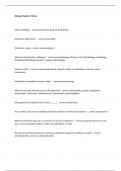
What is biology? - correct answersthe study of living things. What does -Bios mean? - correct answerslife What does -ology - correct answersstudy of What are the branches of Biology? - correct answersZoology, Botany, A & P, Microbiology, cell biology, developmental biology, genetics, ecology, and histology.. What are cells? - correct answerssingle (yeast, bacteria, aniba) or multicelluar- humans, plants, mushrooms. Metabolism is needed to produce what? - correct answersenergy What are the basic life proccesses? (all organisms) - correct answersCells, growth, metabolism, homeostasis, movement, responsiveness, reproduction, and adaptation. All organisms are made of one or more _____? - correct answerscells True or False: Cells are the smallest unit which performs all of the life processes. - correct answersTrue What are the three ways you can increase in size of an organism? - correct answersAn increase in cell size, an increasing the number of cells (cell replication), or both. The sum of all chemical processes that occur within the organism contribute to what? - correct answersgrowth, survival, and reproduction. Catabolism - correct answers"Break down" of chemical substances into simpler compounds. Takes proteins down to amnio acids to simple carbs. Anabolism - correct answers"building up" of complex chemical substances from smaller, simpler components. What is homeostasis? - correct answersmaintenance of internal conditions within limits suitable for life. Disruption of homeostasis can lead to what? - correct answersdisease or death. Ex: blood sugar, body temperature, and blood pressure. Movement: - correct answersmotion of the whole body, individual organs, single cells, and cell parts. Ex: blood cells move through body, white blood cells move to infection and fight it. Responsivessness is: - correct answersstimuli and the ability to detect and respond to change in internal and external environment. Ex: external-you drop a hot pan. Internal- blood pressure What is reproduction? - correct answersthe process by which a cell or organism produces offspring. Asexual reproduction - correct answersresults in offspring which are genetically identical to the parent and to each other. (clone) Sexual Reproduction - correct answersresults in genetically variable offspring. Adaptation: - correct answersif you don't adapt you go extinct. Adaptation is the ability to survive in changing environment. Adaptation is the result of - correct answersmutation and natural selection. Organisms best suited to cope with environmental changes live to pass on their genetic information to their offspring. Levels of Bilogical Organization (smallest to largest) - correct answersAtom, molecule/compound, organelle, cell, tissue, organ, organ system, organism, population, community, ecosystem, biosphere. Atoms - correct answersmost fundamental forms of matter (elements.) these are the smallest unit of an element that retains the properties of that element. What is the name of the atom with a negative charge? - correct answerselectrons What is the name of the atom with a postive charge? - correct answersprotons What is the name of the atom with no charge? - correct answersNeutrons Molecule/compound - correct answersunit in which two or more atoms are bonded together. What are the two types of molecules/compounds? - correct answersinorganic (water) and organic (macromolecules.) What are the 4 types of macromolecules? - correct answerslipids, proteins, carbohyrdrates, and nucleic acids (DNA). Organelle: - correct answerscompartment inside a cell that performs a specific, specialized task. Ex: nucleus Cell - correct answerssmallest unit capable of surviving and reproducing on its own or as part of multicellular organism. Cells have: - correct answersan outer membrane, DNA, and other components. Diversity of cells is defined by shape and function of cell is called - correct answersdifferenentiation. Ex: brain, kidney, and liver cells. What cell is not differentiation? - correct answersa stem cell because it doesn't have a job yet. tissue - correct answersorganize group of cells that function together in a specialize activity or activitities. What are four tissue types? - correct answersepithelial, connective, muscle, nervous. organ - correct answersstructural unit which contains two or more types of tissues combine in specific amounts and patterns. Tissues work together to perform a common function. Ex: parrotfish eye Organ system - correct answersconsist of two or more organs which interact in ways that contribute to survival of the whole organism. How many organ systems make up the body? - correct answers11. What are the 11 organ systems? - correct answersDigestive, integumentary, muscular, nervous, cardiovascular, respiratory, skeletal, endocrine, reproductive, urinary, lymphatic (immune) Organism - correct answersliving thing that has (or can develop) the ability to act or function independently. Most multicelled organisms are organized of what? - correct answerstissue, organs, and organ systems. population - correct answersgroup of individuals of the same kind (same species) occupying a given area. community - correct answersall of the different populations of organisms living in a given area. Ex: coral reef.....snails, fish, corals, etc. biosphere - correct answersregions of the earth where organisms can exist, including the atmosphere, land masses, bodies of water, and sediments at the bottom of the bodies of water. Without the biosphere's abundance of free-flowing water there would be no.... - correct answerslife
Document information
- Uploaded on
- June 27, 2023
- Number of pages
- 9
- Written in
- 2022/2023
- Type
- Exam (elaborations)
- Contains
- Questions & answers