

COMBAT LIFE SAVER TEST|2023 LATEST UPDATE|GUARANTEED SUCCESS
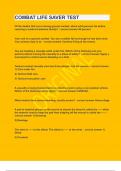
Of the deaths that occur during ground combat, about what percent die before reaching a medical treatment facility? 90 percent Your unit is in ground combat. You see a soldier fall as though he has been shot. Your primary duty is to: Continue firing at the enemy You are treating a casualty while under fire. Which of the following can you perform before moving the casualty to a place of safety? Apply a tourniquet to control severe bleeding on a limb Tactical combat casualty care has three phases. List the phases. 1) Care under fire 2) Tactical field care 3) Tactical evacuation care A casualty is being transported to a collection point using a non-medical vehicle. Which of the following terms apply? CASEVAC What medical term means bleeding, usually severe? Hemorrhage A pad of material placed on the wound to absorb the blood is called the ----- while the material used to keep the pad from slipping off the wound is called the -----. 1) Dressing 2) Bandage The wrist is ----- to the elbow. The elbow is ----- to the wrist. 1) Distal 2) Proximal Is the combat lifesaver considered to be a medical soldier? No What are the three most common medically preventable causes of death on the modern battlefield? 1) Extremity hemorrhage 2) Tension pneumothorax 3) Airway obstruction Of the three most preventable causes of battlefield death, which results in the most deaths? Extremity hemorrhage How does evaluation and treatment of a casualty in a care under fire situation differ from secure (tactical field care) situation? While under fire you only treat life-threatening bleeding from a limb. Once secure you can start evaluating and working on airway, open chest wounds, fractures etc. What type of preventable condition do more soldiers die from during ground combat before reaching a medical treatment facility? Bleeding from wounds to the extremities Your unit is in ground combat. You see a soldier fall as though he has been shot. Your primary duty is to: Continue firing at the enemy When performing care under fire, which of the following actions can be performed before moving the casualty to a safe location? Apply a tourniquet to control bleeding You and another soldier are in the open and separated when you both come under enemy fire. The other soldier is wounded, but is conscious and able to fire his weapon. What should you tell him to do? 1) Seek cover 2) Return fire 3) Administer self-aid You have come under enemy fire. you and another soldier have taken cover together. The other soldier has a severe bleeding wound to his arm. You can administer treatment without endangering the mission or yourself. What treatment should you administer? Apply a tourniquet to control bleeding You are going to the aid of an injured soldier while under fire. What should be your first action upon reaching the soldier? Check the soldier for responsiveness A casualty is lying very still. He does not respond to any of your questions or commands. He does show a reaction when you rub is breastbone briskly with your knuckle. How would you classify the casualty on the AVPU scale? P- for physical You are determining the casualty's level of responsiveness. The casualty tells you that he has been shot in his leg and that he is in pain. How would you classify the casualty on the AVPU scale? A- for attentive
Document information
- Uploaded on
- June 27, 2023
- Number of pages
- 17
- Written in
- 2022/2023
- Type
- Exam (elaborations)
- Contains
- Questions & answers


