Structure of Cell
Membranes
Fluid Mosaic Model
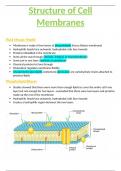
Membrane is made of two layers of phospholipids (hence bilayer membrane)
Hydrophilic heads face outwards, hydrophobic tails face inwards
Proteins imbedded in the membrane
Some all the way through (intrinsic, integral, or transmembrane)
Some just in one layer (extrinsic or peripheral)
Chemical proteins let ions through
Cholesterol regulates membrane fluidity
Glycoproteins/glycolipids (collectively glycocalyx) are carbohydrate chains attached to
proteins/lipids
Phospholipid Bilayer
Studies showed that there were more than enough lipids to cover the entire cell I one
layer but not enough for two layers –concluded that there were two layers and proteins
made up the rest of the membrane
Hydrophilic heads face outwards, hydrophobic tails face inwards
Creates a hydrophilic region between the two layers
Membranes
Fluid Mosaic Model
Membrane is made of two layers of phospholipids (hence bilayer membrane)
Hydrophilic heads face outwards, hydrophobic tails face inwards
Proteins imbedded in the membrane
Some all the way through (intrinsic, integral, or transmembrane)
Some just in one layer (extrinsic or peripheral)
Chemical proteins let ions through
Cholesterol regulates membrane fluidity
Glycoproteins/glycolipids (collectively glycocalyx) are carbohydrate chains attached to
proteins/lipids
Phospholipid Bilayer
Studies showed that there were more than enough lipids to cover the entire cell I one
layer but not enough for two layers –concluded that there were two layers and proteins
made up the rest of the membrane
Hydrophilic heads face outwards, hydrophobic tails face inwards
Creates a hydrophilic region between the two layers