

Edexcel Maths A Level Pure|2023 LATEST UPDATE|GUARANTEED SUCCESS
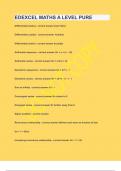
Differentiate tan(kx) ksec^2(kx) Differentiate cos(kx) -ksin(kx) Differentiate sin(kx) kcos(kx) Arithmetic sequence Un = a + (n - 1)d Arithmetic series Sn = n/2 (a + d) Geometric sequences Un = ar^n - 1 Geometric series Sn = a(r^n - 1) / r - 1 Sum to infinity a/1 - r Convergent series Sn closer to 0 Divergent series Sn further away from 0 Sigma notation Recurrence relationship Defines each term as function of last Un + 1 = f(Un) Increasing recurrence relationship Un + 1 Un Decreasing recurrence relationship Un + 1 Un Radians: Arc Length l = r*degree pi radians 180 degrees Radians: Area sector 1/2r^2*degree Radians: Area triangle 1/2r^2(degree-sin(degree)) Small angle approximation sin(x) x Small angle approximation cos(x) 1 - ((x^2)/2) Small angle approximation tan(x) x Binomial expanding (1+x)^n 1 + nx + (n(n-1)/2!)x^2 + (n(n-1)(n-2)/3!)x^3 + ... Expansion valid range |x|1 For |bx|1 |x|1/|b| Binomial expanding (a+bx)^n a^n * (1+(b/a)x)^n Expand as would (1+x)^n then multiply by a^n sec(x) 1/cos(x) cosec(x) 1/sin(x) cot(x) 1/tan(x) cot(x) in terms of sin(x) and cos(x) cosx/sinx 1+tan^2(x) sec^2(x) 1+cot^2(x) cosec^2(x) cosec^4(x) - cot^4(x) (1+cos^2(x))/(1-cos^2(x)) sec^2(x) - cos^2(x) sin^2(x)(1+sec^2(x)) Inverse sin(x) arcsin(x)
Document information
- Uploaded on
- June 24, 2023
- Number of pages
- 6
- Written in
- 2022/2023
- Type
- Exam (elaborations)
- Contains
- Questions & answers


