

BLOK 3.5 PUBLIC INTERNATIONAL LAW REPORTING 1-8
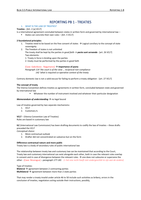
REPORTING PB 1 - TREATIES
1. WHAT IS THE LAW OF TREATIES?
Treaties - [Art. 2 (a) VCLT]
Is a international agreement concluded between states in written form and governed by international law –
States can concrete their own rules – [Art. 5 VCLT]
2 foundational principles:
1. Treaties need to be based on the free consent of states Logical corollary to the concept of state
sovereignty
2. The freedom of states is not unlimited
The treaty shall be kept by the parties in good faith → pacta sunt servanda - [art. 26 VCLT]
Two elements:
1- Treaty in force is binding upon the parties
2- treaty must be performed by the parties in good faith
[Case: Gabcikovo - Nagymaros] Importance of pacta
Paragraph 114 ‘the court is of the view … reciprocal non-compliance
142 ‘what is required co-operative context of the treaty
Contrary domestic law is not a valid excuse for failing to perform a treaty obligation - [art. 27 VCLT]
The concept of treaty
The Vienna Convention defines treaties as agreements in written form, concluded between state and governed
by international law
Whatever the number of instrument involved and whatever their particular designation
Memorandum of understanding no legal bound
Law of treaties governed by two separate mechanisms:
1. VCLT
2. Customary IL
VCLT – (Vienna Convention Law of Treaties)
Rules are based in customary law
ILC (International Law Commission) has been drafting documents to codify the law of treaties – these drafts
preceded the VCLT
Conceptual choice:
1. More contractual outlook
2. Drafter did not concentrated on subsence but on the form
Difference contractual nature and more public
Treaty law is a body of secondary rules of public international law
The relationship between treaty law and customary law can be maintained that according to the Court,
Treaty law and customary international can exist alongside each other, both in case the relevant rules overlap
in consent and in case of divergence between the relevant rules. one does not subsume or supervene the
other - [Case: Nicaragua] – paragraph 177-181 (= het ene recht hoeft niet ondergeschikt te zijn aan de andere)
Type of treaties:
Bilateral agreement between 2 contracting parties
Multilateral agreement between more than 2 state parties
That may render a treaty invalid under article 46 to 50 include such activities as bribery, errors in the
conclusion of treaties, negotiators acting outside their instructions, possibly,
REPORTING PB 1 - TREATIES
1. WHAT IS THE LAW OF TREATIES?
Treaties - [Art. 2 (a) VCLT]
Is a international agreement concluded between states in written form and governed by international law –
States can concrete their own rules – [Art. 5 VCLT]
2 foundational principles:
1. Treaties need to be based on the free consent of states Logical corollary to the concept of state
sovereignty
2. The freedom of states is not unlimited
The treaty shall be kept by the parties in good faith → pacta sunt servanda - [art. 26 VCLT]
Two elements:
1- Treaty in force is binding upon the parties
2- treaty must be performed by the parties in good faith
[Case: Gabcikovo - Nagymaros] Importance of pacta
Paragraph 114 ‘the court is of the view … reciprocal non-compliance
142 ‘what is required co-operative context of the treaty
Contrary domestic law is not a valid excuse for failing to perform a treaty obligation - [art. 27 VCLT]
The concept of treaty
The Vienna Convention defines treaties as agreements in written form, concluded between state and governed
by international law
Whatever the number of instrument involved and whatever their particular designation
Memorandum of understanding no legal bound
Law of treaties governed by two separate mechanisms:
1. VCLT
2. Customary IL
VCLT – (Vienna Convention Law of Treaties)
Rules are based in customary law
ILC (International Law Commission) has been drafting documents to codify the law of treaties – these drafts
preceded the VCLT
Conceptual choice:
1. More contractual outlook
2. Drafter did not concentrated on subsence but on the form
Difference contractual nature and more public
Treaty law is a body of secondary rules of public international law
The relationship between treaty law and customary law can be maintained that according to the Court,
Treaty law and customary international can exist alongside each other, both in case the relevant rules overlap
in consent and in case of divergence between the relevant rules. one does not subsume or supervene the
other - [Case: Nicaragua] – paragraph 177-181 (= het ene recht hoeft niet ondergeschikt te zijn aan de andere)
Type of treaties:
Bilateral agreement between 2 contracting parties
Multilateral agreement between more than 2 state parties
That may render a treaty invalid under article 46 to 50 include such activities as bribery, errors in the
conclusion of treaties, negotiators acting outside their instructions, possibly,


