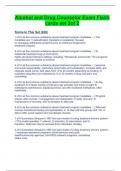
Alcohol and Drug Counselor Exam Flash cards set 2of 2
1 of 6 List five common substance abuse treatment program modalities - The modalities are: 1) detoxification (inpatient or outpatient), focused on managing withdrawal symptoms prior to entering a longer-term treatment program; 2 of 6 List five common substance abuse treatment program modalities - 2) residential treatment long-vs short-term), highly structured intensive settings, including "Therapeutic Community" (TC) programs using hierarchical models to enhance 3 of 6 List five common substance abuse treatment program modalities - personal and social responsibility, restructure personality and socialization, increase skills, and integrate social norms, with stays from 12 to 24 months depending on funding; 3) outpatient drug-free (non-methadone), 6 to 12 months of drug education and counseling; 4 of 6 List five common substance abuse treatment program modalities - 4) day treatment, 6 or fewer months of intensive day activities and home at night; 5) methadone maintenance, displacing heroin use with monitored methadone, often indefinitely. 5 of 6 List five common substance abuse treatment program modalities - Program phases often include: 1) engagement and stabilization; 2) early recovery; 3) maintenance of recovery; and 4) transition to aftercare. 6 of 6 List five common substance abuse treatment program modalities - Aftercare involves transitional therapy and participation in 12-step self help groups (AA, CA, or NA) to offer social support and new lifestyle choices. 1 of 6 Summarize Simpson's 1997 four-part model of a drug treatment delivery system - The model specifies: 1) referral; 2) induction; 3) intervention; and 4) transition. Referrals may be received from individuals, families, 2 of 6 Summarize Simpson's 1997 four-part model of a drug treatment delivery system - employee assistance programs, social services and public health/community agencies, HIV/AIDS outreach programs, centralized intake units, 3 of 6 Summarize Simpson's 1997 four-part model of a drug treatment delivery system - and the criminal justice system. Induction refers to entrance into a treatment program. Intervention and treatment strategies typically involve detoxification and stabilization, motivation and commitment and rehabilitation. 4 of 6 Summarize Simpson's 1997 four-part model of a drug treatment delivery system - Finally, clients are transitioned out to "aftercare" programs (eg, AA, CA, NA). Comprehensive care requires many programs and services to meet diverse needs and widely ranging recovery stages. Optimal programs include: 5 of 6 Summarize Simpson's 1997 four-part model of a drug treatment delivery system - 1) pharmacotherapy to reduce distressing withdrawal symptoms and minimize relapse; 2) cognitive and/or behavioral therapy to address the underlying psychosocial roots of the problem; 6 of 6 Summarize Simpson's 1997 four-part model of a drug treatment delivery system - 3) supportive services for collateral concerns [eg, medical care, employment, transportation, child care). Further, aftercare is needed to aid individuals in resisting urges to relapse, of which drug testing is a crucial part. 1 of 6 The Circumstances, Motivations, Readiness, and Suitability, CMRS, questionnaire, De Leon et al, 1994, is a tool for assessing readiness and motivations for substance abuse treatment. Cite the four primary scales in the CMRS - The four primary scales in the CMRS are: 1) Circumstances; 2) Motivation; 3l Readiness; and 2 of 6 The Circumstances, Motivations, Readiness, and Suitability, CMRS, questionnaire, De Leon et al, 1994, is a tool for assessing readiness and motivations for substance abuse treatment. Cite the four primary scales in the CMRS - 4) Suitability. "Circumstances" refers to external motivation; "Motivation" refers to internal motivation; 3 of 6 The Circumstances, Motivations, Readiness, and Suitability, CMRS, questionnaire, De Leon et al, 1994, is a tool for assessing readiness and motivations for substance abuse treatment. Cite the four primary scales in the CMRS - "Readiness" refers to openness to treatment; and "Suitability" refers to a perception of the client's appropriateness for the proposed treatment modality. 4 of 6 The Circumstances, Motivations, Readiness, and Suitability, CMRS, questionnaire, De Leon et al, 1994, is a tool for assessing readiness and motivations for substance abuse treatment. Cite the four primary scales in the CMRS - Rating the client's level of motivation and readiness is
Document information
- Uploaded on
- June 23, 2023
- Number of pages
- 25
- Written in
- 2022/2023
- Type
- Exam (elaborations)
- Contains
- Questions & answers