

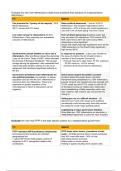
Evaluate the view that referendums create more problems than solutions in a representative
democracy /
For Against
Can promote the “tyranny of the majority” 2016 Raise political awareness, - Vote at 16 2014
Brexit referendum Referendum, The Scottish Independence 2014
48.1% remain and 51% leave referendum - 97% of those who could registering to
vote with 10% of those being ' rst-time' voters
Low voter turnout in referendums AV 2011 Form of direct democracy therefore public feel
Referendum - Party popularity can manipulate they are heard, EU referendum 72% turnout 2016 -
outcome of referendums 64% were 18-24, 2017 GE voter turnout 68%,
referendums more signi cant
Issues that clearly had high signi cance such as the
1988 referendum on the Good Friday Agreement -
high turnout (81%
Governments choose whether or not to call a In response to pressure - Labour gov divided on
referendum - Blair and Brown denied the electorate the issue of whether the UK should remain a
a say on the Lisbon Treaty of 2007, which extended member of the European Community
the process of European integration. This caused - However they got a clear result -67.2% voted yes
outrage among the opposition, who maintained that - 32.8% voted no - 64.5% turnout
voters had been denied a chance to vote on an - Cameron 2013/15 promise for referendum
agreement that transferred signi cant authority to
the EU.
Government sometimes hold referendums for Some issues require the public’s consent -
own political purposes, for example, to defuse Scotland asked the public about a Scottish
opposition and (as with the 2011 referendum) to Parliament being established in a 1997 referendum,
overcome their own differences. There is an popular consent was needed and was received with
argument for greater regulation of the 74.3% voted yes and 25.7% voted no with 60.4%
circumstances in which a referendum can be of Scotland turning out. Wales had a referendum
triggered. about establishing a Welsh assembly which was
also voted for with a 50,3% yes vote and 49.7%
voting no
Getting gov out of a di cult situation - GE
elections can’t work with issues such as Brexit,
membership could across party lines with pro/anti
EU positions in both major political parties
Legitimising a major government initiative -
Since Blair gov, 1997 referendums on devolution +
1998 Belfast Agreement to solve the ‘Irish Troubles’
Evaluate the view that FPTP is the best election system for a representative government
For Against
FPTP maintains MP/Constituency relationship FPTP limits voter choice , prevalence of safe
and preserved and nurtures an important seats - 2015GE electoral reform society estimates
geographical link that 36% were safe seats - 56% of total
- Labour MP Timms holds largest number of Safe seats prevent accounts,
surgeries in 2011, strengthens relation with Waste votes on minor parties
constituents Feeling of apathy resulting from wasted votes
fiffi fififi
democracy /
For Against
Can promote the “tyranny of the majority” 2016 Raise political awareness, - Vote at 16 2014
Brexit referendum Referendum, The Scottish Independence 2014
48.1% remain and 51% leave referendum - 97% of those who could registering to
vote with 10% of those being ' rst-time' voters
Low voter turnout in referendums AV 2011 Form of direct democracy therefore public feel
Referendum - Party popularity can manipulate they are heard, EU referendum 72% turnout 2016 -
outcome of referendums 64% were 18-24, 2017 GE voter turnout 68%,
referendums more signi cant
Issues that clearly had high signi cance such as the
1988 referendum on the Good Friday Agreement -
high turnout (81%
Governments choose whether or not to call a In response to pressure - Labour gov divided on
referendum - Blair and Brown denied the electorate the issue of whether the UK should remain a
a say on the Lisbon Treaty of 2007, which extended member of the European Community
the process of European integration. This caused - However they got a clear result -67.2% voted yes
outrage among the opposition, who maintained that - 32.8% voted no - 64.5% turnout
voters had been denied a chance to vote on an - Cameron 2013/15 promise for referendum
agreement that transferred signi cant authority to
the EU.
Government sometimes hold referendums for Some issues require the public’s consent -
own political purposes, for example, to defuse Scotland asked the public about a Scottish
opposition and (as with the 2011 referendum) to Parliament being established in a 1997 referendum,
overcome their own differences. There is an popular consent was needed and was received with
argument for greater regulation of the 74.3% voted yes and 25.7% voted no with 60.4%
circumstances in which a referendum can be of Scotland turning out. Wales had a referendum
triggered. about establishing a Welsh assembly which was
also voted for with a 50,3% yes vote and 49.7%
voting no
Getting gov out of a di cult situation - GE
elections can’t work with issues such as Brexit,
membership could across party lines with pro/anti
EU positions in both major political parties
Legitimising a major government initiative -
Since Blair gov, 1997 referendums on devolution +
1998 Belfast Agreement to solve the ‘Irish Troubles’
Evaluate the view that FPTP is the best election system for a representative government
For Against
FPTP maintains MP/Constituency relationship FPTP limits voter choice , prevalence of safe
and preserved and nurtures an important seats - 2015GE electoral reform society estimates
geographical link that 36% were safe seats - 56% of total
- Labour MP Timms holds largest number of Safe seats prevent accounts,
surgeries in 2011, strengthens relation with Waste votes on minor parties
constituents Feeling of apathy resulting from wasted votes
fiffi fififi


