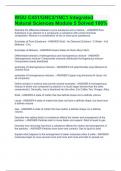
WGU C451/GNC2/1NC1 Integrated Natural Sciences Module 5 Solved 100%
Describe the difference between a pure substance and a mixture. - ANSWER-Pure Substance is an element or a compound; a substance with a fixed chemical composition. Mixture is a combination of two or more pure substances. Examples of Pure Substance - ANSWER-Gold - Au Diamond (Carbon) - C Water - H₂0 Methane - CH₄ Examples of Mixtures - ANSWER-Ocean Water Air Rock Alloy Fabric Differentiate between a heterogeneous and homogeneous mixture - ANSWER-Heterogeneous mixture- Components unevenly distributed Homogeneous mixture- Components evenly distributed examples of heterogeneous mixtures - ANSWER-Fruit salad Noodle soup Macaroni & Cheese Rock examples of homogeneous mixtures. - ANSWER-Copper ring Ammonia Air (local, not all compared) Define solution in science and provide several examples - ANSWER-A homogeneous mixture in which one component is present in a much larger amount than the other component(s). Generally, one is dissolved into the other. Ex) Coffee Tea, Vinegar, Alloy Solid - ANSWER-A state of matter that has definite shape and a definite volume. Liquid - ANSWER-A state of matter that does not have a definite shape, but does have a definite volume Gas - ANSWER-A state of matter that has neither a definite shape nor a definite volume. Describe how adding heat to a substance affects the motion and arrangement of the particles. - ANSWER-Particles start to move faster and expand. Solid to liquid to gas Describe how removing heat from a substance affects the motion and arrangement of the particles. - ANSWER-Particles slow down and contract. Gas to liquid to solid Explain what happens to the arrangement of water molecules when it melts - ANSWER-molecules begin to move around more and more and more and start to spread out. Explain what happens to the arrangement of water molecules when it freezes - ANSWER-molecules slow down and become more compacted Define elements. - ANSWER-Any material that is made up of only one type of atom is classified as an element. #of protons distinguishes one element from another Location of a Proton - ANSWER-Bound to a neutron at the atom's center to form the atomic nucleus Location of a Neutron - ANSWER-Bound to a proton at the atom's center to form the atomic nucleus Location of an Electron - ANSWER-in the mostly empty space surrounding the nucleus Charge of a Proton - ANSWER-+1 Charge of a Neutron - ANSWER-0 Charge of an Electron - ANSWER--1 What are nucleons? - ANSWER-A proton or a neutron What is the difference between atomic number and mass number of an atom? - ANSWER-Sum of protons vs. Sum of protons and neutrons Explain how you can determine the overall charge of an atom if you know the number of protons and the number of electrons? - ANSWER-Proton = +1 Electron = -1 Neutron= NO CHARGE Explain what must be true of the number of protons and electrons in an electrically neutral atom. - ANSWER-The number of protons equals the number of electrons; There is no charge shell model of the atom - ANSWER- Define valence electrons - ANSWER-an electron that is associated with an atom, and that can participate in the formation of a chemical bond How are the isotopes of an element different from one another? - ANSWER-They have different mass numbers and different numbers of neutrons. How do the chemical and physical properties of isotopes of the same element compare? - ANSWER-They have the same chemical and physical properties because they have the same amount of valence electrons. There is a possibility that one can become radioactive because the atom is unstable. Mass number of Iron-55 - ANSWER-55 Atomic number of Iron-55 - ANSWER-26 Proton number of Iron-55 - ANSWER-29 Neutron number of Iron-55 - ANSWER-29 Mass number of Iron-56 - ANSWER-56 Atomic number of Iron-56 - ANSWER-26 Proton number of Iron-56 - ANSWER-30 Neutron number of Iron-56 - ANSWER-30 How can you determine the number of neutrons in an isotope if you know the atomic number? - ANSWER-N=m-n (Neutrons= Atomic Mass- Atomic number) How does an atom of carbon-14 (14C) differ from an atom of carbon-12 (12C)? - ANSWER-carbon-14 (14C) has a mass number of 14; 6 protons and 6 neutrons carbon-12 (12C) has a mass number of 12; 6 protons and 8 neutrons Identify where on the periodic table are metals, nonmetals, and metalloids located. - ANSWER- general properties of metals - ANSWER-gold-opaque, yellowish, substance that is a solid at room temp and has a density of 19.3 grams per milliliter. (gold, zinc, sodium, etc.) general properties of non-metals - ANSWER-diamond-transparent, nonmetal that is solid at room temp, and has a density of 3.5 grams per milliliter. Water- nonmetal, transparent, liquid @ room temp and density of 1.0 gram per milliliter. (oxygen, carbon, etc.) general properties of metalloids - ANSWER-arsenic (silicon) Give some examples of how the properties of metals allow them to be used for a variety of purposes. - ANSWER-Generally solid, good conductor (copper and silver), malleable (aluminum foil), ductile (copper pulling into wires) Alkali metals Group Number - ANSWER-1 (1A) Alkali metals Number of Valence electrons - ANSWER-1 Alkali metals Gain or lose electrons? How many? - ANSWER-Lose 1
Document information
- Uploaded on
- June 22, 2023
- Number of pages
- 8
- Written in
- 2022/2023
- Type
- Exam (elaborations)
- Contains
- Questions & answers