CPCE sample test
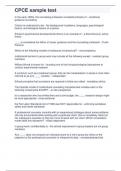
CPCE sample test In the early 1920s, the counseling profession consisted primarily of - vocational guidance counseling Culture is understood to be - the background of patterns, languages, psychological factors, and biological factors of a person Erikson's psychosocial developmental theory is an example of - a discontinuous, active theory ____ is considered the father of career guidance and the counseling profession - Frank Parsons Which of the following models of resistance is behavioral? - noncompliance Institutional barriers to group work may include all the following except - resistant group members William Wundt is known for - founding one of the first psychological laboratories to conduct experimental research A construct, such as a treatment group, that can be manipulated in a study is most often referred to as a(n) ____ variable. - independent Ethical principles that counselors are required to follow are called - mandatory ethics The tripartite model of multicultural counseling competencies includes each of the following components EXCEPT - an etic perspective for a researcher who has limited time and a low budget, the ____ research design might be most appropriate - cross-sectional the Fair Labor Standards Act of 1938 was NOT responsible for - enforcing workplace safety and health standards A professional counselor consults with an experienced colleague about some problems she has encountered while working with a particular client. She is completely reliant on her colleague's expertise to help her move forward with her client. Which consultation model does this represent? - triadic-dependent in group work, confidentiality is - the ethical requirement of group leaders but not group members A(n) ____ does not compare an individual score to a norm group but relies on the judgment of the professional counselor to interpret the data - nonstandardized test
Document information
- Uploaded on
- June 20, 2023
- Number of pages
- 10
- Written in
- 2022/2023
- Type
- Exam (elaborations)
- Contains
- Questions & answers