CMN 577 Unit 5 Student Question Bank.
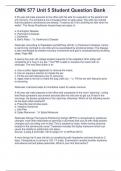
CMN 577 Unit 5 Student Question Bank A 55 year-old male presents to the office with his wife for evaluation of the patient's left arm tremors. The symptoms are increased when he gets upset. The wife has noticed that the patient's movements are slowed, "It seems as if he's shuffling his feet when he walks". The Nurse Practitioner knows these are signs of: a. Huntington Disease b. Parkinson's Disease c. Dementia d. Bell's Palsy - * b. Parkinson's Disease Rationale: According to Papadakis and McPhee (2015), In Parkinson's Disease, tremor is commonly confined to one limb and is exacerbated by emotional stress. The disease is also manifested by slowed voluntary movements and gait is characterized by shuffling steps. Page 988 A twenty-five year old college student presents to the outpatient clinic today with complaints of a "bug in my ear." The FNP is able to visualize the insect with an otoscope. The next best action is to: a. Use a cotton tipped applicator to remove the insect. b. Use an aqueous solution to irrigate the ear c. Fill the ear with lidocaine prior to removing. d. Apply heat to the ear to make the bug crawl out. - *c. Fill the ear with lidocaine prior to removing. Rationale: Lidocaine helps to immobilize insect for easier removal. A 46 year old male presents to the office with complaints of the room "spinning", noting that these symptoms last several seconds after he rolls over to get out of bed in the mornings. He denies symptoms of the 'spinning' otherwise. Which of the following would be the best initial treatment? a. Prescribe steroid dose pack b. Valsalva maneuver c. Hall Pike d. Epley Maneuver - *d. Epley Maneuver Rationale: Benign Paroxysmal Positioning Vertigo (BPPV) is recognized by positional changes, most often described as spinning or dizziness that occurs with head position changes such as rolling over in bed. This is caused by loose, freely moving otoconia located in the semicircular canal. Treatment includes the Epley maneuver which can cause the otoliths to settle back into place. Source: (Lustig & Schindler, 2015) (page 211 in McPhee 2015) A mom brings her 6 year old who is complaining with headache and sore throat for 2 days. Temperature on arrival is 102.1 F orally. Examination reveals tonsillar erythema and edema and soft palate petechiae. What is your first best action?
Document information
- Uploaded on
- June 19, 2023
- Number of pages
- 25
- Written in
- 2022/2023
- Type
- Exam (elaborations)
- Contains
- Questions & answers