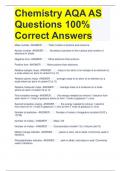
Chemistry AQA AS Questions 100% Correct Answers
Chemistry AQA AS Questions 100% Correct Answers Mass number -ANSWER Total number of protons and neutrons. Atomic number -ANSWER Numbers of protons in the nucleus and number of electrons in shells. Negative Ions -ANSWER More electrons than protons. Positive ions -ANSWER More protons than electrons. Relative isotopic mass -ANSWER mass of an atom of an isotope of an element on a scale where an atom of carbon12 is 12. Relative atomic mass -ANSWER average mass of an atom of an element on a scale where an atom of carbon12 is 12. Relative molecular mass -ANSWER average mass of a molecule on a scale where an atom of carbon12 is 12. First ionisation energy -ANSWER the energy needed too remove 1 electron from each atom in 1 mole of gaseous atoms to form 1 mole of gaseous 1+ ions. Second ionisation energy -ANSWER the energy needed to remove 1 electron from each ion in 1 mole of gaseous 1+ ions to form 1 mole of gaseous 2+ ions. Number of particles= -ANSWER Number of moles x Avagadros constant (6.02 x 10^23) Number of moles= -ANSWER Mass / Mr Number of moles= -ANSWER Concentration (moldm^-3) x Volume (dm^3) Methyl orange indicator -ANSWER yellow in acid, red in alkali. Commonly used in titrations. Phenolphthalein indicator -ANSWER pink in alkali, colourless in acid. Commonly used in titrations. Avogadros constant -ANSWER the number of atoms in 12g of carbon12 (6.02 x 10^23) Ideal gas equation -ANSWER Pv= nRT Empirical formula -ANSWER simplest whole number ratio of atoms of each element in a compound. Molecular formula -ANSWER gives the actual numbers of each element in a molecule. Percentage yield -ANSWER how much product was actually made compared with the amount of product that was expected theoretical yield -ANSWER the maximum mass of product expected in a reaction. actual yield -ANSWER the mass of product that is actually obtained in a reaction. Atom economy -ANSWER measure of the efficiency of a chemical reaction. The proportional mass of reactants that actually become part of the desired product in a balanced chemical equation. Ionic bonding -ANSWER Ions (metal and non metal) are held together by electrostatic forces of attraction due to the transferring of electrons. Eg: Sodium chloride. Mass spectrometer -ANSWER An instrument used to accurately determine the relative atomic mass. Separates atoms or molecules (gaseous positive ions) according to their charge and mass. Orbital -ANSWER Region in space where one is likely to find up to two electrons with opposite spin.
Written for
- Institution
- Chemistry AQA AS
- Course
- Chemistry AQA AS
Document information
- Uploaded on
- June 17, 2023
- Number of pages
- 13
- Written in
- 2022/2023
- Type
- Exam (elaborations)
- Contains
- Questions & answers
Subjects
- chemistry aqa as
-
chemistry aqa as questions
-
chemistry aqa as questions 100 correct answers

Also available in package deal