

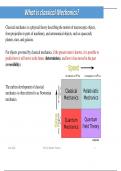
What is classical Mechanics?
Classical mechanics is a physical theory describing the motion of macroscopic objects,
from projectiles to parts of machinery, and astronomical objects, such as spacecraft,
planets, stars, and galaxies.
For objects governed by classical mechanics, if the present state is known, it is possible to
predict how it will move in the future (determinism), and how it has moved in the past
(reversibility).
The earliest development of classical
mechanics is often referred to as Newtonian
mechanics.
wikipedia
Even 2022 PH 212 (Modern Physics) 1
, What is classical Mechanics?
Classical mechanics was traditionally divided into three main branches:
Statics: the study of equilibrium and its relation to forces
Dynamics: the study of motion and its relation to forces
Kinematics: dealing with the implications of observed motions without regard for
circumstances causing them
Another division is based on the choice of mathematical formalism:
• Newtonian mechanics
• Lagrangian mechanics
• Hamiltonian mechanics
Alternatively, a division can be made by region of application:
Celestial mechanics: relating to stars, planets and other celestial bodies
Continuum mechanics: for materials modelled as a continuum, e.g., solids and fluids (i.e.,
liquids and gases).
Relativistic mechanics: (i.e. including the special and general theories of relativity), for
bodies whose speed is close to the speed of light.
Statistical mechanics: which provides a framework for relating the microscopic properties
of individual atoms and molecules to the macroscopic or bulk thermodynamic properties of
materials.
Even 2022 PH 212 (Modern Physics) 2
, Macroscopic world: Microscopic world:
A basket of cherries A single cherry
Many of them (identical) Either, we look at it without eating, It is
We can see them and taste others red Or we eat it, it is good.
Taking one has negligible effect We can not try both at the same time
Cherries are both red and good. The cherry could not be good and red at
the same time.
Even 2022 PH 212 (Modern Physics) 3
, Where classical mechanics fails?
Various phenomena could not be explained by classical mechanics such as:
• Black-Body radiation spectrum
• Specific heat
• Stability of atoms
• Spectrum of hydrogen emissions
• Photoelectric effect
• Compton scattering
• Wave-Particle Duality
Although, classical physics does not hold for microscopic regions (atoms, electrons
etc.), it does still hold well for the macroscopic world.
Even 2022 PH 212 (Modern Physics) 4
Classical mechanics is a physical theory describing the motion of macroscopic objects,
from projectiles to parts of machinery, and astronomical objects, such as spacecraft,
planets, stars, and galaxies.
For objects governed by classical mechanics, if the present state is known, it is possible to
predict how it will move in the future (determinism), and how it has moved in the past
(reversibility).
The earliest development of classical
mechanics is often referred to as Newtonian
mechanics.
wikipedia
Even 2022 PH 212 (Modern Physics) 1
, What is classical Mechanics?
Classical mechanics was traditionally divided into three main branches:
Statics: the study of equilibrium and its relation to forces
Dynamics: the study of motion and its relation to forces
Kinematics: dealing with the implications of observed motions without regard for
circumstances causing them
Another division is based on the choice of mathematical formalism:
• Newtonian mechanics
• Lagrangian mechanics
• Hamiltonian mechanics
Alternatively, a division can be made by region of application:
Celestial mechanics: relating to stars, planets and other celestial bodies
Continuum mechanics: for materials modelled as a continuum, e.g., solids and fluids (i.e.,
liquids and gases).
Relativistic mechanics: (i.e. including the special and general theories of relativity), for
bodies whose speed is close to the speed of light.
Statistical mechanics: which provides a framework for relating the microscopic properties
of individual atoms and molecules to the macroscopic or bulk thermodynamic properties of
materials.
Even 2022 PH 212 (Modern Physics) 2
, Macroscopic world: Microscopic world:
A basket of cherries A single cherry
Many of them (identical) Either, we look at it without eating, It is
We can see them and taste others red Or we eat it, it is good.
Taking one has negligible effect We can not try both at the same time
Cherries are both red and good. The cherry could not be good and red at
the same time.
Even 2022 PH 212 (Modern Physics) 3
, Where classical mechanics fails?
Various phenomena could not be explained by classical mechanics such as:
• Black-Body radiation spectrum
• Specific heat
• Stability of atoms
• Spectrum of hydrogen emissions
• Photoelectric effect
• Compton scattering
• Wave-Particle Duality
Although, classical physics does not hold for microscopic regions (atoms, electrons
etc.), it does still hold well for the macroscopic world.
Even 2022 PH 212 (Modern Physics) 4


