Post-Transcriptional Regulation
How are different proteins produced from the same genomic DNA?
- Different mRNAs are produced from different promoters
- Cells make cell-specific TFs and splicing factors (ISS, ISE, ESS, ESE)
- Therefore different promoters on the gDNA template are recognised
producing different mRNAs
- mRNAs can undergo different alternative splicing events resulting in
different proteins
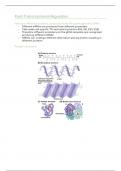
Protein structure
,RNA structure
Regulation of alternative splicing
- Splicing is tissue-specific
- Different mRNAs will therefore encode for unique proteins
- This is mediated by tissue-specific splice factors
- Processing vs. discard decisions are also made
- Unspliced RNA would be degraded within the nucleus or
transported to the cytoplasm
- If it is transported and unable to make a functional protein, it is
degraded via nonsense-mediated degradation pathway
- Alternative splicing - when a single gene is transcribed in different
tissues and each processed differently to yield different functional
mRNAs
- In most cases these RNAs are translated to yield different protein
products
- This is a frequent process in embryonic development, sex
determination, muscular contractions, neuronal functioning etc.
- In humans, 90% of genes undergo alternative splicing
- Regulation of splicing is linked to regulation of transcription
- Alternatively spliced genes is only transcribed in certain ell types
, How can alternative splicing be mediated?
- Differential use of promoters
- Folding of the transcript
- Trans-acting proteins that bind to cis-acting sites
- Rate of transcription elongation
- Amount of splicing factors present
Model 1: Differential use of promoters
- Involves situations where the 5’ end of the alternatively processed
transcript is different
- Two alternative transcripts are produced by transcription from different
promoter elements
- Two promoters can occur upstream of the first exon or may be
separated by exons yielding alternative spliced transcripts
- Different promoter sequences recruit different TFs which position RNA
pol on different sites so that different lengths of mRNAs are formed
Model 2: Folding of the pre-mRNA transcript
- Folding favours different splicing events via recruitment of different
protein complexes
- This is dependent on the sequence and rate of transcription
How are different proteins produced from the same genomic DNA?
- Different mRNAs are produced from different promoters
- Cells make cell-specific TFs and splicing factors (ISS, ISE, ESS, ESE)
- Therefore different promoters on the gDNA template are recognised
producing different mRNAs
- mRNAs can undergo different alternative splicing events resulting in
different proteins
Protein structure
,RNA structure
Regulation of alternative splicing
- Splicing is tissue-specific
- Different mRNAs will therefore encode for unique proteins
- This is mediated by tissue-specific splice factors
- Processing vs. discard decisions are also made
- Unspliced RNA would be degraded within the nucleus or
transported to the cytoplasm
- If it is transported and unable to make a functional protein, it is
degraded via nonsense-mediated degradation pathway
- Alternative splicing - when a single gene is transcribed in different
tissues and each processed differently to yield different functional
mRNAs
- In most cases these RNAs are translated to yield different protein
products
- This is a frequent process in embryonic development, sex
determination, muscular contractions, neuronal functioning etc.
- In humans, 90% of genes undergo alternative splicing
- Regulation of splicing is linked to regulation of transcription
- Alternatively spliced genes is only transcribed in certain ell types
, How can alternative splicing be mediated?
- Differential use of promoters
- Folding of the transcript
- Trans-acting proteins that bind to cis-acting sites
- Rate of transcription elongation
- Amount of splicing factors present
Model 1: Differential use of promoters
- Involves situations where the 5’ end of the alternatively processed
transcript is different
- Two alternative transcripts are produced by transcription from different
promoter elements
- Two promoters can occur upstream of the first exon or may be
separated by exons yielding alternative spliced transcripts
- Different promoter sequences recruit different TFs which position RNA
pol on different sites so that different lengths of mRNAs are formed
Model 2: Folding of the pre-mRNA transcript
- Folding favours different splicing events via recruitment of different
protein complexes
- This is dependent on the sequence and rate of transcription