
Neuron Structures
8.1 Know the structure and function of sensory, relay and motor neurones including the role of Schwann
cells and myelination.
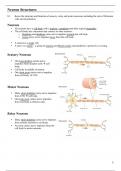
Neurons
• All neurons have a cell body with a nucleus, cytoplasm and other typical organelles.
• The cell body has extensions that connect to other neurons:
o Dendrites and dendrons carry nerve impulses towards the cell body.
o Axons carry nerve impulses away from the cell body.
• A neuron is a single cell.
• A nerve is a tissue – a group of neurons and blood vessels surrounded by a protective covering.
Sensory Neurons
• One long dendron carries nerve
impulses from receptor cells ! cell
body.
• Cell body in middle of neuron.
• One short axon carries nerve impulses
from cell body ! CNS
Motor Neurons
• Many short dendrites carry nerve impulses
from CNS ! cell body.
• One long axon carries nerve impulses
from cell body to effector cells.
Relay Neurons
• Many short dendrites carry nerve impulses
from sensory neurons to cell body.
• An axon carries nerve impulses from the
cell body to motor neurons.
5
, Resting Potential
Membrane Potential
• Membrane Potential: Voltage across a cell’s plasma membrane.
• The inside of a cell is negative relative to the outside.
• Resting Potential: Membrane potential of an non-stimulated neuron.
• The resting potential is maintained by ion pumps and channels in the plasma membrane.
• Action Potential: The series of changes in the membrane potential of a neuron caused by an
electrical impulse.
• These changes occur as charged ions move into and out of the neuron across the plasma membrane.
Establishing and Maintaining Resting Potential
The Na+/K+ pump, located within the plasma membrane of a neuron, establishes a concentration gradient for
Na+ and K+.
1. 3 Na+ ions in the cytoplasm bind to the Na+/K+ pump.
2. ATP is hydrolysed into ADP + Pi.
3. Pi binds to the Na+/K+ pump, causing the 1st conformational change.
4. The 3 Na+ ions are released into the extracellular fluid.
5. 2 K+ ions in the extracellular fluid bind to the Na+/K+ pump.
6. Pi is released from the pump, causing the 2nd conformational change.
7. The 2 K+ ions are released into the cytoplasm.
K+ channels and Na+ channels are also present within the cell membrane:
• K+ channels allow for the passive diffusion of K+ ions out of the cell, down their conc. gradient.
• The membrane is much less permeable to Na+ due to the presence of fewer Na+ channels.
• Hence the passive diffusion of Na+ makes negligible contribution to the resting potential.
• There is an overall electrochemical equilibrium for K+ which polarises the membrane to a resting
potential of -70mV.
6
8.1 Know the structure and function of sensory, relay and motor neurones including the role of Schwann
cells and myelination.
Neurons
• All neurons have a cell body with a nucleus, cytoplasm and other typical organelles.
• The cell body has extensions that connect to other neurons:
o Dendrites and dendrons carry nerve impulses towards the cell body.
o Axons carry nerve impulses away from the cell body.
• A neuron is a single cell.
• A nerve is a tissue – a group of neurons and blood vessels surrounded by a protective covering.
Sensory Neurons
• One long dendron carries nerve
impulses from receptor cells ! cell
body.
• Cell body in middle of neuron.
• One short axon carries nerve impulses
from cell body ! CNS
Motor Neurons
• Many short dendrites carry nerve impulses
from CNS ! cell body.
• One long axon carries nerve impulses
from cell body to effector cells.
Relay Neurons
• Many short dendrites carry nerve impulses
from sensory neurons to cell body.
• An axon carries nerve impulses from the
cell body to motor neurons.
5
, Resting Potential
Membrane Potential
• Membrane Potential: Voltage across a cell’s plasma membrane.
• The inside of a cell is negative relative to the outside.
• Resting Potential: Membrane potential of an non-stimulated neuron.
• The resting potential is maintained by ion pumps and channels in the plasma membrane.
• Action Potential: The series of changes in the membrane potential of a neuron caused by an
electrical impulse.
• These changes occur as charged ions move into and out of the neuron across the plasma membrane.
Establishing and Maintaining Resting Potential
The Na+/K+ pump, located within the plasma membrane of a neuron, establishes a concentration gradient for
Na+ and K+.
1. 3 Na+ ions in the cytoplasm bind to the Na+/K+ pump.
2. ATP is hydrolysed into ADP + Pi.
3. Pi binds to the Na+/K+ pump, causing the 1st conformational change.
4. The 3 Na+ ions are released into the extracellular fluid.
5. 2 K+ ions in the extracellular fluid bind to the Na+/K+ pump.
6. Pi is released from the pump, causing the 2nd conformational change.
7. The 2 K+ ions are released into the cytoplasm.
K+ channels and Na+ channels are also present within the cell membrane:
• K+ channels allow for the passive diffusion of K+ ions out of the cell, down their conc. gradient.
• The membrane is much less permeable to Na+ due to the presence of fewer Na+ channels.
• Hence the passive diffusion of Na+ makes negligible contribution to the resting potential.
• There is an overall electrochemical equilibrium for K+ which polarises the membrane to a resting
potential of -70mV.
6


