
Cell Membranes
2.2 i) Know the structure and properties of cell membranes.
ii) Understand how models such as the fluid mosaic model of cell membranes are interpretations of
data used to develop scientific explanations of the structure and properties of cell membranes.
Phospholipid Bilayer
• Cell membrane, consisting of two layers of phospholipids.
Triglyceride Molecules
• Triglycerides – made up of 3 fatty acids and 1 glycerol
molecule, linked by condensation reactions.
• Ester Bond – bond formed between each fatty acid and
glycerol.
Phospholipids
• In a phospholipid, there is glycerol, 2 fatty acids and a
negatively charged phosphate group (which replaces the third
fatty acid).
• Both phospholipid and triglycerides possess fatty acids, ester
bonds and a glyceride molecule.
Orientation of Phospholipids
• Phospholipid molecules have a head and a tail:
o Head – contains phosphate group; hydrophilic because the phosphate is polar
o Tail – contains 2 fatty acids; hydrophobic because fatty acids are non-polar
• Therefore, the molecules arrange themselves into a bilayer.
o Head = hydrophobic – face outwards, towards water.
o Tail = hydrophilic – face inwards, away from water.
• The membrane has selective permeability:
o Lipid soluble molecules easily pass through by diffusion.
o Hydrophobic substances cannot diffuse through.
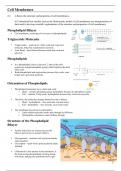
Structure of the Phospholipid
Bilayer
• Protein molecules are scattered across the
bilayer and can move around within it.
• Glycoproteins – proteins with a polysaccharide
chain attached.
• Glycolipids – lipids with a polysaccharide chain
attached.
• Cholesterol is also present in the membrane. It
fits between the phospholipid, forming bonds
with them, making the membrane more rigid.
5
2.2 i) Know the structure and properties of cell membranes.
ii) Understand how models such as the fluid mosaic model of cell membranes are interpretations of
data used to develop scientific explanations of the structure and properties of cell membranes.
Phospholipid Bilayer
• Cell membrane, consisting of two layers of phospholipids.
Triglyceride Molecules
• Triglycerides – made up of 3 fatty acids and 1 glycerol
molecule, linked by condensation reactions.
• Ester Bond – bond formed between each fatty acid and
glycerol.
Phospholipids
• In a phospholipid, there is glycerol, 2 fatty acids and a
negatively charged phosphate group (which replaces the third
fatty acid).
• Both phospholipid and triglycerides possess fatty acids, ester
bonds and a glyceride molecule.
Orientation of Phospholipids
• Phospholipid molecules have a head and a tail:
o Head – contains phosphate group; hydrophilic because the phosphate is polar
o Tail – contains 2 fatty acids; hydrophobic because fatty acids are non-polar
• Therefore, the molecules arrange themselves into a bilayer.
o Head = hydrophobic – face outwards, towards water.
o Tail = hydrophilic – face inwards, away from water.
• The membrane has selective permeability:
o Lipid soluble molecules easily pass through by diffusion.
o Hydrophobic substances cannot diffuse through.
Structure of the Phospholipid
Bilayer
• Protein molecules are scattered across the
bilayer and can move around within it.
• Glycoproteins – proteins with a polysaccharide
chain attached.
• Glycolipids – lipids with a polysaccharide chain
attached.
• Cholesterol is also present in the membrane. It
fits between the phospholipid, forming bonds
with them, making the membrane more rigid.
5


