Linton: Medical-Surgical Nursing, 7th Edition
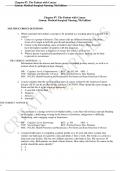
1. Which statement best defines concepts to be included in a teaching plan for a patient with cancer? a. Cancer is a group of diseases. The cancer cells are different from the cells in the tissue of its origin in both the growth and spreading of abnormal cells. b. Cancer is the third leading cause of death in the United States. Many hospitals have the highest number of patients with this diagnosis. c. Americans who have a diagnosis of cancer die within 1 year or less. d. When a person is genetically predisposed to a type of cancer, nothing can be done to prevent its occurrence. THE CORRECT ANSWER IS: A Information about the disease and disease process is helpful to allay anxiety, as well as to instruct about its pathophysiologic changes. 4. What phase is considered the latent period before the period of rapid growth of tumors? a. Initiation b. Promotion c. Progression d. Metastasis THE CORRECT ANSWER IS: B The stage of promotion is the latest period in which a cell is quiet, just before the rapid growth and tumor production, which begins in the progression phase. 13. A patient whose cancer has been staged at T4 N2 M1 has been assigned for care. What is the best interpretation of this staging information in planning care for this patient? a. The primary tumor has shrunk, although some lymph nodes remain involved. Teach the patient that this is good news. b. The primary tumor has now responded to a combination of chemotherapy and radiation. The patient should now receive much less analgesic medication. c. The primary tumor is quite large and has extended to lymph glands and distant areas. Gentle touch and therapeutic listening will be especially helpful. d. After the series of radiation treatments, the distant metastases are still present. Prepare the patient to accNept RonlyItheGcuBre.oCf theMprimary tumor. THE CORRECT ANSWER IS: C
Document information
- Uploaded on
- June 12, 2023
- Number of pages
- 12
- Written in
- 2022/2023
- Type
- Exam (elaborations)
- Contains
- Questions & answers