

Exercise
1.5
Question 1:
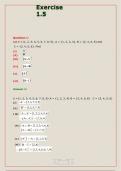
Let U ={1, 2, 3; 4, 5, 6, 7, 8, 9}, A = {1, 2, 3, 4}, B = {2, 4, 6, 8} and
C = {3, 4, 5, 6}. Find
(i)
(ii)
(iii)
(iv)
(v)
(vi)
Answer 1:
U ={1, 2, 3, 4, 5, 6, 7, 8, 9} A = {1, 2, 3, 4} B = {2, 4, 6, 8} C = {3, 4, 5, 6}
( i)
( ii )
( iii )
( iv )
(v )
( vi )
1
, Question 2:
If U = {a, b, c, d, e, f, g, h}, find the complements of the following sets:
(i) A = {a, b, c}
(ii) B = {d, e, f, g}
(iii) C = {a, c, e, g}
(iv) D = {f, g, h, a}
Answer 2:
U = {a, b, c, d, e, f, g, h}
(i) A = {a, b, c}
(i) B = {d, e, f, g}
(ii) C = {a, c, e, g}
(iii) D = {f, g, h, a}
Question 3:
Taking the set of natural numbers as the universal set, write down the
complements of the following sets:
(i) {x: x is an even natural number}
(ii) {x: x is an odd natural number}
(iii) {x: x is a positive multiple of 3}
(iv) {x: x is a prime number}
(v) {x: x is a natural number divisible by 3 and 5}
(vi) {x: x is a perfect square}
(vii) {x: x is perfect cube}
2
1.5
Question 1:
Let U ={1, 2, 3; 4, 5, 6, 7, 8, 9}, A = {1, 2, 3, 4}, B = {2, 4, 6, 8} and
C = {3, 4, 5, 6}. Find
(i)
(ii)
(iii)
(iv)
(v)
(vi)
Answer 1:
U ={1, 2, 3, 4, 5, 6, 7, 8, 9} A = {1, 2, 3, 4} B = {2, 4, 6, 8} C = {3, 4, 5, 6}
( i)
( ii )
( iii )
( iv )
(v )
( vi )
1
, Question 2:
If U = {a, b, c, d, e, f, g, h}, find the complements of the following sets:
(i) A = {a, b, c}
(ii) B = {d, e, f, g}
(iii) C = {a, c, e, g}
(iv) D = {f, g, h, a}
Answer 2:
U = {a, b, c, d, e, f, g, h}
(i) A = {a, b, c}
(i) B = {d, e, f, g}
(ii) C = {a, c, e, g}
(iii) D = {f, g, h, a}
Question 3:
Taking the set of natural numbers as the universal set, write down the
complements of the following sets:
(i) {x: x is an even natural number}
(ii) {x: x is an odd natural number}
(iii) {x: x is a positive multiple of 3}
(iv) {x: x is a prime number}
(v) {x: x is a natural number divisible by 3 and 5}
(vi) {x: x is a perfect square}
(vii) {x: x is perfect cube}
2


