DAANCE- Module 3- Anesthetic Drugs & Techniques Already Graded A
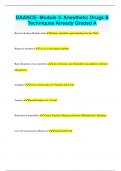
DAANCE- Module 3- Anesthetic Drugs & Techniques Already Graded A Brevital (Sodium Methohexital) Primary anesthetic agent introduced in the 1960's. Balanced Anesthesia Use of several agents together Basic Requisites of an Anesthetic Lack of toxicity, non-flammable, non-addictive, minimal allergenicity. Analgesia Given to feel no pain (ex: Fentanyl and Local) Amnesia Benzodiazepines (ex: Versed) Relaxation & Immobility Versed, Propofol (Diprivan), Brevital (Methohexital), Ketamine Loss of Consciousness (Hypnosis) Propofol & Brevital Wakefulness System Core of brainstem, neurons to cerebrum. When a sleep inducing drug is introduced it interrupts transmission. Anxiolytic (Anxiety Reducing) Meds Diazepam or Midazolam Relay Center Sensory neurons that sense pain pass through this. Homeostasis (Homeostatic State) Normal state in which there is minimal variation in respiration and circulation. Pharmacokinetics The effects that the body has on drugs. Pharmacodynamics The effects that the drug has on various body systems. Rapid Redistribution Short acting drug only remain attached to the receptor sites for a short time and then move to the other tissues. PO (per os) Through the mouth. (Delayed onset, unpredictable effects, patient compliance, not good when pt in nauseated) Subcutaneous (SQ) Beneath the Skin (Absorption is somewhat delayed compared to IM or IV) Intramuscular (IM) In the muscle (Unpredictable onset of drug effect, cannot titrate the dose) Intravenous (IV) In the vein Inhalation Route Inhaled (Very rapid absorption and titration) 4 Levels of Continuum Minimal Sedation, Moderate Sedation, Deep Sedation (Analgesia), and General Anesthesia Minimal Sedation (Anxiolysis) Normal response to verbal stimulation, cardiovascular function unaffected. Moderate Sedation (Conscious Sedation) Normal response to verbal or light tactile stimulation with cardiovascular function usually maintained. Deep Sedation (Analgesia) Not easily aroused but has purposeful response after repeated or painful stimulation. General Anesthesia Not a rousable even with painful stimulation. Diffusion hypoxia Nitrous Oxide rapidly moves from the blood to the alveoli of the lungs and displaces other gases, including oxygen. Hypoxia Low levels of oxygen in the bodies tissues. Hypercarbia An increased level of carbon dioxide. Anxiolytic Triazolam, Diazepam, Modazolam Propofol (Diprivan) Has antiemetic (anti-nausea) properties, insoluble in water, highly lipid soluble. Propofol (Diprivan) Respiratory depressant and apnea may be noted after on induction dose. Ketamine (Ketalar) Dissociative drug. Eye, cough and swallow reflexes are still present, eyes are open, but gaze in distant or wandering. Nystagmic Gaze Distant or wandering gaze. Ketamine (Ketalar) Undergoes metabolism in the liver, and excreted in the urine. Ketamine(Ketalar) Increase in cerebral oxygen consumption, cerebral blood flow and intracranial pressure. Ketamine (Ketalar) Stimulates the cardiovascular system, increases BP, heart rate and cardiac output. Contraindications to Ketamine use. Severe cardiovascular disease, severe hypertension, glaucoma (not controlled), severe psychotic illnesses, pregnancy. Barbiturates Taken up by body fat and released into the system slowly, depressing the CNS. Barbiturates Detoxified in the liver. Side effects of Brevital Apnea on induction, laryngospasm, bronchospasm, hypotension, tachycardia, hiccups, and muscle twitching. Esters Metabolized in the bloodstream by an enzyme known as pseudocholinesterase. Amides Metabolized more slowly in the liver. Esters Cocaine, Procain (Novocaine) Amides Lidocaine (max 10 or 11 carpules) Amides Mepivacaine (Carbocaine) (max 7-8 carpules) Amides Prilocaine (Citamest) (max 6 carpules) Amides Bupivacaine (Marcaine) (max 10 carpules) Amides Articaine (Septocaine) (max 7 carpules) Sympatho-mimetic Mimics the effects of the sympathetic nervous system. Anxiolytic Dissolving anziety Paradoxical Effect Patients exhibit an excitement with the administration of Diazepam rather than a tranquilization. Midazolam (Versed) 3-6 times more potent than Diazepam. Morphine Major action in analgesia but also produces drowsiness, euphoria and sedation. Meperidine (Demerol) Has a slight drying effect, commonly used for postoperative pain. Fentanyl (Sublimaze) 100 times more potent than morphine. Rapid onset of action, duration of only 30-45 minutes Remifentanil (Ultiva) Metabolized by enzymes throughout the body. Very rapid dissipation. Rapid onset of action, duration of only 5-10 minutes. Can be used in patients with liver and kidney failure. Narcotic Reversals Naloxone (Narcan), Pentazocine (Talwin), Nalbuphine (Nubain), Butorphanol Tartrate (Stadol), Flumazenil (Romazicon) Narcotic Agonist-Antagonist Reverse the effects of narcotics, and when given by themselves have agonistic or therapeutic properties. Anticholinergic Decrease secretions of the salivary glands, thus helping to provide a dry airway during surgery. Anticholinergic Agents Atropine, Scopolamine, Glycopyrrolate (Robinul) Antiemetics Antihistamines, Chlorpromazine (Thorazine), Prochlorperazine (Compazine), Metoclopramide (Reglan) Antiemetics Trimethobenzamide (Tigan), Ondansetron (Zofran), Corticosteroids, Benzodiazepines Steroids Dexamethasone (Decadron), Methylprednisolone (Solu-Medrol), Hydrocortisone (Solu-Cartef) Muscle Relaxants Succinylcholine (Anectine) Fasciculation Total body muscle twitching. Succinylcholine (Anectine) Can be a significant trigger for malignant hyperthermia in susceptible individuals, either adults or children. Short Acting. Rocuronium Steroid based, short to intermediate acting muscle relaxant with rapid onset of action. Not a triggering agent for malignant hypertheria. Long acting Halogenated Hydrocarbons Inhalation agents used for general anesthesia.
Document information
- Uploaded on
- June 9, 2023
- Number of pages
- 10
- Written in
- 2022/2023
- Type
- Exam (elaborations)
- Contains
- Questions & answers