
Chemistry
Distinguish and understand the terms used to classify matter: Elements, Compounds,
Molecules, Mixtures and Pure substances
● Elements - are pure substances that can not be broken down into simpler
substances. They are composed of only one type of atom (e.g. H for hydrogen, O for
Oxygen etc.)
● Compounds - are pure substances composed of two or more different elements
chemically combined in a fixed ratio (they can be broken down). For example H20
(water), is a compound
● Molecules - molecules are formed when two or more atoms are chemically bonded
together. Either the same element or a different element can be bonded together. For
example O2, or N2 or H20
● Mixtures - are combinations of two or more substances that are physically mixed
together but not chemically bonded. For example saltwater (mixture of salt and
water)
● Pure substances - is a type of material that is made up of only one kind of particle.
These particles can either be atoms or molecules. For example water is a pure
substance because it is made up of only water molecules. Water will always be
formed by many molecules (with 2 hydrogen atoms and one oxygen atom)
use “group" and "period" to describe patterns of organisation in terms of protons, electron
composition, and chemical reactivity
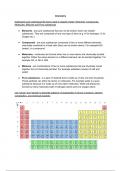
, ● Groups - are the vertical columns. Elements in the same group have the same
number of electrons in their outermost energy level.
○ Group 1 → has 1 valence electron
○ Group 2 → has 2 valence electrons
○ Group 3 → has 3 valence electrons
○ Etc.
● Group 1: Alkali Metals
● Group 2: Alkaline Earth Metals
● Group 7: Halogenes
● Group 8: Noble Gases
● Periods - are horizontal rows in a periodic table. Elements in the same period share
the same number of electron shells
identify the divide between metals and non-metals
● Metals are separated by nonmetals on a periodic table through a zigzag line starting
from carbon, till radon.
identify that atoms have neutral neutrons, positive protons and are surrounded by
negatively-charged electrons.
● Atoms are composed of 3 subatomic particles:
○ Neutrons - Neutral particles, found within the nucleus of an atom
○ Protons - Positively charged particles (+1), also found within the nucleus of
an atom
○ Electrons - Negatively charged particles (-1), that orbit around the nucleus of
an atom
Be able to predict the # of p+, n and e- in an atom given the Mass number and Atomic
number.
● The atomic number tells us the number of protons, which is equal to the number of
electrons
● To find the number of neutrons, you must take the atomic mass and subtract the
atomic number


