
BUSINESS OBJECTIVES:
Most firms have the rational business objective of profit maximisation, which is achieved
when marginal cost (MC) = marginal revenue (MR) because then no additional profit can be
extracted by producing another unit of output but beyond this the firm is making a marginal
loss on each unit produced.
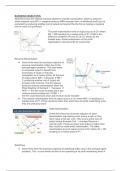
The profit maximisation level of output occurs at Q1 where
MC = MR resulting in a market price of P1. Profit is the
difference between AR and AC at Q1, shown by the
shaded area. Social enterprises/ not for profit
organisations reinvest profit for social aims
Revenue Maximisation
● Some firms have the business objective of
revenue maximisation (often due to the
principal agent problem). This also leads
to increased output to benefit from
economies of scale or reducing
competition as it lowers prices. At the level
of output where MR = 0 because if MR >
0, producing another unit of output will
increase total revenue. The firm always
achieves revenue maximisation when the
Price Elasticity of Demand = 1 because If
PED < 1 the firm could increase price and
revenue would increase but If PED > 1
the firm could decrease price and revenue would increase
● The revenue maximisation level of output occurs at Q1 where MR = 0 resulting in a
market price of P1. Prices would be lower than when they are profit maximising since
they are producing more.
Sales Maximisation
Some firms have the business objective of sales
maximisation (eg clearing stock during a sale so they
don't make a loss per unit). This occurs at the level of
output where Average Cost = Average Revenue =
normal profit . Prices are lower and output is higher than
they would be under profit maximisation. The sales
maximisation level of output occurs at Q1 where AC = AR
resulting in a market price of P1
Satisficing
● Some firms have the business objective of satisficing (often due to the principal agent
problem). This occurs where the firm is not operating at its profit maximising level of
, output but is able to meet other objectives. Occurs at any point between profit max
and sales max
DEMAND/SUPPLY FOR LABOUR
Demand for labour: how many workers an employer is willing
and able to hire at a given wage rate at a given time period.
This slopes downwards because there is an inverse
relationship between labour and the wage rate.
If wages rise, demand for capital increases because this is a
substitute for labour.
A shift in the curve is from non wage factors
Shifters include: rise in demand for your product, change in
market price of your output, increased productivity,
government employment subsidies, change in cost of capital
Derived demand for labour: the demand for a factor of production used to produce another
good or service eg steel for cars/buildings
Total Physical Product- everything that is produced
Marginal Physical Product- the additional product from employing one more worker
Marginal revenue product- the additional revenue gained from employing 1 more worker
MRP- wage rate is the contribution of each worker
The MRP curve = maximum price a firm would pay for an extra unit of a factor of production
Wage elasticity of demand = % change qd labour / % change wage rate
This is determined by things like: labour as a percentage of total cost, ease and cost of
factor substitution (elastic when switching to capital instead is easy) and PED of your output.
Labour supply: the total hours that workers wish to work at a
given real wage rate.
The opportunity cost of working is your leisure time = labour-
leisure trade off.
Rising wages attract other workers to enter the industry as an
incentive
A positive income effect is when higher wages mean we want
to work more hours to reach a target income, but a negative
income effect is when you've reached that target due to
higher wages so prefer your leisure time. This is the opposite
of the substitution effect which says that when wages rise the
opportunity cost of leisure is too high so we work more hours.
A backwards bending labour supply curve shows a negative
income effect.
, Labour supply is affected by things like: inward migration of suitably experienced workers,
changes in pay to substitute careers, barriers to entry of the career, demographic changes
(ageing population etc), brain drain, decline in non monetary rewards (eg too stressful),
expectations of the economy (eg higher pension) and improved occupational mobility
Non wage influences would include: the job risks, anti-social hours, pensions, strength of
vocation, conditions, overseas working and flexibility.
The elasticity of labour supply is the extent to which labour supply responds to a change in
the wage rate in a given time period.
This is affected by things like: the skills required (more training is less elastic as it lowers the
available labour pool), your vocation level (more love is more inelastic), the level of
unemployment (More is more elastic), the time period (inelastic in short run as no time to
retrain) and the geographical and occupational mobility
Economic rent is the amount earned by a factor of
production above the minimum amount required for them
to work in an industry
Transfer earnings is the minimum reward required to
keep a factor of production in its current occupation
If labour supply is inelastic, more of the labour reward is
economic rent than transfer earnings.
COST/PRODUCT/REVENUE/PROFIT
A cost - the opportunity cost of production for a firm.
Imputed/implicit costs - resources with an opportunity cost
for which no payment is made
Accounting costs- explicit costs
Economic costs- accounting + implicit costs
Depreciation- the difference between the purchase price
and the second hand value
Financial capital - a lump sum that's invested
Labour- the value of the workers time
Goodwill- a brands good reputation, earns them interest
Fixed cost- costs that do not vary with output (short run)
Variable cost- vary with output
Semi-variable cost- composed of both fixed and variable
elements.
Short run- at least one of the factor inputs is fixed (often
land or capital)
Long run- all factors of production/scale of production
are variable
Total product- same as total output


