
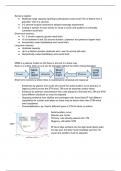
Sensory register :
● Relatively large capacity (sperling's participants could recall 75% of letters from a
grid after 1/20 of a second)
● 0-2 second duration (treisman's delayed message experiment)
● Coding is specific to each sense so visual is iconic and auditory is echoically
(crowders recall test)
Short term memory :
● 7+- 2 chunks capacity (jacobs recall test)
● 18 (or between 6 and 30) second duration (peterson and peterson trigram test)
● Acoustically coded (baddeleys word recall test)
Long term memory:
● Unlimited capacity
● Up to a lifetime duration (bahricks who i went to school with test)
● Semantically coded (baddeleys word recall test)
MSM is a passive model so info flows in and out in a linear way
Each is a unitary store so one can be damaged without the others being damaged
Sens Short Long
ory term term
From regist attentio mem retriev Prolon mem
er ory ory
Short term memory is where there is maintenance rehearsal and response
- Evidenced by glanzer and cunitz who found the serial position curve (primary vs
regency) which proves the STM and LTM must be separate unitary stores
- Evidence by peterson and peterson who used trigrams to find that the LTM and STM
have different durations so must be separate
- Opposing evidence from shallice and warrington who found that KF had different
capabilities for number and letters so there may be stores other than STM which
aren't explained
- Oversimplification, eg there's different types of LTM for facts vs actions
Serial position curve;
Glanzer and Cunitz
Primacy- has already passed into LTM
Regency- still within STM
Kf had a bike accident and his digit recall (being read
to) was poor but letter recall (reading) was fine. So
visual and auditory must be separate.
, Tulvings three types of LTM
Episodic
● Experiences that have to be consciously remember (declarative)
● Easily forgotten
● Associated with the time/place/emotions we did at that time
Semantic
● Facts we consciously remember (declarative)
● Easily forgotten
● Don't remember where we learnt them
Procedural
● Skills and actions we can unconsciously do (non declarative)
● Resistant to forgetting
● We can't really explain them because we do them unawarely
Baddeley and hitch: WMM (stm as several connected stores that
are being worked on)
All stores have a limited capacity because information is passed
on
Central Executive - A problem solving and decision making
attention system. Directs info to the correct store (has limited
capacity). Codes from all senses
VisuoSpatial Sketchpad- processes in a visual/ spatial form (how
things look and related) with visual coding but limited capacity.
Inner Scribe -visual rehearsal device about how items relate to each other (spatial)
Visual Cache - temporary visual store
Phonological Loop- processes auditory information with auditory coding, limited capacity
Articulatory Control System- verbal rehearsal device for words we see or hear
Phonological Store - understands and stores words we hear as speech
Episodic Buffer (added in 2000 by baddley) - temporary information store that links WM to
LTM. stores around 4 chunks in the order learnt so all can be brought together as a whole.
- Evidenced by logies dual task study shows multiple STM stores in WMM, unlike STM
- Evidenced by KF study who had worse auditory memory than visual memory so they
are independent stores
- Lack of clarity over the central executive and cognitive psychologists say it doesn't
explain anything enough. Badeley argued it was the least understood part and needs
a clear definition so the WMM isn't a full explanation.
- Can't operationalise the DV so cant objectively measure the DV. logie assumes the
participant is using each slave system but no certainty so WMM is less valid.
Logies dual task study (1968) :
Participants have to recall words by visualising or maintenance rehearsal when they're
interrupted by the same or opposite method (pictures or words). More words were
remembered when they are interrupted by the opposite method because each system is
responsible for something unique so it's ok to do two tasks at once unless they're both trying
to use the same system at the same time. Eg visualising images and using maintenance
rehearsal is ok but listening and using maintenance rehearsal isn't.


