TRANSPORT IN PLAN
INTRODUCTION
• In a flowering plant the substances that would need to be transported are water, • Transport in xylem is essentially UNIDIRE
mineral nutrients, organic nutrients and plant growth regulators leaves through the stem
• Water and mineral nutrients are taken up by roots and food is synthesised in the • Organic and mineral nutrients undergo
leaves
• From SENESCENT plant parts nutrients a
• But plants do not have a circulatory system transport is complex but orderly each o
out some others.
• So in plants, there are two broad strategies for transport, short-distance and
long-distance
• Short-distance movement is through-diffusion. cytoplasmic streaming and active
transport: and transport through longer distances is through vascular system
{xylem and phloem} and Is called TRANSLOCATION
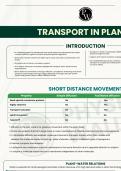
SHORT DISTANCE MOVEMENT
Y S I
Property Simple Diffusion Facilitated Diffusion
H
Need special membrane proteins No Yes
P
Highly selective No Yes
Transport saturates No Yes
L L
Uphill movement No No
A
Need ATP No No
W
1. Diffusion is the only means far gaseous movement within the plant body.
2. Porins are proteins that form large pores in outer membranes of Plastids. Mitochondria and some Bacteria
3. m facilitated diffusion extracellular molecule is bound io transport protein which then rotates and
releases the molecule inside the cell, eg., water channels-made of 8 different types of aquaporins.
4. Passive symports and antiports
• In symports two molecules cross the membrane in the same direction and in opposite direction in antiport
• In uniport a molecule moves across a membrane independent of other molecules.
PLANT-WATER RELATIONS
Water is essential for all physiological activities of plant. Because of its high demand water is often the limiting
INTRODUCTION
• In a flowering plant the substances that would need to be transported are water, • Transport in xylem is essentially UNIDIRE
mineral nutrients, organic nutrients and plant growth regulators leaves through the stem
• Water and mineral nutrients are taken up by roots and food is synthesised in the • Organic and mineral nutrients undergo
leaves
• From SENESCENT plant parts nutrients a
• But plants do not have a circulatory system transport is complex but orderly each o
out some others.
• So in plants, there are two broad strategies for transport, short-distance and
long-distance
• Short-distance movement is through-diffusion. cytoplasmic streaming and active
transport: and transport through longer distances is through vascular system
{xylem and phloem} and Is called TRANSLOCATION
SHORT DISTANCE MOVEMENT
Y S I
Property Simple Diffusion Facilitated Diffusion
H
Need special membrane proteins No Yes
P
Highly selective No Yes
Transport saturates No Yes
L L
Uphill movement No No
A
Need ATP No No
W
1. Diffusion is the only means far gaseous movement within the plant body.
2. Porins are proteins that form large pores in outer membranes of Plastids. Mitochondria and some Bacteria
3. m facilitated diffusion extracellular molecule is bound io transport protein which then rotates and
releases the molecule inside the cell, eg., water channels-made of 8 different types of aquaporins.
4. Passive symports and antiports
• In symports two molecules cross the membrane in the same direction and in opposite direction in antiport
• In uniport a molecule moves across a membrane independent of other molecules.
PLANT-WATER RELATIONS
Water is essential for all physiological activities of plant. Because of its high demand water is often the limiting