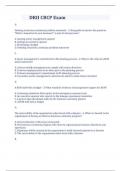
DRII CBCP Exam With Complete Solution
DRII CBCP Exam D. Defining a business continuity problem statement - 1. Being able to answer the question, "What is important to your business?" is part of what process? A. Gaining senior management support B. Getting an executive sponsor C. Developing a budget D. Defining a business continuity problem statement C. It shows management's commitment to BC planning process - 2. What is the value of a BCM policy statement? A. It forces middle management to comply with senior directives B. It shows employees how to do their part in the planning process C. It shows management's commitment to BC planning process D. It provides senior management a direction in which to make future decisions D. A BCM staff with a budget - 3. What would be evidence of management support for BCM? A. A steering committee that reports to the emergency response team B. An executive sponsor who reports to the damage assessment committee C. A project plan developed solely by the business continuity planner D. A BCM staff with a budget D. The survivability of the organization when faced with a disaster - 4. What is a benefit to the organization of having an effective business continuity program? A. Internal disasters will not go unreported B. The business continuity program will relate to organizational mission, objectives, and operations C. Employees will be amazed at the organization's multi-faceted response to a disaster D. The survivability of the organization when faced with a disaster B. Personally determining what is critical to the organization - 5. What must the planner avoid when developing a business continuity program? A. Obtaining management support B. Personally determining what is critical to the organization C. Organizing and managing the project D. Completing the project within agreed upon time and budget limits A. To communicate up to management, laterally to other programs, and down to project members - 6. Why is it important to track and report project progress? A. To communicate up to management, laterally to other programs, and down to project members B. To conduct meetings to ensure that all members of the organization share responsibility in the project plan C. To involve all organizational personnel in developing and adjusting scope D. To validate that the planning team is sticking to the project plan B. A full description of the quality of the work completed by the project team - 7. A presentation to leadership should avoid which of the following? A. Data presentation charts B. A full description of the quality of the work completed by the project team C. Cost/Benefit slides D. A full written report provided as a supplement to the presentation A. Entire organization - 8.What should be the initial scope or focus when developing a BCM program? A. Entire organization B. IT / Information Systems C. Financial Department D. Critical business units C. Gain senior management commitment to project - 9.What step needs to occur first in Program Initiation and Management A. Develop a detailed project plan B. Identify project objectives and risks C. Gain senior management commitment to project D. Establish framework of project D. Project planning - 10.Planning, organizing and managing tasks and resources can best be described as... A. Strategy development B. Data gathering C. Coordinating with external agencies D. Project planning A. Reduction - 11.Which of the following best describes the steps taken to identify and mitigate risk? A. Reduction B. Restoration C. Recovery D. Response D. Identifies risks, threats, vulnerabilities and the probability of them occurring to an organization - 12.What is the benefit of performing a risk assessment and analysis? A. Eliminates vulnerabilities to potential loss B. Stabilizes the incident and provides for improved employee safety C. Eliminates the impact of the threats to the organization D. Identifies risks, threats, vulnerabilities and the probability of them occurring to an organization A. Suppliers of goods and services - 13.Which of the following would be considered an external risk factor? A. Suppliers of goods and services B. Disgruntled employees C. Employee drug screening D. Clean desk policy procedures D. Clean desk policy procedures - 14.Which of the following would be considered a control? A. Loss of access to facilities B. A tornado C. Lack of fire suppression systems D. Clean desk policy procedures C. To determine where mitigating factors should be implemented - 15.The result of performing a risk analysis is A. All risks are eliminated B. All risk will be mitigated to prevent a disaster C. To determine where mitigating factors should be implemented D. To prevent a risk from occurring and causing a disaster C. To identify which business processes and assets require the highest level of protection, establishing priorities, and a time line - 16.Which answer describes the purpose of a business impact analysis? A. To calculate the probability of disruptions to the organization B. To evaluate the effectiveness of existing controls and safeguards C. To identify which business processes and assets require the highest level of protection, establishing priorities, and a time line D. To develop preparations and procedures for responding to a disaster B. Loss of employee morale - 17.Which of the following is an example of a qualitative impact? A. Loss of sales B. Loss of employee morale C. Loss of revenue due to penalties D. Extra expense C. Loss of sales - 18.Which of the following is an example of a quantitative impact? A. Lower level of customer service B. A disruption of quality assurance C. Loss of sales D. Reduced financial credibility
Document information
- Uploaded on
- June 4, 2023
- Number of pages
- 12
- Written in
- 2022/2023
- Type
- Exam (elaborations)
- Contains
- Questions & answers