

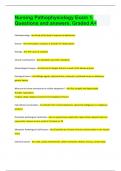
Nursing Pathophysiology Exam 1 , Questions and answers. Graded A+ Pathophysiology - Ans-Study of the body's response to dysfunction Disease - Ans-Interruption, cessation or disorder of a body system Etiology - Ans-The cause of a disease Clinical manifestation s - Ans-Symptoms and chief complaints Morphological changes - Ans-Structural changes that are a result of the disease process Etiological factors - Ans-Biologic agents, physical forces, chemicals, nutritional excess or deficiency, genetic factors What are the three mechanisms of cellular adaptation? - Ans-Size: atrophy and hypertrophy Number: hyperplasia Irregular shape: dysplasia (severe) and metaplasia (chronic) Intercellular accumulation - Ans-Results from normal substances, abnormal endogenou s or exogenous products Dystrophic pathological calcification - Ans-In injured tissue, dead cells create calcium deposits that can cause aortic stenosis or be a result of a fracture or TB Metastatic Pathological Calcifications - Ans-Caused by an increase of serum calcium levels in non -injured tissue Chemical injuries - Ans-Lead, carbon tetrachloride, carbon monoxide, ethanol, mercury, street drugs Asphyxiation injuries - Ans-Suffocation, strangulation, drowning Hypoxic injuries - Ans-Ischemia (lack of blood flow) and anoxia (lack of oxygen ) What does cellular aging cause? - Ans-Atrophy, decreased functioning Isotonic solutions - Ans-Will cause no change to cells 0.9% saline Hypertonic solutions - Ans-Will cause cells to shrink/crenate 3% saline or 5% dextrose Hypotonic solutions - Ans-Will cause cells to swell 0.45% saline Edema - Ans-Accumulation of fluid in interstitial spaces What are causes of edema? - Ans-Increased capillary hydrostatic pressure (fluid moves from capillary to interstitial space) Decrease in plasma osmotic pressure (decrease in RBC, plasma and proteins causing fluid to leak into tissues) Increase in capillary permeability (inflammation causes fluid to leak into surrounding tissues) Lymph obstruction What are the functions of Na as a cation? - Ans-Neuromuscular irritability, acid base balance through the exchange of water and bicarb, chemical reactions and memb rane transport Hypernatremia - Ans-Na>147 Intercellular dehydration, convulsions, pulmonary edema, hypotension, tachycardia, pruny fingers Hyponatremia - Ans-Na<135
Preview 2 out of 11 pages
Exam (elaborations)
Nursing Pathophysiology Exam 1, Questions and answers. Graded A+
Preview 2 out of 11 pages
Nursing Pathophysiology Exam 1, Questions and answers. Graded A+ Document Content and Description Below Pathophysiology - Ans-Study of the body's response to dysfunction Disease - Ans-Interruption, cessation or disorder of a body system Etiology - Ans-The cause of a disease Clinical manifestati ons - Ans-Symptoms and chief complaints Morphological changes - Ans-Structural changes that are a result of the disease process Etiological factors - Ans-Biologic agents, physical forces, chemicals, nutritional excess or deficiency, genetic factors What are the three mechanisms of cellular adaptation? - Ans-Size: atrophy and hypertrophy Number: hyperplasia Irregular shape: dysplasia (severe) and metaplasia (chronic) Intercellular accumulation - Ans-Results from normal substances, abnormal endogenous or exogenous products Dystrophic pathological calcification - Ans-In injured tissue, dead cells create calcium deposits that can cause aortic stenosis or be a result of a fracture or TB Metastatic Pathological Calcifications - Ans-Caused by an increase of serum calcium levels in non-injured tissue Chemical injuries - Ans-Lead, carbon tetrachloride, carbon monoxide, ethanol, mercury, street drugs Asphyxiation injuries - Ans-Suffocation, strangulation, drowning Hypoxic injuries - Ans-Ischemia (lack of blood flow) and anoxia (lack of oxygen) What does cellular aging cause? - Ans-Atrophy, decreased functioning Isotonic solutions - Ans-Will cause no change to cells 0.9% saline Hypertonic solutions - Ans-Will cause cells to shrink/crenate 3% saline or 5% dextrose Hypotonic solutions - Ans-Will cause cells to swell 0.45% saline Edema - Ans-Accumulation of fluid in interstitial spaces What are causes of edema? - Ans-Increased capillary hydrostatic pressure (fluid moves from capillary to interstitial space) Decrease in plasma osmotic pressure (decrease in RBC, plasma and proteins causing fluid to leak into tissues) Increase in capillary permeability (inflammation causes fluid to leak into surrounding tissues) Lymph obstruction What are the functions of Na as a cation? - Ans-Neuromuscular irritability, acid base balance through the exchange of water and bicarb, chemical reactions and membrane transport Hypernatremia - Ans-Na147 Interc
Content preview
Document information
- Uploaded on
- June 4, 2023
- Number of pages
- 11
- Written in
- 2022/2023
- Type
- Exam (elaborations)
- Contains
- Questions & answers
$8.49
Wrong document? Swap it for free
Within 14 days of purchase and before downloading, you can choose a different document. You can simply spend the amount again.
Written by students who passed
Immediately available after payment
Read online or as PDF

Reputation scores are based on the amount of documents a seller has sold for a fee and the reviews they have received for those documents. There are three levels: Bronze, Silver and Gold. The better the reputation, the more your can rely on the quality of the sellers work.
Available in package deal
Package deal
PATHOPHYSIOLOGY BUNDLED, RATED A+.

