

Tennessee National Portion REAL ESTATE EXAM Latest 2023 Graded A+
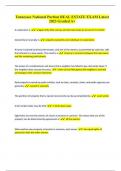
Tennessee National Portion REAL ESTATE EXAM Latest 2023 Graded A+ A corporation is - a legal entity that can buy and sell real estate as set out in its charter. Ownership in severalty is - property owned by one individual or corporation. A house is owned by three joint tenants, and one of the owners, as permitted by state law, sells that interest to a new owner. The result is a - tenancy in common between the new owner and the remaining joint tenants The owner of a condominium unit learns that a neighbor has failed to pay real estate taxes. If this neighbor does not pay the taxes, - a lien can be filed against the neighbor's unit and percentage of the common elements. Real properties owned by public entities, such as cities, counties, states, and public agencies are generally - owned in severalty The partition of property that is owned concurrently can be accomplished by - court action A fee simple estate may be held - in three basic ways Eight heirs are now the owners of a farm as tenants in common. This means that use of the property can be determined by agreement of - all the owners. When parties own property as tenants in common, each owner - has equal rights of possession with the other owners. A person who owns one unit in a multiunit structure together with a specified undivided interest in the common elements owns a - condominium A trust is a device by which one person transfers ownership of property to someone else to hold or manage for - the benefit of a third party. Joint tenancy is - a form of concurrent ownership of property that is available to two or more people, whether married or unmarried. Property owned by a married person can belong to - the spouses together or be the separate property of one spouse. An ownership interest that is based on annual occupancy intervals is a - time share. Depending on the type of trust and its purpose, the trustor, trustee, and beneficiary can all be either - people or legal entities. A deed conveying land on a one-third and two-thirds share basis establishes a - tenancy in common An advantage of cooperative ownership of a dwelling is that - there are income tax advantages. The term severalty comes from the fact that - a sole owner is severed or cut off from other owners. Which of the following is NOT a form of co-ownership? - Ownership in severalty
Document information
- Uploaded on
- June 3, 2023
- Number of pages
- 155
- Written in
- 2022/2023
- Type
- Exam (elaborations)
- Contains
- Questions & answers


