
Case 10:
What is a phylogenetic tree? (phylogenetics)
Phylogenetics: The research of how related different species are to each other.
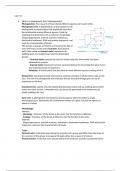
Phylogenetic tree: A hypothetical, central element in all
phylogenetic reconstructions that graphically describes
the relationship among different species. Made by
analysing characteristics such as external morphology
(shape/appearance), internal anatomy, behaviours,
biochemical pathways, DNA and protein sequences, and
even the characteristics of fossils.
The species or groups of interest are found at the tips of
lines referred to as the tree's branches. Each branch
point (also called an internal node) represents the
splitting apart of a single group into two descendant
groups.
- Terminal nodes indicate the taxa for which molecular information has been
obtained for analysis.
- Internal nodes represent common ancestors before the branching that gave rise to
two separate groups of organisms.
Polytomy: A branch point that has three or more different species coming off of it
Rooted tree: One internal node represents a common ancestor to all the other nods on the
tree. The root of a phylogenetic tree indicates that an ancestral lineage gave rise to all
organisms on the tree.
Unrooted trees: specify only the relationship between nodes and say nothing about which
nodes are more ancient. Unrooted trees can always be generated from rooted ones by
simply omitting the root.
Gene tree: A phylogenetic tree based on the divergence observed within a single
homologous gene. Represents the evolutionary history of a gene, but not the species in
which it is found.
Morphology:
Internal:
- Homology : Structure of the bones is the same, but the function is different.
- Analogy : Structure of the bones is different, but the function is the same.
External:
- Shape/appearance, internal anatomy, behaviours, biochemical pathways, DNA and protein
sequences, and even the characteristics of fossils.
Traits:
Derived traits: Traits that arise during the evolution of a group and differ from the traits of
the ancestor of the group. may appear through either loss or gain of a feature.
Ancestral traits: Traits that were already there in the common ancestor and passed down.
, How do you make a polygenetic tree?:
- Parsimony: Comparing traits. Choosing the simplest explanation that can account for our
observations. In the context of making a tree, it means that we choose the tree that requires
the fewest independent genetic events (appearances or disappearances of traits) to take
place.
- UPGMA method: Stands for Unweighted Pair Group Method with Arithmetic mean
Simplest method for constructing trees
1. Write sequences
2. Count differences between sequences (in a table)
3. Lowest difference first on tree (closer
to now)
4. New table with incorporating the
doubles with lowest score
1. First clustering
2. First branch length estimation
3. First distance matrix update
4. Second clustering
5. Second branch length estimation
6. …. You’ll go so on until the final step
Assumes the same evolutionary speed on all
lineages → rate of mutations is constant over
time and for all lineages in the tree. This would mean that all leaves (terminal nodes) have
the same distance from the root. In reality, the individual branches are very unlikely to have
the same mutation rate. Therefore, UPGMA frequently generates wrong tree topologies!
The mutation rate: The frequency of new mutations in a single gene or organism over a
various amount of time. Not constant and not limited. Generally expressed as the number of
mutations per biological unit, which may be mutations per cell division, per gamete or per
round of replication
The mutation frequency is the number of occurrences of a particular kind of mutation,
expressed as the proportion of cells or individuals in a population, such as the number of
mutations per 100,000 organisms or the number per 1 million gametes.
Molecular clock hypothesis: The molecular clock uses the
mutation rate as indicator for how long it takes for two
species to diverge. It calculates the timing of evolutionary
events. They measure the number of changes or mutations.
This happens at a relatively constant rate. Thus, the theory
goes, the number of differences between any two gene
sequences increases over time. This thinking led to the idea
that the number of mutations in a given stretch of DNA could
be used as a measure of time. once the rate of mutation is
determined, calculating the time of divergence of that species becomes relatively easy. If the
rate is 5 mutations every million years, and you count 25 mutations in your DNA sequence,
then your sequences diverged 5 million years ago.
Chronological order: This is done by comparing sequences from different species to
determine when they last shared a common ancestor
What is a phylogenetic tree? (phylogenetics)
Phylogenetics: The research of how related different species are to each other.
Phylogenetic tree: A hypothetical, central element in all
phylogenetic reconstructions that graphically describes
the relationship among different species. Made by
analysing characteristics such as external morphology
(shape/appearance), internal anatomy, behaviours,
biochemical pathways, DNA and protein sequences, and
even the characteristics of fossils.
The species or groups of interest are found at the tips of
lines referred to as the tree's branches. Each branch
point (also called an internal node) represents the
splitting apart of a single group into two descendant
groups.
- Terminal nodes indicate the taxa for which molecular information has been
obtained for analysis.
- Internal nodes represent common ancestors before the branching that gave rise to
two separate groups of organisms.
Polytomy: A branch point that has three or more different species coming off of it
Rooted tree: One internal node represents a common ancestor to all the other nods on the
tree. The root of a phylogenetic tree indicates that an ancestral lineage gave rise to all
organisms on the tree.
Unrooted trees: specify only the relationship between nodes and say nothing about which
nodes are more ancient. Unrooted trees can always be generated from rooted ones by
simply omitting the root.
Gene tree: A phylogenetic tree based on the divergence observed within a single
homologous gene. Represents the evolutionary history of a gene, but not the species in
which it is found.
Morphology:
Internal:
- Homology : Structure of the bones is the same, but the function is different.
- Analogy : Structure of the bones is different, but the function is the same.
External:
- Shape/appearance, internal anatomy, behaviours, biochemical pathways, DNA and protein
sequences, and even the characteristics of fossils.
Traits:
Derived traits: Traits that arise during the evolution of a group and differ from the traits of
the ancestor of the group. may appear through either loss or gain of a feature.
Ancestral traits: Traits that were already there in the common ancestor and passed down.
, How do you make a polygenetic tree?:
- Parsimony: Comparing traits. Choosing the simplest explanation that can account for our
observations. In the context of making a tree, it means that we choose the tree that requires
the fewest independent genetic events (appearances or disappearances of traits) to take
place.
- UPGMA method: Stands for Unweighted Pair Group Method with Arithmetic mean
Simplest method for constructing trees
1. Write sequences
2. Count differences between sequences (in a table)
3. Lowest difference first on tree (closer
to now)
4. New table with incorporating the
doubles with lowest score
1. First clustering
2. First branch length estimation
3. First distance matrix update
4. Second clustering
5. Second branch length estimation
6. …. You’ll go so on until the final step
Assumes the same evolutionary speed on all
lineages → rate of mutations is constant over
time and for all lineages in the tree. This would mean that all leaves (terminal nodes) have
the same distance from the root. In reality, the individual branches are very unlikely to have
the same mutation rate. Therefore, UPGMA frequently generates wrong tree topologies!
The mutation rate: The frequency of new mutations in a single gene or organism over a
various amount of time. Not constant and not limited. Generally expressed as the number of
mutations per biological unit, which may be mutations per cell division, per gamete or per
round of replication
The mutation frequency is the number of occurrences of a particular kind of mutation,
expressed as the proportion of cells or individuals in a population, such as the number of
mutations per 100,000 organisms or the number per 1 million gametes.
Molecular clock hypothesis: The molecular clock uses the
mutation rate as indicator for how long it takes for two
species to diverge. It calculates the timing of evolutionary
events. They measure the number of changes or mutations.
This happens at a relatively constant rate. Thus, the theory
goes, the number of differences between any two gene
sequences increases over time. This thinking led to the idea
that the number of mutations in a given stretch of DNA could
be used as a measure of time. once the rate of mutation is
determined, calculating the time of divergence of that species becomes relatively easy. If the
rate is 5 mutations every million years, and you count 25 mutations in your DNA sequence,
then your sequences diverged 5 million years ago.
Chronological order: This is done by comparing sequences from different species to
determine when they last shared a common ancestor


