TNCC 8th Edition 2023 Latest Update
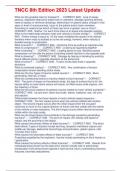
What are the greatest risks for transport? - CORRECT ANS Loss of airway patency, displaced obstructive tubes lines or catheters, dislodge splinting devices, need to replace or reinforce dressings, deterioration in patient status change in vital signs or level of consciousness, injury to the patient and/or team members According to newtons law which of these two force is greater: size or force? - CORRECT ANS Neither. For each force there is an equal and opposite reaction. What is the relationship between mass and velocity to kinetic energy? - CORRECT ANS Kinetic energy is equal to 1/2 the mass multiplied the square of its velocity therefore when mass is doubled so is the net energy, however, when velocity is doubled energy is quadrupled. What is tension? - CORRECT ANS stretching force by pulling at opposite ends What is compression? - CORRECT ANS Crushing by squeezing together What is bending? - CORRECT ANS Loading about an axis. Bending causes compression on the side the person is bending toward intention to the opposite side What is shearing? - CORRECT ANS Damage by tearing or bending by exerting faucet different parts in opposite directions at the same time. What is torsion? - CORRECT ANS Torsion forces twist ends in opposite directions. What is combined loading? - CORRECT ANS Any combination of tension compression torsion bending and/or shear. What are the four types of trauma related injuries? - CORRECT ANS Blunt, penetrating, thermal, or blast. What are contributing factors to injuries related to blunt traumas? - CORRECT ANS The point of impact on the patient's body, the type of surface that is hit, the tissues ability to resist (bone versus soft tissue, air-filled versus solid organs), and the trajectory of force. What are the seven patterns of pathway injuries related to motor vehicle accidents? - CORRECT ANS Up and over, down and under, lateral, rotational, rear, roll over, and ejection. Differentiate between the three impacts of motor vehicle impact sequence. - CORRECT ANS The first impact occurs when the vehicle collided with another object. The second impact occurs after the initial impact when the occupant continues to move in the original direction of travel until they collide with the interior of the vehicle or meet resistance. The third impact occurs when internal structures collide within the body cavity. What are the three factors that contribute to the damage caused by penetrating trauma's? - CORRECT ANS The point of impact, the velocity and speed of impact, and the proximity to the object. What causes the primary effects of blast traumas? - CORRECT ANS The direct blast effects. Types of injuries include last long, tympanic membrane rupture and middle ear damage, abdominal hemorrhage and perforation, global rupture, mild Trumatic brain injury. What causes the secondary effects of blast traumas? - CORRECT ANS Projectiles propelled by the explosion. Injuries include penetrating or blunt injuries or I penetration. What causes the tertiary effects of blast traumas? - CORRECT ANS Results from individuals being thrown by the blast wind. Injuries include hole or partial body translocation from being thrown against a hard service: blunt or penetrating trauma's, fractures, traumatic amputations.
Document information
- Uploaded on
- May 30, 2023
- Number of pages
- 4
- Written in
- 2022/2023
- Type
- Exam (elaborations)
- Contains
- Questions & answers