Summary ATI Mental Health CMS Complete Study Guide_ Summer 2023.
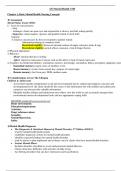
ATI Mental Health CMS Chapter 1; Basic Mental Health Nursing Concepts → Assessment Mental Status Exam (MSE) 1) Level of consciousness: - Alert - Lethargic: client can open eyes and respond but is drowsy and falls asleep quickly - Stuporous: client requires vigorous and painful stimuli to elicit brief response - Comatose: unconscious & does not respond to painful stimuli Abnormal posturing in comatose client Decorticate rigidity; flexion & internal rotation of upper extremity joints & legs Decerebrate rigidity; neck & elbow extension, wrist & finger flexion 2) Physical appearance 3) Behavior - Mood: emotion that she is feeling - Affect: objective expression of mood, such as flat affect or lack of facial expression 4) Cognitive & intellectual abilities: orientation, memory, knowledge, calculation, illness perception, judgment, speech - Immediate memory; repeat series of numbers or list - Recent memory: visitors from current day, purpose of current appt - Remote memory: fact from past, DOB, mothers name → Considerations Across The Lifespan Children & Adolescents - Assessment includes temperament social and environmental factors cultural and religious concerns and developmental level. the client should be the source of the information but with children and adolescents caregivers can also provide valuable information. - Mentally healthy children and adolescents trust others view the world as safe accurately interpret their environments master developmental tasks and use appropriate coping skills HEADSSS standardized assessment tool Home environment; Education/employment; Activities; Drug/ substance abuse; Sexuality; Suicide/depression; Safety →Mental Health Diagnoses • The Diagnostic & Statistical Manual of Mental Disorders 5th Edition (DSM-5) - Used by mental health professionals - establishes diagnostic criteria for mental health disorders - identifies expected findings for mental health disorders - used by nurses to plan implement and evaluate care for clients who have mental health disorders • Serious Mental Illness - Includes disorders classified as severe and persistent mental illnesses - Clients often have difficulty with activities of daily living - Are lifelong disorders that can have remissions and exacerbations → Therapeutic Strategies in The Mental health Setting • Counseling; using therapeutic communication skills, assisting with problem solving, crisis intervention, and stress management • Milieu therapy; orienting the client to the physical setting, identifying rules and boundaries of the setting, ensuring a safe environment for the client, and assisting the client to participate in appropriate activities • Promotion of self-care activities; helping with self-care task, allowing time for the client to complete self-care task, and setting incentives to promote client self-care • Psychobiological interventions; administering prescribed medications, providing teaching to the client and family about medications, and monitoring for adverse effects and effectiveness of pharmacological therapies • Cognitive & behavioral therapies; modeling, operant conditioning, systemic disinvitation • Health teaching; teaching social & coping skills • Health promotion & maintenance • Case management; coordinate holistic care to include medical, mental health, & social services Chapter 2; Legal & Ethical Issues → Legal rights of Clients in Mental Health Setting Same civil rights as any other citizen including; - the right to humane treatment and care - right to vote - rights r/t granting, forfeiture, or denial of driver’s license - right to due process of law including right to press charges - right to consent & refuse treatment - confidentiality - written plan of care, participation, and discharge follow up - right to communicate with others outside facility - psychiatric advanced directive → Ethical Issues Bioethics; ethical dilemmas regarding patient care Beneficence: quality of doing good Autonomy; right to make own choices Justice; fair & equal treatment Fidelity: loyalty & faithfulness to client and own duty Veracity; honesty → Types of Admission to Mental Health Facility Criteria for involuntary admission; - presence of mental illness - danger to self or others - demonstrates severe disability or inability to meet basic needs - requires treatment but unable to seek it r/t impact of mental illness Number of physicians required to certify clients conditions varies (usually 2) Limited to 60 days Still considered competent and have the right to refuse. → Clients Rights w/ Seclusion & Restraint When a nurse has tried all other less restrictive means to prevent a client from harming self or others the following must occur in order to use seclusion or restraint; - Prescriber must prescribe seclusion or restrain in writing ......................................
Document information
- Uploaded on
- May 30, 2023
- Number of pages
- 22
- Written in
- 2022/2023
- Type
- Summary