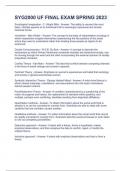
SYG2000 UF FINAL EXAM SPRING 2023
Sociological Imagination - C. Wright Mills - Answer- The ability to connect the most basic, intimate aspects of an individual's life to seemingly impersonal and remote historical forces. Verstehen - Max Weber - Answer- The concept is the basis of interpretative sociology in which researchers imagine themselves experiencing the life positions of the social actors they want to understand rather than treating those people as objects to be examined. Double Consciousness - W.E.B. Du Bois - Answer- A concept to describe the mechanism by which African Americans constantly maintain two behavioral scripts, one for moving through the world and the other incorporating the external opinions of racially prejudiced onlookers. Conflict Theory - Karl Marx - Answer- The idea that conflict between competing interests is the force of social change and society in general. Feminist Theory - Answer- Emphasis on women's experiences and belief that sociology and society in general subordinate women. Symbolic Interaction Theory - George Herbert Mead - Answer- A micro-level theory in which shared meanings, orientations, and assumptions form the basic motivations behind people's actions. Post-Modernism Theory - Answer- A condition characterized by a questioning of the notion of progress and history, the replacement of narrative within pastiche, and multiple, perhaps even conflicting, identities resulting from disjointed affiliations. Quantitative methods - Answer- To obtain information about the social world that is already in or can be converted to numeric form. Scientists are able to state with some certainty that one condition causes another. Qualitative methods - Answer- To collect information about the social world that cannot be readily converted to numeric form. Scientists describe social processes in such detail to rule out competing possibilities. Deductive approach - Answer- It starts with a theory, forms a hypothesis, makes empirical observations, and then analyzes the data to confirm, reject, or modify the original theory. Inductive approach - Answer- It starts with empirical observations and tries to form a theory. Causality - Answer- The notion that a change in one factor results in a corresponding change in another. Correlation - Answer- Simultaneous variation in two variables. Dependent variable - Answer- The outcome that the researcher is trying to explain. Independent variable - Answer- A measured factor that may have a casual impact on the dependent variable. Hypothesis - Answer- A proposed relationship between two variables, usually with a stated direction. Hypothesis testing - Answer- Must assign dependent and independent variables, make research question, make casual story of why you would expect your hypothesis to be true and one for the alternative hypothesis. Culture - Answer- The sum of the social categories and concepts we embrace. That which is not the natural environment us. Ethnocentrism - Answer- The belief that one's own culture or group is superior to others, and the tendency to view all other cultures from the perspective of one's own. Material Culture - Answer- All that is part of our constructed, physical environment, including technology. Nonmaterial Culture - Answer- Includes values, beliefs, behaviors, and social norms. Ideology - Answer- The system of concepts and relationships, an understanding of cause and effect. A consistent set of beliefs by groups/individuals. Cultural Relativism - Answer- Involves taking into account the differences across cultures without passing judgment or assigning value. Cultural Scripts - Answer- These are modes of behavior and understanding that are not universal or natural. Subculture - Answer- The distinct cultural values and behavioral patterns of a particular group in society. Hegemony - Antonio Gramsci - Answer- Refers to the historical process in which a dominant group uses its power to elicit the voluntary "consent" of the masses. Media Concentration - Answer- Most broadcasting companies are privately owned in the U.S. and are likely to reflect the biases of their owners and backers. Consumerism - Answer- The steady acquisition of material possessions, often with the belief that happiness and fulfillment can thus be achieved. Culture Jamming - Answer- It is part of a larger movement to promote anti-consumerism. Socialization - Answer- The process by which individuals internalize the values, beliefs, and norms of a given society and learn to function as members of that society. Self, Looking Glass Self Theory - Charles Horton Cooley - Answer- The self emerges from our ability to assume the POV of others and thereby imagine how they see us. I, Me, Other - Answer- George Herbert Mead I - Answer- one's sense of agency, action, or power Me - Answer- the self as a distinct object to be perceived by the "I" Other - Answer- the someone or something outside of oneself Generalized Other - Answer- It is an internalized sense of the total expectations of others in a variety of settings - regardless of whether we've encountered those place or people before. Agents of Socialization - Answer- family, school, peers, media Accomplishment of Natural Growth - Annette Lareau - Answer- Working class and poor parents focus on the "accomplishment of growth." They give their children the room and resources to develop but leave it up to the kids to decide how they want to structure their free time. Dramaturgical Theory - Erving Goffman - Answer- It proposed the view of social life as essentially a theatrical performance, in which we are all actors on metaphorical stages, with roles, scripts, costumes, and sets. Ethnomethodology - Harold Garfinkel - Answer- The approach to studying human interaction focuses on the ways in which we make sense of our world, convey this understanding to others, and produce a shared social order ("the methods of the people"). Breaching Experiments - Answer- Garfinkel would send students into the social world to see what happened when they breached social norms. Group Conformity - Answer- Groups have strong inf
École, étude et sujet
- Établissement
- SYG2000 UF
- Cours
- SYG2000 UF
Infos sur le Document
- Publié le
- 28 mai 2023
- Nombre de pages
- 9
- Écrit en
- 2022/2023
- Type
- Examen
- Contient
- Questions et réponses
Sujets
- verstehen max weber
-
syg2000 uf final exam spring 2023
-
sociological imagination c wright mills
-
double consciousness web du bois
-
conflict theory karl marx

Document également disponible en groupe