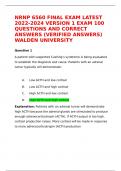
Nrnp 6560 Final Exam Latest Version 1 Exam 100 Questions And Correct Answers (Verified Answers) Walden University
Question 3 Jennifer is an RN applicant for a staff nurse position in the surgical ICU. She has had a screening PPD and comes back in 48 hours to have it read. There is a 12-mm induration at the site of injection. A chest radiograph is negative. The AGACNP knows that the next step in Jennifer’s evaluation and management should include: A. No further care, because the chest radiograph is negative B. Quantiferon serum assay for exposure C. Consideration of prophylactic therapy D. Beginning therapy for pulmonary TB pending sputum cultures Explanation: While the chest radiograph is negative, more steps are needed to ensure that the pulmonary functioning is okay. A therapy for pulmonary TB pending sputum cultures will help in the identification of any abnormalities in the chest. For this reason, the next step is beginning therapy for pulmonary TB pending sputum cultures. Question 4 P. E. is a 61-year-old female who presents for a postoperative visit following a gastric resection after a perforation of peptic ulcer. She reports feeling better, although it is taking longer than she expected. However, she says she is feeling better each day, her appetite is returning, and her incision is healing well. She is being discharged from surgical care and advised to continue her routine health promotion follow-up with her primary care provider. As part of her surgical discharge teaching, the AGACNP counsels P. E. that as a result of her gastric resection she will need lifelong follow-up of: A. Blood group substances B. Electrolytes C. Vitamin B12 D. Gastric pH Explanation: The gastric cells secrete intrinsic factor and hydrochloric acid. Intrinsic factor is responsible for the absorption of vitamin B 12 as food moves down the ileum. When a gastric resection is done, the gastric cells are reduced thus less intrinsic factor will be produced. Lifelong follow up of Vitamin B12 is necessary in these patients so as to reduce the risk of vitamin B12 deficiency. Question 5 M. T. is a 71-year-old female who presents for evaluation of a ―lump on her chest.‖ She denies any symptoms—there is no pain, erythema, edema, ecchymosis, or open areas—it is just a lump. She has no idea how long it has been there and just noticed it a few weeks ago. Physical examination reveals a round, smooth, flesh-colored tumor. It is firm but not hard; it has smooth borders. It measures 6 cm in diameter and is non-tender to palpation. The AGACNP suspects that this is a classic presentation of the most common chest wall tumor known as a: A. Neurolemma B. Lipoma C. Hemangioma D. Lymphangioma Explanation: Lipoma is usually smooth, fresh colored and is painless. Lipoma is soft to touch, small and commonly occurs in the neck, back, shoulders and the chest. Lipoma is only painful when grows into the nerves. M.T. denies any symptoms since there is no pain. Such kinds of lumps are associated with Lipoma because they are painless. Lipoma also had smooth boarders. Question 6 The AGACNP is receiving report from the recovery room on a patient who just had surgical resection for pheochromocytoma. He knows that which class of drugs should be available immediately to manage hypertensive crisis, a possible consequence of physical manipulation of the adrenal medulla? A. Alpha-adrenergic antagonists B. Beta-adrenergic antagonists C. Intravenous vasodilators D. Arteriolar dilators
Document information
- Uploaded on
- May 27, 2023
- Number of pages
- 68
- Written in
- 2022/2023
- Type
- Exam (elaborations)
- Contains
- Questions & answers